
Samsung Patents a GAN-Driven System for Context-Aware AR Surface Reflections
When you place a virtual object in an AR scene, its reflections are usually static — they don't respond to what's actually happening around it. Samsung's new patent describes a system that reads the context of your XR environment in real time and dynamically rewrites how that virtual surface reflects light.
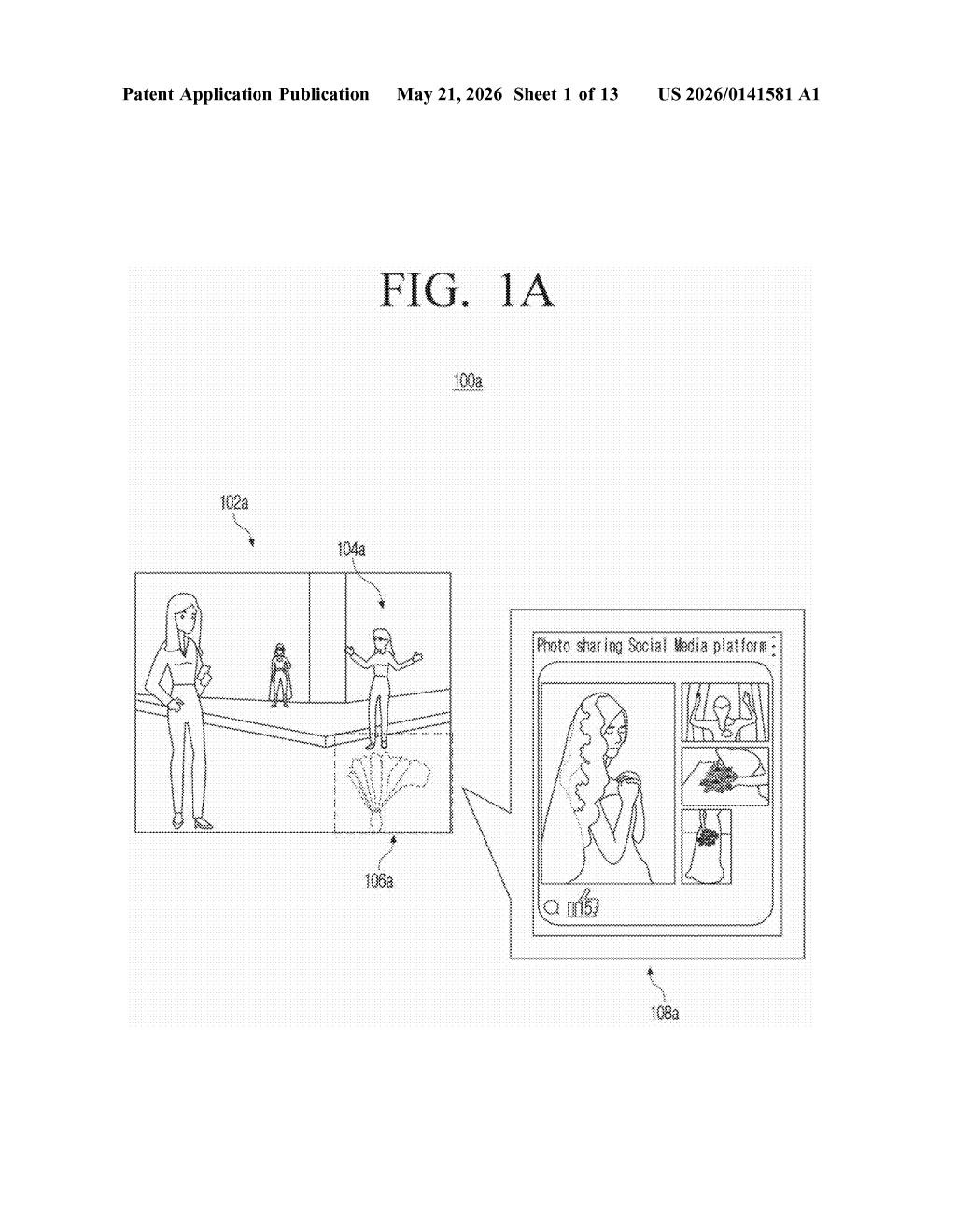
What Samsung's context-aware AR reflections actually do
Imagine putting on an AR headset and dropping a virtual chrome vase onto your kitchen table. Right now, the reflections on that vase are basically pre-baked — they don't change when you walk past a window or when the lighting shifts. The vase just looks pasted in.
Samsung's patent tackles exactly that problem. The system watches what's in your scene — the real-world media data and your current XR frame of view — and figures out which visual elements are contextually relevant to the virtual object sitting in front of you. It then feeds that context into an AI model to rewrite the object's surface reflections on the fly.
The result: a virtual object whose reflections match the environment you're actually in, not some generic studio backdrop. If you walk into a darker room, the reflections shift. If context changes, so does the surface. It's the difference between a prop and something that feels like it belongs.
How Samsung's GAN transforms virtual surface reflections
The system works in a layered pipeline. First, it pulls in two types of data: media data (visual information about the virtual entity itself) and content data (your current XR frame-of-view and scene metadata). From these, it generates two sets of vectors — think of vectors as compact mathematical fingerprints — one describing the image context, one describing the XR environment context.
Next, the system runs a similarity mapping between the two vector sets to find image context vectors that closely match what's happening in your XR scene. If the similarity score clears a predefined threshold, those matching vectors are flagged as relevant. A content relevance ranking index then ranks them further, so only the most contextually appropriate image data influences the output.
Those ranked vectors are then concatenated (combined) with the virtual object's existing reflection attributes and spatial tensors (mathematical representations of the object's position and geometry in 3D space) to form a conditional tensor — essentially a rich instruction set describing how the surface should look given the current context.
Finally, a Generative Adversarial Network (GAN) — an AI model where two neural networks compete to produce and critique outputs — consumes that conditional tensor and synthesizes the transformed surface reflection. The GAN approach means the output looks photorealistic rather than algorithmically obvious.
What this means for the next wave of XR headsets
For XR headsets like Samsung's Galaxy XR platform (developed alongside Google), surface reflections are one of the most visible tells that a virtual object isn't real. Getting them wrong breaks immersion instantly. A system that adapts reflections to live context — rather than relying on static environment maps — could meaningfully close that realism gap without requiring artists to manually author reflections for every scene.
The GAN-based approach is also interesting from a compute standpoint. Rather than ray-tracing reflections in real time (expensive), this method leans on a learned model conditioned on context vectors. That trade-off — inference over brute-force rendering — fits the power and thermal envelope of a wearable device much better than traditional physically-based rendering pipelines would.
This is a genuinely interesting patent because it attacks the reflections problem from an AI angle rather than a graphics-rendering angle — and for wearable XR hardware, that's probably the right call. The GAN conditioning pipeline is non-trivial, and the similarity-mapping filter before the tensor generation shows real architectural thought. Whether Samsung can run this on-device at acceptable latency is the real question, but the approach is worth watching.
There are more where this came from
We read every patent application Big Tech publishes and send you the ones worth knowing. Plain English, free, every week.
Want this weekly breakdown for a company we don't cover? Patentlyze Pro →