
Qualcomm Patents a Camera System That Exposes Each Object in a Scene Separately
Your phone already takes multiple shots at different brightness levels and blends them together. Qualcomm's new patent takes that further by deciding the right brightness level for each object in the scene individually, before the blending even happens.
How Qualcomm's per-object brightness blending works
Imagine you're photographing a friend standing in front of a sunny window. Your phone struggles because the room is dark but the window is blown out and bright. Most phones fix this by taking a few shots at different brightness levels and mixing them together, but they treat the whole image the same way during that mix.
Qualcomm's patent changes that by first identifying the distinct objects in your photo (your friend, the window, the furniture) and then figuring out which brightness level makes each object look best. The system scores how well each exposure handles each object separately, then weights the blending accordingly.
The result is that your friend's face, the bright window behind them, and the shadowy bookcase in the corner each get the brightness treatment they actually need, rather than a one-size-fits-all compromise. It's the same multi-shot HDR trick your phone already uses, but applied with a lot more awareness of what's actually in the picture.
… determine, for each respective segmentation map of at least a subset of the plurality of segmentation maps and each respective second image frame of at least a subset of the plurality of second image frames, a score based on an exposure of image regions defined by the respective segmentation map in the respective second image frame; …
Translation: The system calculates a brightness score for every object in each different exposure level.
Inside Qualcomm's segmentation-guided fusion pipeline
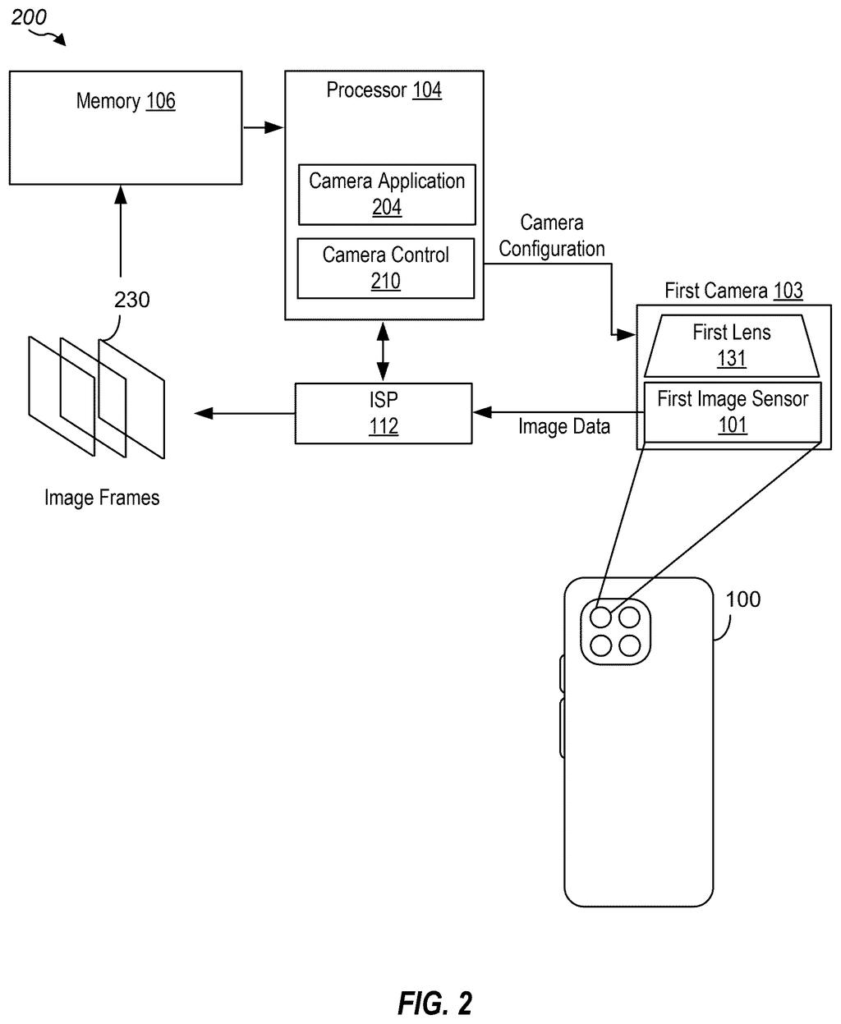
The system starts by taking a single reference image frame at its default exposure, then generates several additional frames at different exposure values (brighter and darker versions of the same scene).
From the reference frame, it runs segmentation (a computer-vision technique that draws outlines around distinct objects or regions in the image, like a person, a sky, or a lamp) to produce a set of segmentation maps. For each of those maps, the system scores how well each exposure handles that specific region, measured by how close the brightness of that area is to an ideal target level.
Those scores feed into a set of weights that determine how much each exposure frame contributes to the final image within each object's region. The blending itself uses two additional techniques:
- Pyramid decomposition: breaking the image into layers of different scales so fine details and broad tones are blended separately
- Guided filtering: a technique that sharpens or smooths the blend boundary by referencing the structure of the original image, keeping edges clean
The output is a single tone-mapped image, which means a high-dynamic-range scene compressed into the brightness range a regular screen can display, but with per-object awareness baked in.
This disclosure provides systems, methods, and devices that perform object-aware guided exposure fusion for tone mapping high dynamic range (HDR) images to lower dynamic range images.
Translation: Qualcomm patented a method to intelligently blend different exposures for distinct objects in a single photo.
What this means for HDR photography on Android phones
HDR photography on phones has improved a lot, but most current approaches blend exposures globally or use relatively coarse regional weighting. By tying the exposure scoring directly to object segmentation, Qualcomm's approach gives camera software a much cleaner way to protect faces, preserve sky detail, and avoid washing out artificial lighting all in the same shot.
Qualcomm supplies the Snapdragon chips and image signal processors inside a large share of Android flagship phones, from Samsung Galaxy to OnePlus to Motorola. A technique like this, baked into the Snapdragon camera stack, could ship across many devices at once without phone makers having to build it themselves. For you as a user, that likely means better-looking photos in mixed-light scenes without any extra steps.
This is incremental rather than transformational, but it's the kind of carefully targeted improvement that actually changes what photos look like in everyday situations. The clever part is attaching exposure scoring to segmentation maps rather than to arbitrary image regions. Whether Qualcomm's implementation beats what Apple and Google already do in their own camera pipelines is an open question, but the approach is sound and fits neatly into how Snapdragon image processing already works.
There are more where this came from
We read every patent application Big Tech publishes and send you the ones worth knowing. Plain English, free, every week.
The drawings
8 drawing sheets from US 2026/0228858 A1 · click any drawing to enlarge


Want this weekly breakdown for a company we don't cover? Patentlyze Pro →
Be the first to weigh in