
Red Hat Patents a Plugin-Driven Build System for Multiple Runtime Environments
Building software that runs in multiple environments — containers, VMs, serverless, bare metal — usually means maintaining separate toolchains and pipelines. Red Hat's new patent describes a single build system that handles all of them through a common interface and a set of swappable plugins.
What Red Hat's multi-runtime build system actually does
Imagine you're a developer who needs to package your app as a Docker container and a serverless function and a traditional binary — each for a different deployment target. Normally, you'd wrangle three separate build tools, each with its own quirks. That's a lot of overhead.
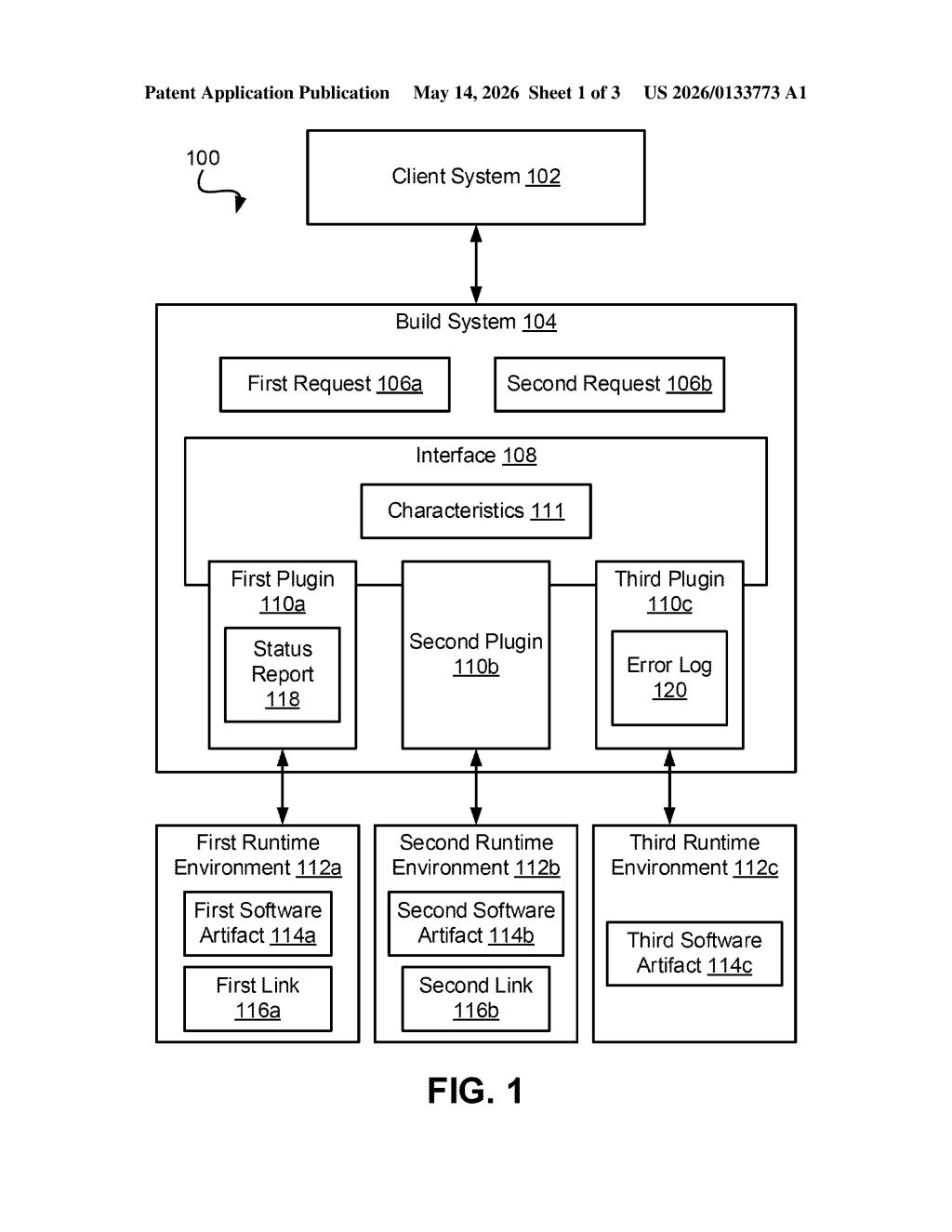
Red Hat's patented system proposes a single build system with a shared interface that enforces consistent rules about what your final software artifact must look like. Under the hood, it routes your build request to a plugin specific to whatever runtime environment you asked for — and that plugin does the heavy lifting of actually producing the artifact.
From your perspective as the client, you send one request and get back access to a finished artifact, no matter which runtime it was built for. The system abstracts away the messy differences between environments so you don't have to care about them.
How the interface and plugin selection mechanism works
The system is built around two core components: a central interface and a set of runtime-specific plugins.
The interface acts as a contract layer — it enforces a consistent set of characteristics that every generated software artifact must satisfy, regardless of where it will run. Think of it like a quality checklist that applies across the board.
When a client system sends a build request specifying a particular runtime environment (say, a container runtime vs. a serverless platform), the build system:
- Selects the plugin associated with that runtime
- Hands off the build job to that plugin, which produces the artifact in the correct format for that environment
- Receives access to the completed artifact from the plugin
- Returns that access back to the requesting client
Each plugin is tied to exactly one runtime environment, keeping concerns cleanly separated. The patent also references an error log in the system diagram, suggesting the architecture includes structured error handling when a build fails. The design is explicitly described as extendable — new runtime environments can presumably be added by writing a new plugin that conforms to the existing interface.
What this means for cross-environment software delivery
For enterprise software teams — Red Hat's core customer base — managing builds across heterogeneous environments is a genuine operational headache. A unified abstraction layer like this could simplify CI/CD pipelines significantly, especially as organizations run workloads across containers (OpenShift), VMs, and serverless platforms simultaneously.
The plugin architecture also means you don't have to rip out your existing build logic when adding support for a new runtime — you just write a new plugin. That's a meaningful developer-experience win. For Red Hat specifically, this kind of tooling fits squarely into their broader platform engineering story around OpenShift and the hybrid cloud.
This is solid, unsexy infrastructure engineering — the kind of thing that makes platform teams' lives materially better without making headlines. The plugin-interface pattern is well-established in software design, so the novelty here is more about the specific application to multi-runtime artifact generation than any architectural breakthrough. Worth watching if you follow Red Hat's developer tooling roadmap, but don't expect this to spark a bidding war.
There are more where this came from
We read every patent application Big Tech publishes and send you the ones worth knowing. Plain English, free, every week.
Want this weekly breakdown for a company we don't cover? Patentlyze Pro →