
Sony Patents a Margin-Region Eye-Gaze System for Picking Objects in 3D Space
Staring at something in VR to select it sounds simple — until you realize how hard it is to tell exactly which object your eyes are aimed at. Sony's new patent tackles that with a geometric 'margin region' that forgives imprecise gaze without making selection feel sloppy.
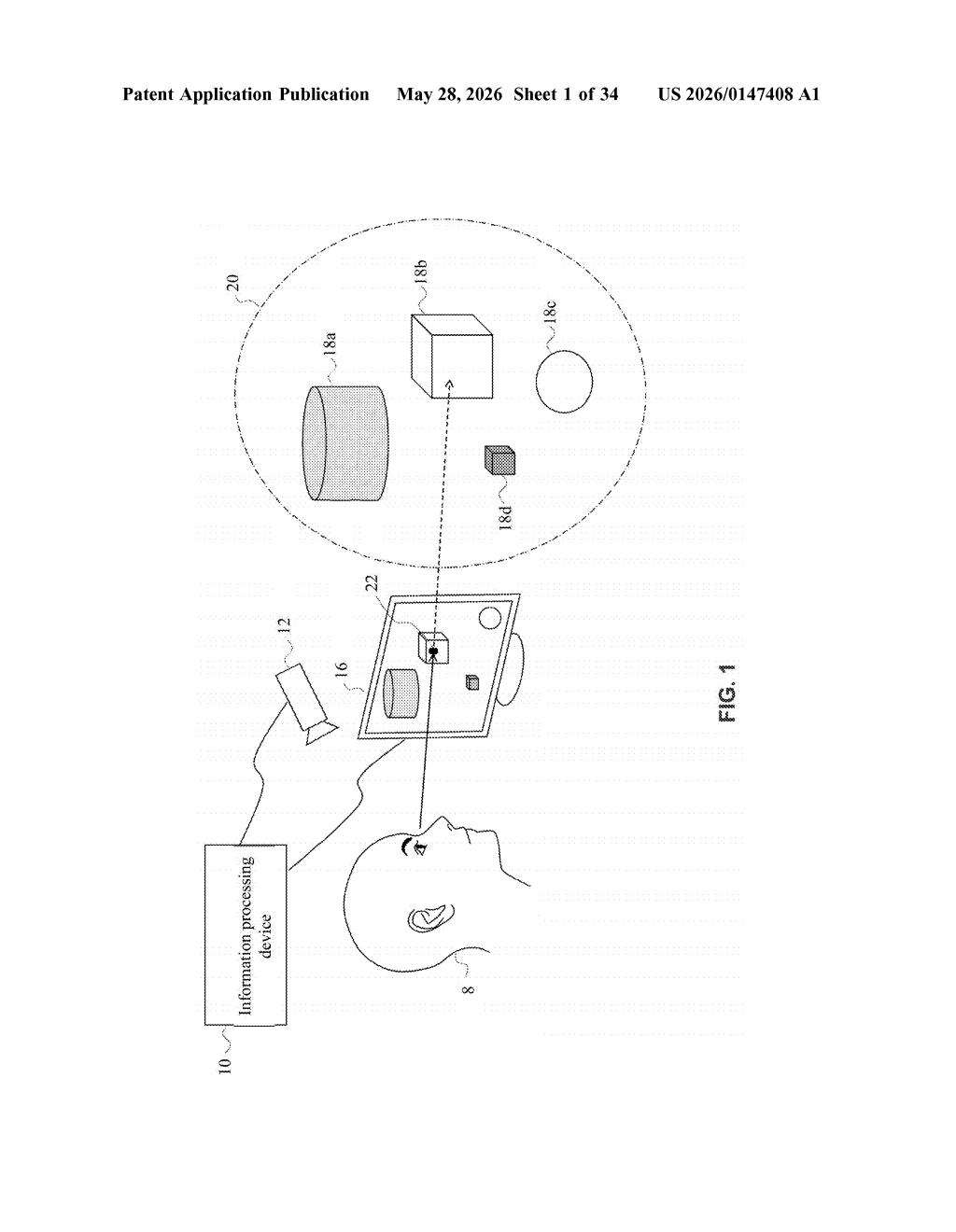
What Sony's eye-gaze selection margin actually does
Imagine you're in a VR game and you want to pick up a sword lying on a table. You look at it — but your eye tracker says you're aimed slightly to the left of the hilt. Did you mean the sword, or the potion bottle next to it? This is the core problem with gaze-based selection in virtual environments.
Sony's patent describes a system that draws a cone-shaped margin region around the direction your eyes are pointing. Any object that falls even partially inside that cone becomes a selection candidate. The system then compares all the candidates and figures out which one you most likely meant.
This is the behind-the-scenes math that makes hands-free, gaze-driven interfaces feel natural rather than frustrating. Instead of requiring pixel-perfect aim with your eyeballs, it builds in a forgiving buffer — and then uses additional logic to resolve ties.
How the margin cone turns a gaze vector into a selection
The patent describes an information processing device — think a VR headset's onboard chip or a connected console — that handles object selection using eye tracking.
Here's how the pipeline works:
- The device acquires an eye-gaze vector — a ray cast from your viewpoint in the direction your eyes are pointing, placed into 3D space.
- It checks whether that ray directly intersects (or 'collides with') any objects in the scene.
- It then constructs a margin region — essentially a cone defined by a predetermined angular threshold around the gaze vector. Any object that has at least part of its geometry inside this cone is flagged as a selection candidate.
- The device compares all selection candidates using additional criteria to determine the final selected object.
The angular margin is the key innovation here. Rather than treating eye-gaze like a laser pointer that must hit a target exactly, the system treats it more like a spotlight with a defined spread. The 'predetermined value θ' (theta) in the abstract refers to that cone half-angle — a tunable parameter that controls how forgiving or precise the selection feel is. The comparison step at the end (likely using proximity, depth, or object priority) resolves ambiguous cases where multiple objects land in the margin zone.
What this means for PS VR2 and gaze-driven interfaces
For Sony, this directly feeds into the PlayStation VR2's eye-tracking hardware, which already exists but could be used far more aggressively for UI navigation, inventory management, and in-game interaction. Right now, gaze on PS VR2 is mostly used for foveated rendering (sharpening whatever you're looking at to save GPU budget). Selection via gaze — picking objects, choosing menu items, aiming abilities — is a harder problem, and this patent is squarely aimed at solving it.
For you as a player, this means future Sony games or firmware updates could let you navigate menus, grab items, or interact with NPCs just by looking at them, without needing to physically point a controller. That's a genuine accessibility and comfort win, especially in longer VR sessions where controller fatigue is real.
This is solid, unglamorous infrastructure work — the kind of patent that doesn't make headlines but quietly enables a better product. Eye-tracking as a selection mechanism has been stuck in the 'cool demo, painful in practice' zone for years precisely because of the aiming accuracy problem this patent addresses. Sony filing this under Interactive Entertainment rather than a pure research arm suggests it's headed toward a real shipping product, not a lab shelf.
There are more where this came from
We read every patent application Big Tech publishes and send you the ones worth knowing. Plain English, free, every week.
Want this weekly breakdown for a company we don't cover? Patentlyze Pro →