
Samsung Patents a Fix for Screen Brightness Flicker When Display Speed Changes
Every time your screen quietly switches refresh rates — say, from power-saving mode back to full speed — the image can briefly dim or flicker. Samsung's new patent targets exactly that moment with a small but precise brightness correction.
What Samsung's refresh-rate brightness fix actually does
Imagine you're watching a video on your phone and it switches from a slow, battery-saving mode to full-speed scrolling mode. In that fraction of a second, the pixels on the screen can look slightly dimmer or washed out — not because the content changed, but because the display hardware is adjusting how often it refreshes the image.
Samsung's patent describes a controller that notices when the refresh rate is about to jump from slow to fast, and temporarily sends a slightly brighter signal to the pixels to compensate. The idea is that the pixel's physical behavior differs depending on how frequently it's being driven, so you need to nudge it a little harder to get the same visual result.
The end goal is a display that looks visually consistent regardless of whether it's running at a power-saving low rate or a silky-smooth high rate — with no visible flicker or pop when it transitions between the two.
How the controller compensates grayscale at frequency shifts
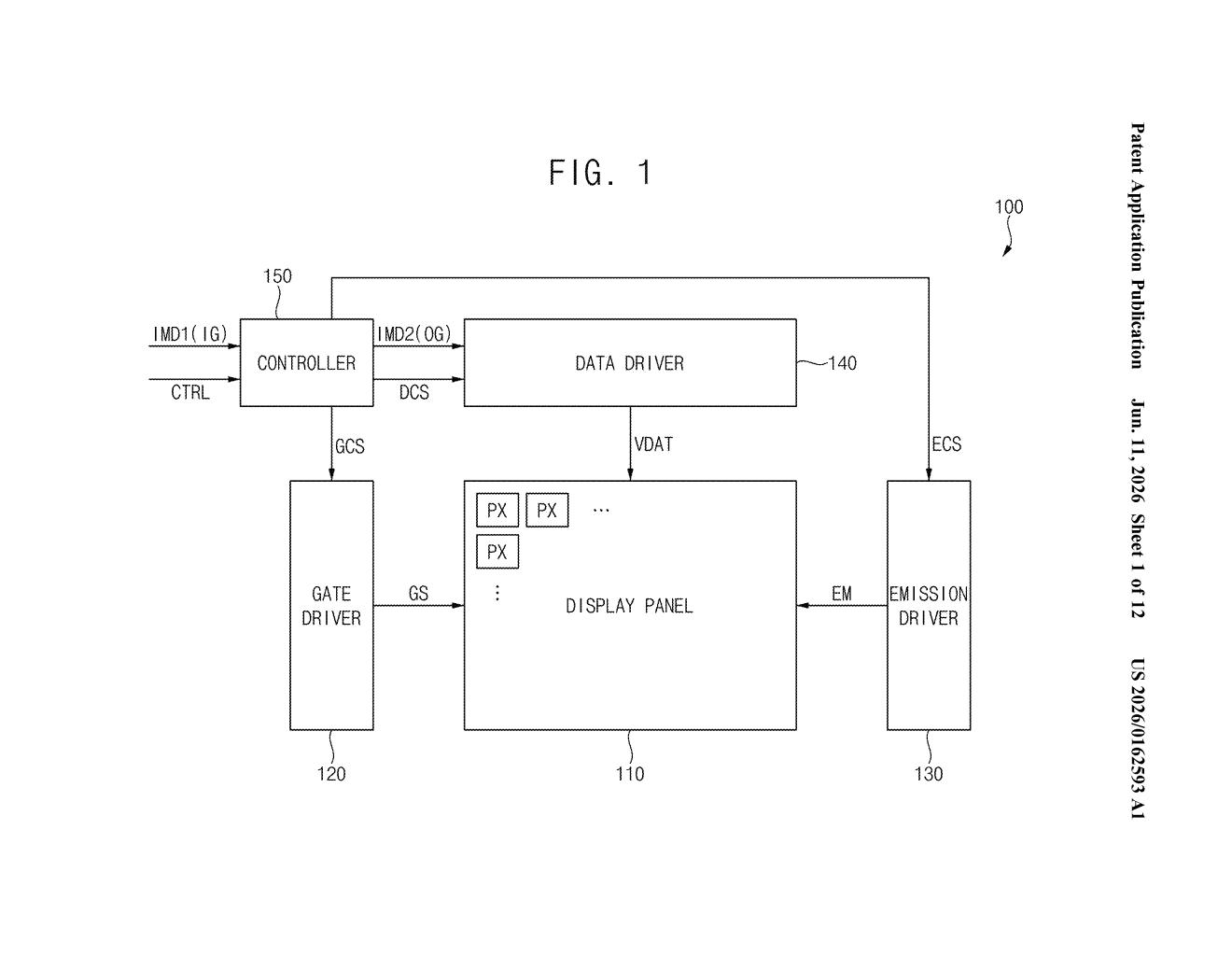
The patent centers on a display controller that sits between the system's graphics output and the actual pixel hardware on the screen panel.
The controller receives two inputs simultaneously: the input grayscale (essentially the brightness level the system wants each pixel to show) and the current refresh rate (how many times per second the screen is being redrawn). When those inputs indicate that the refresh rate is climbing from a lower frequency to a higher one, the controller does not simply pass the original brightness value through. Instead, it calculates a higher output grayscale and sends that boosted value to the data driver — the chip that actually sets each pixel's voltage.
Why does this help? OLED and LCD pixels respond slightly differently depending on how often they are pulsed. A pixel being refreshed at a low rate has more time to settle into its target brightness level; at a higher rate, it has less time per cycle, which can make it appear dimmer even if the nominal signal hasn't changed. The compensation grayscale effectively accounts for that physical lag.
- Controller monitors both brightness data and refresh-rate data in real time
- Detects the low-to-high frequency transition event
- Substitutes a boosted grayscale value for the transition frame(s)
- Data driver applies the corrected value to the pixel
What this means for OLED screens and adaptive-sync gaming
Variable refresh rate (VRR) displays are now standard on flagship phones, tablets, gaming monitors, and laptops — any screen that dynamically adjusts its redraw speed to save power or match content. The technology is great for battery life, but the transition moments between rates have long been a source of subtle visual artifacts that manufacturers work hard to hide.
For Samsung Display, which supplies OLED panels to its own Galaxy devices as well as Apple, Google, and others, solving this at the controller level is cleaner and cheaper than trying to fix it in software on the host device. If this approach ships, it could quietly improve visual consistency on a wide range of screens without any action needed from app developers or operating systems.
This is unglamorous but real engineering. Variable refresh rate flicker is a known, documented problem that reviewers regularly flag in display tests — Samsung is patenting a specific hardware-level solution to it. It won't make headlines on a spec sheet, but it's the kind of fix that separates a great panel from a very good one.
There are more where this came from
We read every patent application Big Tech publishes and send you the ones worth knowing. Plain English, free, every week.
Want this weekly breakdown for a company we don't cover? Patentlyze Pro →