
Qualcomm Patents a Display Pipeline That Fixes Color Fringing After Foveated Blending
Color fringing at the edge of your field of view is one of those small-but-annoying artifacts that XR headsets still haven't fully solved. Qualcomm's new patent tackles it by stitching together two display-processing steps — foveated blending and chromatic aberration correction — into a single late-stage pipeline.
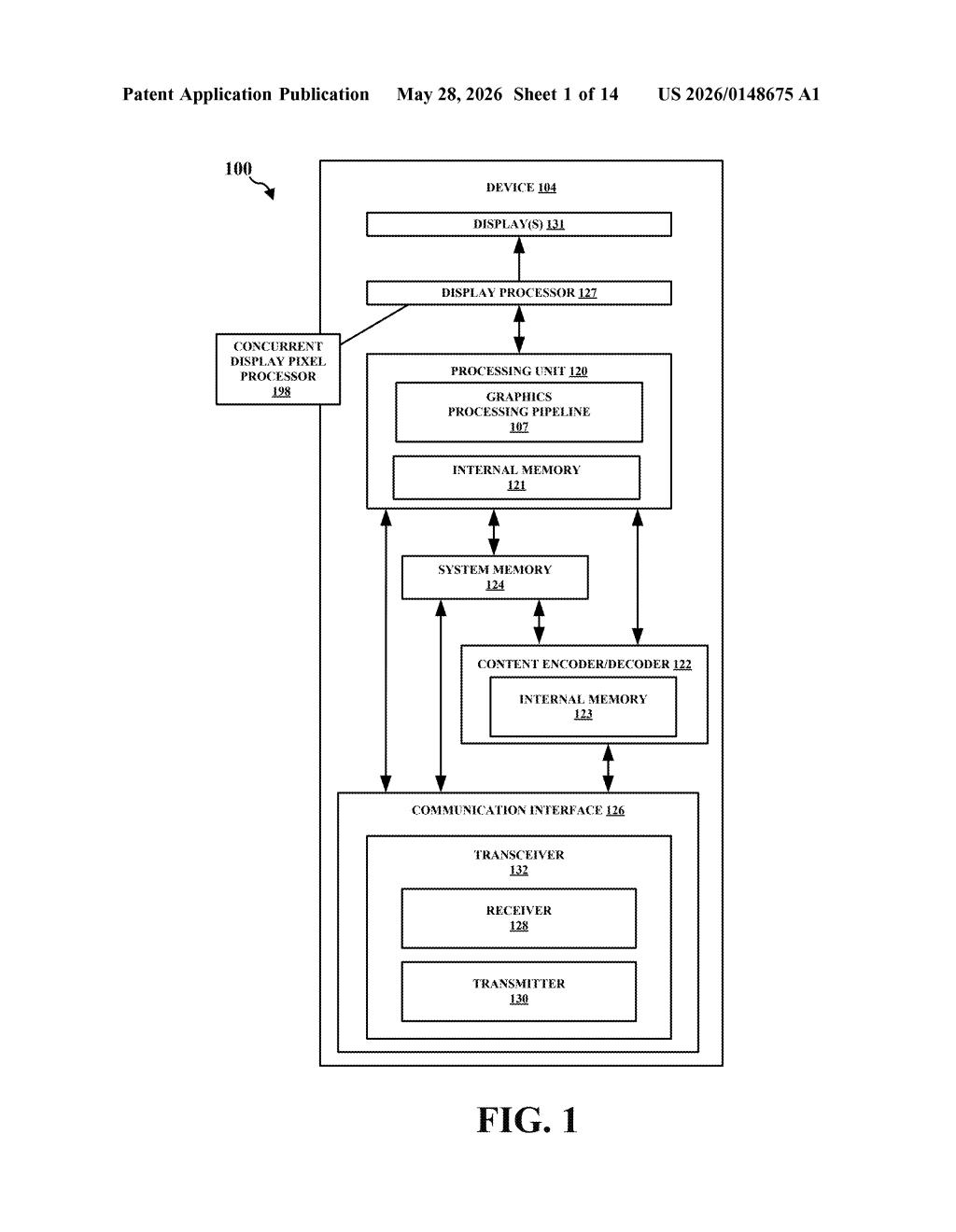
What Qualcomm's foveated blending CAC fix actually does
Imagine you're wearing an XR headset and the center of the image looks crisp, but the edges have a faint rainbow-colored halo around sharp lines. That's chromatic aberration — a lens distortion where red, green, and blue light don't land in exactly the same spot. Headset lenses make it worse, and it's annoying once you notice it.
At the same time, modern headsets use a technique called foveated rendering, where the GPU only renders the region you're actually looking at in full detail, and blends that high-res patch with a lower-res background. That blend happens right before the image hits the display.
Qualcomm's patent describes a pipeline that does both jobs in sequence: first blend the foveated regions together, then run chromatic aberration correction on the combined result. Doing CAC after the blend (rather than before) means you're correcting the final image as it truly looks, not each piece separately — which should produce a cleaner output with fewer artifacts.
How the pixel pipeline sequences blending and CAC
The patent describes a display-processing apparatus — think a hardware block inside a Snapdragon SoC — that chains two correction stages together.
Stage 1 — Foveated blending: The system receives two portions of image data. One is the high-resolution foveal region (the area your eye is pointed at), the other is the lower-resolution peripheral region. A blending step merges them at a transition zone so the seam isn't obvious.
Stage 2 — Chromatic aberration correction (CAC): CAC compensates for the way headset lenses split white light into its component colors, causing colored fringing around edges (think the purple fringe around high-contrast subjects in old photos). The patent applies CAC after the foveal blend, so the correction sees the final composited image rather than the two input layers separately. The pipeline also includes a pixel converter and crossbar/splitter elements that route pixel data between stages and reformat it (e.g., 2-to-4 pixel expansion) to match downstream display panel requirements.
The key architectural claim is the ordering: blend first, correct second. This "late-stage" CAC approach avoids mismatches that could arise if you corrected each image region independently before blending.
What this means for next-gen XR display quality
For XR headset makers, display pipeline efficiency is a constant tradeoff between image quality and latency. Doing foveated blending and CAC in a unified, sequential hardware block — rather than as two separate software passes — can reduce the number of frame-buffer reads and writes, which saves power and cuts processing time. On a device worn on your face all day, both of those matter a lot.
For you as a user, the practical outcome is fewer lens artifacts in the peripheral blend zone — the exact region where your eye is most sensitive to color shifts. It's incremental rather than transformational, but display artifacts are one of the friction points that still make long XR sessions uncomfortable. Qualcomm's Snapdragon XR platform already powers most standalone headsets on the market, so this kind of pipeline work has a direct path to real hardware.
This is solid, focused display-pipeline engineering — exactly the kind of unglamorous optimization work that separates good XR displays from great ones. It won't generate headlines about a new product category, but it's the type of patent that quietly ends up in a Snapdragon XR chip and makes reviewers write 'noticeably less color fringing at the edges.' That's worth caring about.
There are more where this came from
We read every patent application Big Tech publishes and send you the ones worth knowing. Plain English, free, every week.
Want this weekly breakdown for a company we don't cover? Patentlyze Pro →