
Qualcomm Patents a Camera That Focuses Its Processing Power Where Your Eyes Do
Your eyes don't look at every part of a scene equally — so why should your camera chip work equally hard on every part of the frame? Qualcomm's new patent proposes a system that shifts processing muscle toward what you're actually looking at, and dials it back everywhere else.
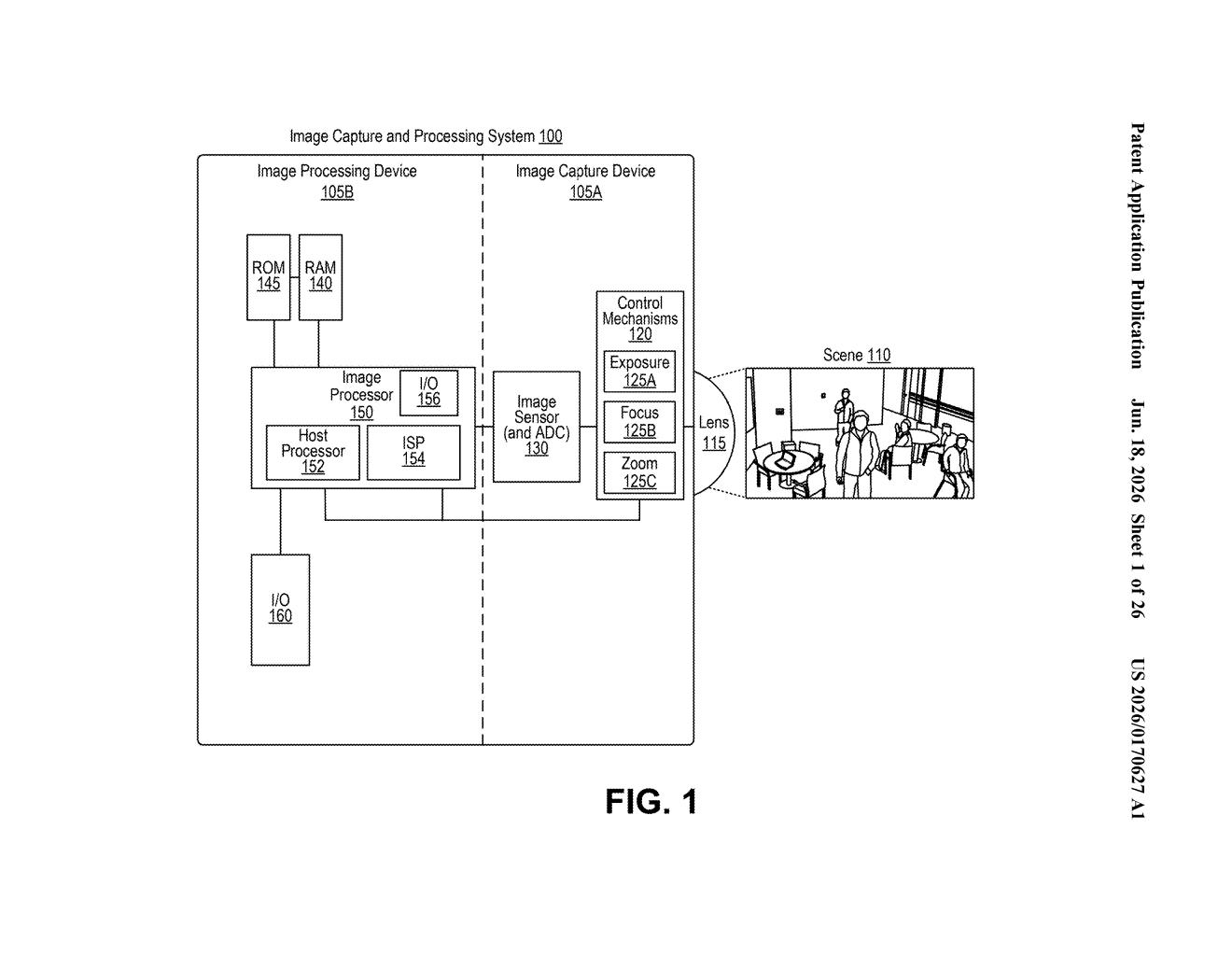
How Qualcomm's gaze-aware camera saves processing power
Imagine watching a video call on a mixed-reality headset. Your eyes are locked on the person speaking in the center of the frame, but the blurry background is still eating up the same amount of processing power as the thing you actually care about. That's wasteful — and Qualcomm thinks it can fix it.
The patent describes a camera processing system that divides each captured frame into sections, or "windows." It then measures how much image data each section is producing — which naturally tracks with how much detail is there and how much attention it's drawing. Sections with more activity (and more viewer attention) get more processing resources; quieter sections get less.
The practical payoff is that your device doesn't burn full power on every pixel all the time. That could mean better battery life, less heat, or — if you redirect that saved power — sharper images in the areas you actually look at.
How data rates per window drive the scaling factor
The patent describes an image processing system built around what Qualcomm calls a processing scaling factor — essentially a per-region power budget for the camera chip.
Here's how it breaks down:
- The camera captures a sequence of frames during an active-frame duration (the time the sensor is actively recording).
- Those frames are divided into multiple windows — spatial or temporal regions of the image.
- Each window is assigned a data rate — a measure of how much image information it contains. High data rates suggest busy, detailed, or fast-moving content; low rates suggest static or blurry areas.
- The system then calculates a scaling factor for each window — essentially deciding how much compute to throw at it — based on that data rate.
- Processing is then applied proportionally across all windows.
The title of the patent ties this to both gaze (where you're looking, likely detected by eye-tracking sensors common in XR headsets) and exposure (how bright or dark different parts of the scene are). Both signals can influence which windows get high data rates — and therefore more processing attention.
What this means for XR headsets and mobile cameras
This patent is most obviously relevant to XR headsets and AR glasses, where eye-tracking is already standard hardware and battery life is a constant constraint. Qualcomm's Snapdragon XR chips power most of the major headsets on the market today, so a technique like this fits directly into their existing product stack. Spending less power on the parts of a frame nobody is looking at is a straightforward way to stretch battery life without sacrificing perceived image quality.
It's also applicable to smartphone camera processing, where gaze data is less common but exposure variation across a frame — bright sky, dark foreground — is a universal challenge. If this approach ships in a future Snapdragon mobile chip, it could mean your phone makes smarter trade-offs about where to apply HDR and detail-recovery work in real time.
This is exactly the kind of unglamorous, hardware-level optimization that quietly makes next-generation devices feel noticeably better. Eye-tracking-aware compute allocation is a sensible evolution for XR chips, and Qualcomm is the right company to file it — they're already inside most of the headsets where it would matter most. Don't expect a feature announcement anytime soon, but do expect to see this principle embedded in a future Snapdragon XR chip spec sheet.
There are more where this came from
We read every patent application Big Tech publishes and send you the ones worth knowing. Plain English, free, every week.
Want this weekly breakdown for a company we don't cover? Patentlyze Pro →