
Google Patents a Smarter Prediction Scheme for 3D Mesh Compression
3D meshes are made of millions of tiny triangles, and compressing them efficiently means guessing vertex positions as accurately as possible before storing only the error. Google thinks it has a better guessing strategy.
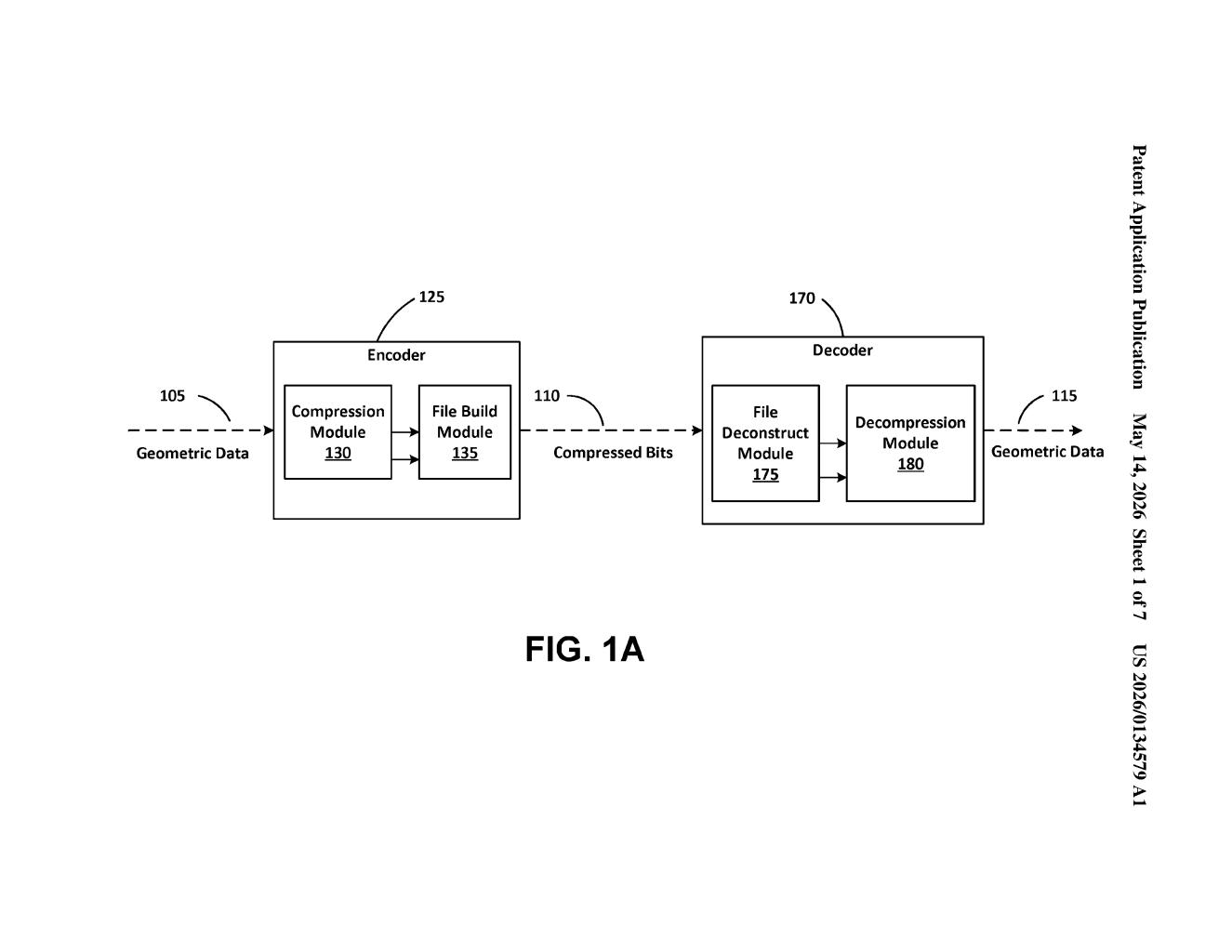
How Google predicts 3D vertex positions more accurately
Imagine a 3D model of a human face — it's built from thousands of tiny triangles, each defined by corner points called vertices. When you compress that model to send it over the internet or store it efficiently, the key trick is predicting where each vertex probably sits, then saving only how far off that prediction was. The smaller the error you need to save, the better your compression.
Right now, many compression systems make fairly naive guesses about where a vertex sits. Google's patent describes a smarter approach: look at a ring of already-decoded neighboring vertices arranged roughly like the corners of a hexagon around the point you're trying to reconstruct. By combining two edge vectors — essentially arrows pointing from one known neighbor to another — you arrive at a much more accurate predicted position.
The final decompressed position is just that prediction plus a small correction value stored in the file. Because the prediction is more accurate, the correction is smaller, which means the file is smaller. It's a geometric insight that pays off in reduced bandwidth and storage for anyone working with 3D content.
How the hexagonal neighbor prediction actually works
The patent describes a vertex prediction algorithm for compressing and decompressing triangular mesh geometry — the kind of data that defines the shape of 3D objects in games, maps, AR, and medical imaging.
When decompressing a vertex, the decoder already has access to several previously decoded neighboring vertices. The key insight is how to use those neighbors optimally. The method identifies a second vertex that sits geometrically opposite the target vertex — think of it as the far point of the hexagon. It then computes two edge vectors (directional arrows between specific pairs of neighbors) and adds both to that opposite vertex's position. The result is the predicted position of the target vertex.
Formally:
- Identify the target vertex and its decoded neighbors (arranged roughly hexagonally)
- Find the neighbor opposite the target vertex
- Compute edge vector 1 and edge vector 2 from specific neighbor pairs
- Add both vectors to the opposite vertex to get the predicted position
- Add the stored correction variable (the residual error) to get the final decompressed position
Because the hexagonal neighbor geometry captures local surface curvature better than simpler schemes, the predicted position is closer to the true position, meaning the correction residual — and thus the bits needed to store it — is smaller. The corresponding encoder works in reverse: compute the prediction, subtract it from the true position, and store only the difference.
What this means for 3D streaming and file sizes
Triangular mesh compression is foundational infrastructure for 3D content on the web, in games, and in AR/VR. Google's existing Draco library is already one of the dominant open-source tools for this exact problem, used in glTF files, Google Maps, and Android's SceneCore. A more accurate prediction scheme directly translates to smaller file sizes or higher geometric fidelity at the same file size — a real, practical win.
For you as a developer or end user, this could mean faster-loading 3D maps, more detailed AR objects that don't blow out your data plan, or richer 3D assets in web-based experiences. It's not a flashy AI feature, but tighter mesh compression is exactly the kind of unsexy infrastructure improvement that quietly makes the entire ecosystem better.
This is a focused, well-scoped geometric optimization — not a moonshot. But Google owns the Draco compression library, which is baked into the glTF standard and used everywhere from Google Maps to Unity. Even a modest improvement in prediction accuracy at Google's scale of 3D content delivery is worth real bandwidth dollars. This one is worth watching if you follow 3D web standards.
There are more where this came from
We read every patent application Big Tech publishes and send you the ones worth knowing. Plain English, free, every week.
Want this weekly breakdown for a company we don't cover? Patentlyze Pro →