
Google Patents an AI System That Applies Facial Expression Edits Across Any Photo
Every photo filter you've ever used works by eyeballing general visual rules. Google's new patent describes a system that instead studies specific examples of a facial expression, boils them down to a precise mathematical recipe, and then applies that recipe to any face, consistently.
What Google's expression-editing AI actually does to your photos
Every time a photo app lets you tweak a person's expression, it's doing something surprisingly imprecise: applying a broad, pre-baked effect that wasn't specifically tuned to the look you actually wanted. The results often feel off, like the smile doesn't quite match the face.
Google's patent describes a way to fix that at the training stage. You feed the system pairs of photos: an ordinary face alongside a version showing the target expression. The system studies those pairs, figures out what changed, and distills that change into a compact set of instructions called an editing vector. It then refines those instructions until they meet quality criteria, so the result is consistent and realistic rather than drifted or glitchy.
Once that recipe is locked in, it's used to build a whole training dataset automatically, teaching a separate AI model to apply the same expression to new faces it has never seen before. You end up with a model that can take any input portrait and give it a specific, repeatable expression style.
obtaining an optimized overall editing vector representing a target expression photo editing effect, wherein the optimized editing vector has been optimized in accordance with one or more optimization criteria in an embedded style space; …
Translation: The system calculates a mathematical formula that defines how a specific facial expression should look.
How the system builds and optimizes an expression editing vector
The core invention is a pipeline with three linked stages.
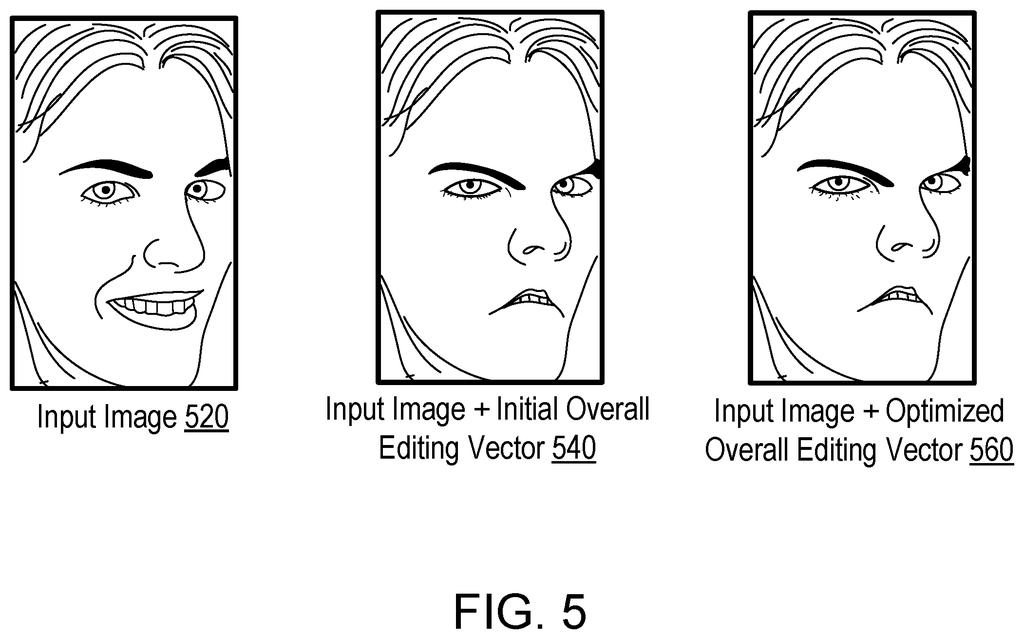
Stage one: learning from examples. The system takes pairs of face images, one neutral and one showing a target expression. Each image is passed through a style space encoder, a neural network that converts the image into a compact numerical representation (called an embedding) capturing the face's visual style. The difference between the two embeddings, averaged across many pairs, becomes an initial editing vector: a set of numbers that describes, in the AI's internal language, what the expression change looks like.
Stage two: optimization. That initial vector is then refined. The system adjusts the numbers according to one or more optimization criteria (think of these as quality checks: does the result look realistic? Does the identity of the person hold up? Is the expression strong enough?). The output is an optimized overall editing vector that captures the effect more precisely than the raw average.
Stage three: dataset generation and model training. The optimized vector is applied to a large collection of input face embeddings, automatically producing a dataset of paired images. A machine learning model is then trained on that dataset to perform the expression edit on any new portrait. The trained model is the deliverable: something that can be deployed in a real photo editing product.
The claim is specifically about the deployment end of this pipeline, starting from an already-optimized vector and ending with a trained model ready to ship.
… receiving a plurality of image pairs, each comprising an original face image and an expressive face image representative of a target expression photo editing effect, …
Translation: It starts by looking at examples of faces before and after a specific expression is applied.
What this means for AI photo editing tools
Photo editing features that touch faces are everywhere: in phone camera apps, social platforms, and creative tools. The hard part has always been consistency. A filter that looks great on one face can look wrong on another because it wasn't tuned carefully enough. Google's string of AI photo-editing filings points to an effort to make that tuning automatic and reproducible.
For users, a system like this could mean expression-based edits that hold up across a full album of portraits, not just a lucky single shot. For product teams building photo tools, it describes a way to manufacture training data for any expression style without hiring people to pose for thousands of example photos, which is both expensive and slow.
Google's 61st filing we've tracked since May in our AI photo editing watch adds to a run that includes a tap-to-reframe camera and a filter sharpening streamed video.
The problem this patent attacks is real and frustrating. Building a facial expression editing feature that looks consistent across different people, lighting conditions, and camera types is genuinely hard. Most shortcuts produce results that look uncanny or uneven. A method that systematically learns from examples and then optimizes before training has a plausible claim to doing better.
That said, the claim in this filing is narrow. It covers the deployment pipeline: take an already-optimized vector, make a dataset, train a model, ship it. The harder and more interesting part, how you decide what the optimization criteria should be, is largely upstream of what's claimed here. The filing describes a sound engineering process, but the criteria that make an expression look good are still a human judgment call baked in elsewhere.
For a general reader, the takeaway is simple: this is infrastructure work. It's the kind of careful plumbing that makes AI photo effects reliable rather than hit-or-miss, and that reliability is what separates a feature people actually use from one that gets buried in a settings menu.
There are more where this came from
We read every patent application Big Tech publishes and send you the ones worth knowing. Plain English, free, every week.
The drawings
6 drawing sheets from US 2026/0301464 A1 · click any drawing to enlarge


Want this weekly breakdown for a company we don't cover? Patentlyze Pro →
Be the first to weigh in