
Google Patents a Chat Tool That Turns Typed Descriptions Into Custom Stickers
Type 'good morning with coffee in the background' and Google's patent has an AI hand back a finished, styled sticker ready to send.
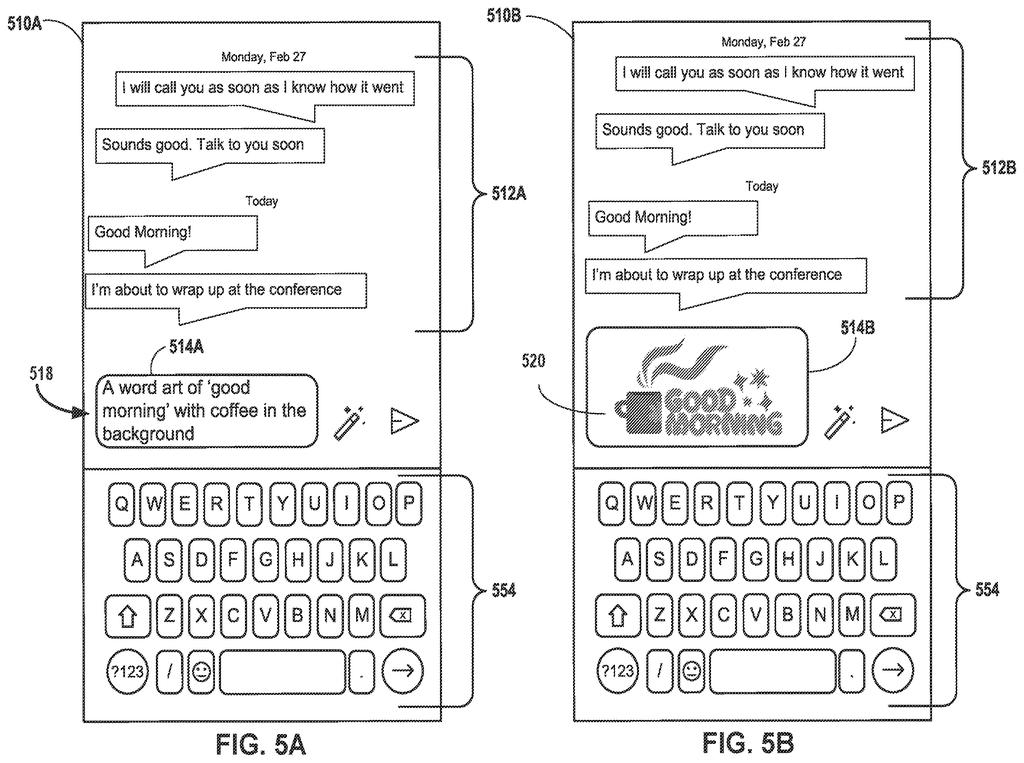
What Google's sticker generator actually does
Imagine you want to wish a friend good morning, but a plain text message feels flat. You type 'word art of good morning with coffee in the background,' and the app hands back a finished sticker with stylized lettering and a coffee cup behind it.
That is what Google describes in this patent application. Instead of drawing something yourself or hunting through a sticker library, you describe what you want (or sketch it roughly), and an AI model produces the image. You can also pick two emoji and ask the AI to combine them, such as taking the hearts from one and adding them to another.
You get to look the result over before it goes out. From there you can tweak it, ask for variations, or send it straight into your conversation.
obtaining, by a computing device, an image generation prompt that includes a description of an image to be generated; providing, by the computing device, the image generation prompt to a machine learning model; …
Translation: The app takes your typed description and sends it to an AI model to create a picture.
How a typed phrase becomes a finished sticker
The patent describes a messaging feature built on a simple loop. You give the phone a prompt (a written description of the image you want). The phone passes it to an AI image model, gets the picture back, and shows it on screen for you to review. The model can run on your device or on remote cloud servers.
The filing leans on two uses. The first is emoji remixing: you pick one or two emoji and describe a change, like adding tears to a face or moving the hearts from one emoji onto another. The result can even come out in a different style, such as a 3D ghost dog inspired by an emoji. The second is text stickers: you type a message and the AI draws it in a styled typeface. The look can follow a background picture you choose or the mood of the words.
Under the hood, the filing describes two models stacked together. A text-to-image model turns words into pictures, and an image customization model layered on top adjusts the result. The filing says it should keep lettering free of typos (fixing 'Good Mornnning' to 'Good Morning') and avoid mismatched art, like pairing a moon with 'Good Morning.' It can also be tuned to attach an identifier to a particular subject, such as cats or coffee.
The method further includes outputting, by the computing device, a graphical user interface that includes the image.
Translation: The system finally displays the newly generated picture right on your screen.
Why your next chat reply might be AI-drawn
If this ships in a messaging app, the practical change is that a custom reply stops requiring any art skill. Instead of scrolling a sticker library or drawing with a thumb on a small screen, you describe the reply and get something made for that exact moment. The filing says the goal is fewer taps and less time to get an image you're happy with.
This is a patent application, so nothing here promises a product. But the emoji-combining example points at a feature people already use, and the text sticker idea would extend it to words. Chat apps compete on expression, and this is one way to make your messages feel more personal.
Google's 38th filing in the AI image and video space we've tracked since May adds to a run that includes editing photos with text and rebuilding video from sample frames.
The trade here is effort for control: typing a sentence beats drawing, but you hand the artistic choices to a model. The filing itself admits the hard part is keeping lettering readable, which is why typo fixing shows up as a feature.
The other cost is privacy. Generating pictures usually happens on remote servers, so your drawings and prompts would travel off your phone. The filing says that only happens with your permission, and it also allows the model to run on the device itself, which is the better deal if phones can handle it.
The first claim is broad enough to cover almost any app that turns a typed description into a picture. The emoji mashups and styled text stickers in the later claims are where the idea gets specific, and for a messaging app the trade looks worth making.
Get our take in your Top Stories
Liked this breakdown? Add Patentlyze as a preferred source on Google, and our plain-English take shows up more often in your Top Stories the next time Google patent news breaks.
There are more where this came from
We read every patent application Big Tech publishes and send you the ones worth knowing. Plain English, free, every week.
The drawings
9 drawing sheets from US 2026/0311399 A1 · click any drawing to enlarge


Want this weekly breakdown for a company we don't cover? Patentlyze Pro →
Be the first to weigh in