
Google Patents a Way to Rebuild Any Video Using Just a Few Sample Frames
Google has filed a patent for a system that can regenerate an entire video by feeding only a small selection of its frames into an AI model. The idea is that you don't need the whole clip to rebuild it, just enough key snapshots to let AI fill in the rest.
What Google's frame-sampling video generator actually does
A filmmaker exports a rough cut of a short film. Instead of sending every one of its thousands of frames through an AI tool, the system grabs a handful of representative frames from each scene and uses those as instructions. You get a brand-new version of the video out the other end.
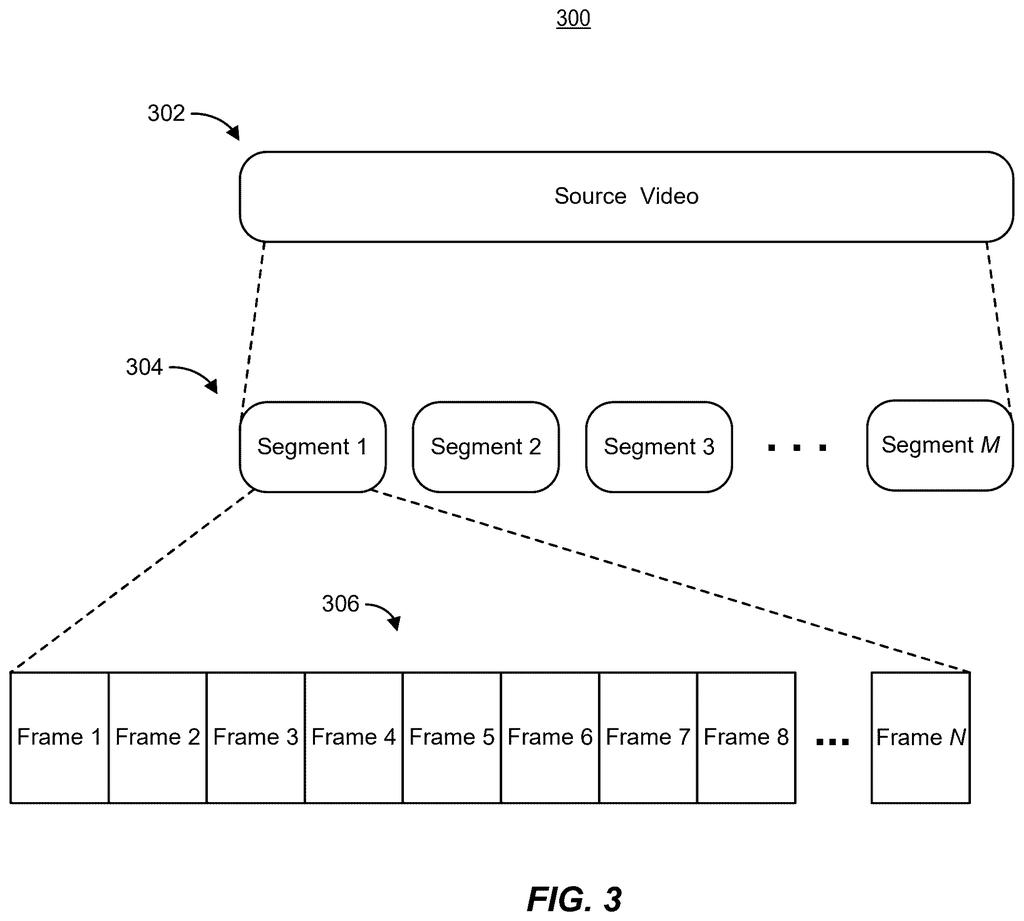
That's the core of this Google patent. It slices a source video into segments, picks a small subset of frames from each segment, and hands those subsets to a generative AI model. The AI produces new video segments to match, which are then stitched into a complete new video.
The result is a pipeline that doesn't need to process every single frame as its own independent task. Instead, the frame selection does the heavy lifting of communicating what a scene looks like, and the AI handles the rest. Think of it like describing a movie to someone who then re-shoots it from your description, except the description is a few actual stills.
obtaining, by one or more processors, a source video; identifying, by the one or more processors, a plurality of video segments in the source video, wherein each video segment of the plurality of video segments includes a respective plurality of consecutive frames …
Translation: The system starts by breaking a source video down into smaller chunks of consecutive frames.
How the AI fills in footage from a handful of frames
The patent describes a multi-step pipeline for transforming an existing video into a new one using a generative AI model.
First, the system takes a source video and divides it into video segments, each made up of consecutive frames (a sequence of images that, played together, form motion). Rather than processing every frame, it then selects a frame subset from each segment. These subsets are smaller collections of frames that are meant to represent what's happening in that portion of the video.
Those frame subsets are then passed as inputs to a generative AI model (the type of AI that can produce new content, not just classify or label existing content). The model generates a corresponding new video segment for each subset it receives. Because the subsets carry information about the original footage, the AI has enough context to produce something coherent rather than random.
- Source video is split into segments
- A frame subset is selected from each segment
- The subsets are fed into a generative AI model
- The model outputs new video segments
- Those segments are assembled into a complete new video
The patent is focused on the method itself, not a specific AI architecture, so it could apply to a range of underlying models.
… generating, by a generative artificial intelligence (AI) model, new video segments each corresponding to a different one of the frame subsets by providing the frame subsets as inputs to the generative AI model …
Translation: An AI model takes the sample frames and uses them to recreate whole new video segments.
What this means for AI-generated video at scale
Processing video with AI is expensive. A full-resolution video can have thousands of frames per minute, and running all of them through a generative model would be slow and computationally heavy. By working from frame subsets rather than every frame, this approach could make AI video generation meaningfully faster and cheaper to run at scale.
For users, the practical upside would be faster turnaround when regenerating or restyling footage, whether that's for video editing tools, content creation platforms, or something built into a product like Google Photos or YouTube Studio. The filing doesn't name a specific product, but the technique fits naturally into any platform where people upload and edit video.
Google's 57th filing we've tracked in the AI photo editing race since May follows work like distance-based sharpening and text-driven editing.
The core trade this patent makes is compression of information: instead of feeding an AI model every frame of a video, you give it a sample and trust it to extrapolate. That's a real efficiency gain, and the logic is sound. But it is also the design's main vulnerability.
AI models asked to regenerate footage from sparse inputs can drift. Small details, consistent lighting, a character's face across a long scene, these are exactly the things that frame subsets might undersample. The patent doesn't describe how the frame selection is done or how the model is guided to stay consistent across segments, which is where the hard work actually lives.
So the filing reads as a solid high-level architecture, but it leaves the difficult questions open. Whether the output is actually coherent across segments depends entirely on implementation choices the patent doesn't lock down. For now, this is a claim on an approach, not a guarantee of results.
There are more where this came from
We read every patent application Big Tech publishes and send you the ones worth knowing. Plain English, free, every week.
The drawings
4 drawing sheets from US 2026/0289847 A1 · click any drawing to enlarge


Want this weekly breakdown for a company we don't cover? Patentlyze Pro →
Be the first to weigh in