
Wing Aviation Patents a System That Lets Drones Find Their Own Spot on a Shared Landing Track
When multiple delivery drones share the same landing rail, how does each one know exactly where it is? Wing Aviation has filed a patent for a system that lets each drone figure out its own position on the rail and act on that information automatically.
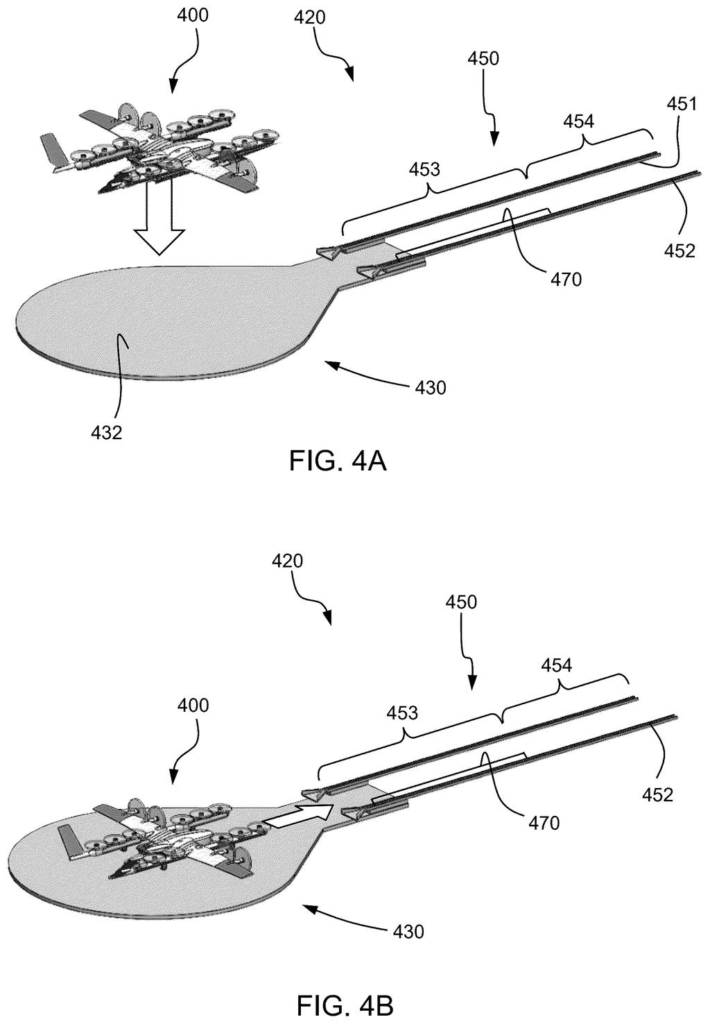
What Wing's drone-positioning system actually does
Ever tried to find one car in a packed parking garage with no numbered spots? That is roughly the problem Wing Aviation is solving, except the cars are drones and the garage is a shared metal rail.
Wing's patent describes a "holding system" where a long track can accommodate several drones at once. A locating component tied to that track tells each drone exactly where it sits along the rail. Once a drone knows its position, it can carry out whatever action makes sense next, whether that is waiting its turn, moving to a different spot, or preparing for takeoff.
The idea is to give drones the kind of self-awareness they need to share physical infrastructure without bumping into each other or blocking the queue. For you as a potential customer, this is the behind-the-scenes plumbing that keeps deliveries moving when multiple drones are coming and going from the same station.
navigating, by a UAV, onto a first track of a UAV holding system; determining, by the UAV, a location of the UAV along the first track based on a locating component associated with the UAV holding system; and performing, by the UAV, a control operation based on the determined location of the UAV along the first track.
Translation: A drone lands on a shared track, figures out where it is using built-in sensors, and then takes action based on that position.
How a drone reads its position along the track
The patent describes a three-step process: a drone navigates onto a track, figures out where it is, and then takes an appropriate action.
The first track is long enough to hold several drones at the same time, more like a train platform than a single landing pad. The locating component is the key piece. The patent does not lock in one technology, leaving room for optical markers, radio-frequency tags, or other sensing approaches that tell the drone its position along the rail's length.
Once the drone has a confirmed position, it performs a control operation based on that information. That vague phrase is intentional: the patent is broad enough to cover a range of follow-on behaviors, such as:
- Moving forward or backward to free up space for another drone
- Signaling readiness for a battery swap or package load
- Adjusting its hold position based on traffic from other drones joining or leaving the track
The drone does all of this autonomously, meaning ground operators do not have to manually choreograph positions across a busy rail.
What this means for multi-drone delivery operations
For drone delivery to work at scale, the ground infrastructure has to be just as capable as the aircraft. A single landing pad handles one drone at a time. A shared track multiplies throughput, but only if each drone knows where it stands and can act accordingly. This patent addresses that coordination problem at the drone level, pushing the intelligence onto the aircraft rather than onto centralized ground software.
If this system works as described, your delivery is less likely to sit in a queue because one drone is blocking the rail waiting for a human to reposition it. The payoff is subtle but real: faster turnaround times at delivery hubs with no added staff.
Google's 732nd filing in our Google coverage since May adds to a run that includes a drone rail calibration idea and an AI prompt expander.
When you order something by drone and it shows up late, the delay usually happens before the drone ever leaves the ground. Figuring out which drone is where on a shared rail, and whether it can move without hitting another one, takes time that adds up fast across dozens of deliveries.
This patent lets each drone work out its own position on that rail and act on it immediately, without waiting for anyone to sort things out from above. That shift matters because it removes a choke point that would otherwise get worse as more drones share the same station.
For the person watching a delivery estimate, the effect is simple: the time between placing an order and a drone lifting off gets shorter, and the window where things go wrong before you even know it shrinks considerably.
There are more where this came from
We read every patent application Big Tech publishes and send you the ones worth knowing. Plain English, free, every week.
The drawings
26 drawing sheets from US 2026/0277214 A1 · click any drawing to enlarge


Want this weekly breakdown for a company we don't cover? Patentlyze Pro →