
Google Files Patent to Make Smart Glasses Displays Look Evenly Bright
The lenses in display glasses are etched with patterns so fine that factories hit a floor on how thin the lines can get. Google's filing describes a way to behave as if the lines were thinner than that floor.
What Google's smart glasses lens fix does
Ever shined a flashlight at a wall and noticed the bright spot in the middle fading toward the edges? Glasses that project an image into your eye can have the same problem: one part of the picture glows while another looks dim.
The lens in those glasses carries a pattern of microscopic ridges that steers light out toward your eye. To keep the picture even, only a small share of light should escape at each spot. But the ridges can only be made so thin, because factories can only etch so small. Google's patent adds even tinier notches or bumps inside the pattern, which gets around that limit.
The result is a lens that behaves as though its ridges were thinner than they can actually be made. The light leaks out gently, and the image looks more uniform.
… one or more sub-wavelength features reduce a diffraction efficiency of at least one diffraction order of the diffraction grating beyond fabrication limits.
Translation: Tiny microscopic patterns push the glass beyond normal manufacturing limits to fine-tune how light behaves.
How tiny notches and bumps dim the exit light
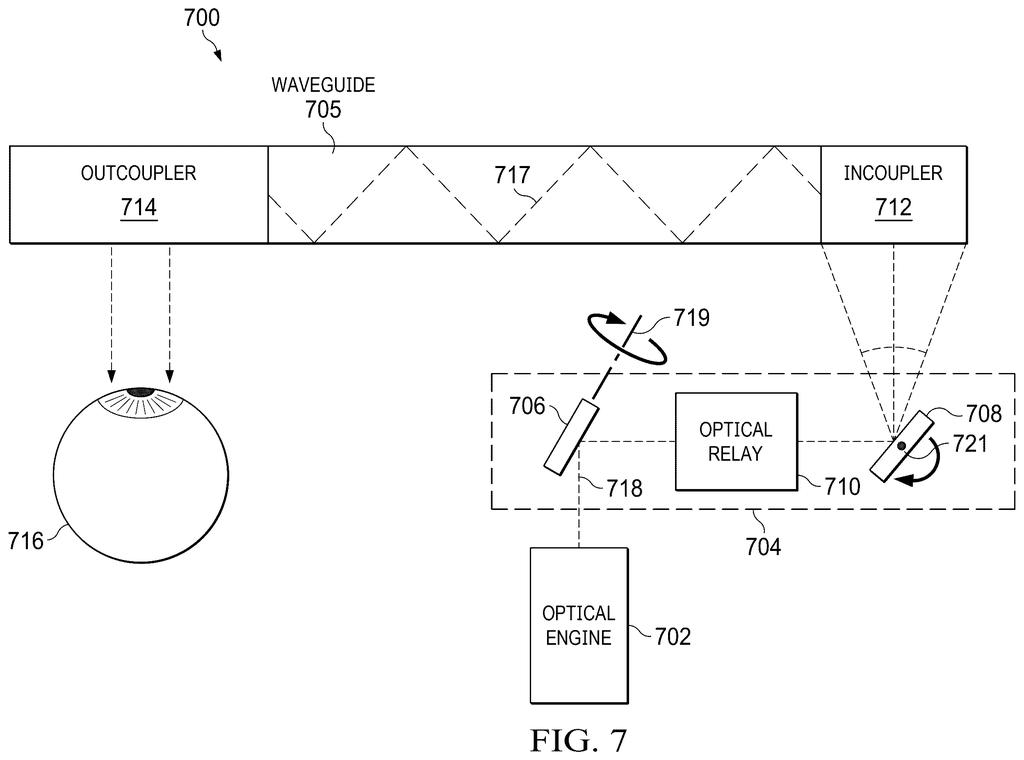
A diffraction grating is a surface with a repeating pattern of tiny ridges and grooves that bends light. In smart glasses, the lens (a waveguide, a clear slab that carries light) uses one grating to take light in and another, the outcoupler, to send it out toward your eye.
For the outcoupler, the lens wants a weak grating, so only a little light escapes at each spot and the image stays even. How weak it gets depends on the fill factor, the share of each repeat that is solid ridge. The catch is that a factory can't make features below a minimum size (the critical dimension), and that sets a floor on how thin or thick the ridges can go.
The patent adds sub-wavelength features, details smaller than the wavelength of the light itself. It describes two versions:
- Notches cut into the ridges, splitting each long ridge into separate segments.
- Small islands of ridge material placed in the grooves between ridges.
Either way, the effective fill factor moves past what the factory limit normally allows. The features are sized so very little light is pushed sideways. In one option, their spacing matches the ridge spacing, which lets a small amount leak sideways and lowers efficiency further. Other gratings in the waveguide then handle that leaked light. The claims cover the grating itself and a waveguide that uses it.
Why even brightness matters for glasses displays
If you ever wear display glasses, you want the picture to look the same wherever your eye sits. The description says a strong outcoupler makes the light intensity uneven across the viewing area, and this design is a way to get a weaker one than manufacturing normally allows.
The filing describes a laser projection system built into an eyeglass lens, so the target is thin, wearable displays. The appeal for a company is practical: it can improve the image through the pattern on the lens, without waiting for a finer factory process. The text gives no test results, so treat the gains as a design claim for now.
Google's 51st filing we've tracked since May in our smart glasses display work watchlist follows one on cutting wasted display light and one on landmark and sound navigation.
Every fix here has a price. Adding tiny notches or bumps turns a simple set of parallel lines into a busier pattern, and a busier pattern invites light to scatter in directions nobody wanted.
The filing deals with that by sizing the features so sideways light either fades out or stays small. In one version it lets a little leak on purpose and relies on other gratings in the lens to catch it. That means more design work and one more thing that has to line up in manufacturing.
The trade looks worth making. The alternative is an exit pattern that can't get dim enough, which means a picture that is bright in one spot and weak in another. The patent gives no measured results, so how much it helps is unproven, but the logic holds and the cost is modest.
Get our take in your Top Stories
Liked this breakdown? Add Patentlyze as a preferred source on Google, and our plain-English take shows up more often in your Top Stories the next time Google patent news breaks.
There are more where this came from
We read every patent application Big Tech publishes and send you the ones worth knowing. Plain English, free, every week.
The drawings
7 drawing sheets from US 2026/0329086 A1 · click any drawing to enlarge


Want this weekly breakdown for a company we don't cover? Patentlyze Pro →
Be the first to weigh in