
Google Files Patent to Stop Smart Glasses Displays From Wasting Light
Google's glasses display has a leak problem: light that has just entered the lens can bounce straight back out. A new filing describes a two-layer fix that sends it back in.
What Google's glasses-lens light trap actually does
Imagine you're wearing glasses that project a map onto the lens. A tiny projector in the arm works hard to push the image into the glass, but a lot of that light slips back out right after it enters. Your battery pays for light you never see.
Google's filing goes after that waste. A thin plate on top of the lens twists the light's polarization (the direction its waves vibrate). A filter layer on the bottom lets the light in on the way through, then acts like a one-way door: light trying to escape gets twisted a second time and is bounced back into the lens.
In the example Google describes, that roughly doubles the light the lens captures. The payoff could be longer battery life, a smaller battery, or fewer charges.
… trading polarization state purity for reduced space-bandwidth product using a combination of optical elements, thereby improving system efficiency, reducing power constraints, and thus enabling longer battery life and/or smaller battery size.
Translation: It sacrifices some light purity to save space and drastically improve battery life.
How the twist-and-reflect layers keep light in
The claim covers a head mounted display (a headset or glasses worn on your face) built from four parts working together:
- Light source: the projector that makes the image.
- First optical element: changes the light's polarization. The main example is a quarter-wave plate, a thin film that twists polarization.
- Second optical element: a reflective polarizer that passes or bounces light depending on its polarization.
- Incoupler: a grating (a surface etched with tiny ridges) that bends light into the waveguide, the thin lens layer that carries the image to your eye.
Here is the trick. After the incoupler bends light into the lens, that light passes back through the first element, which flips its polarization to the perpendicular state. Now the second element reflects it instead of letting it through. Light that would have leaked out in a "multibounce" event gets sent back in.
The underlying problem is etendue, a physics rule that a bundle of light can't be squeezed into a smaller space without losing some. With projector beams as wide as 4 mm and a thin lens, many rays simply don't fit. The filing trades polarization purity (light in the lens ends up mixed) for a smaller space-bandwidth product (roughly, how much room the light needs). In its example, extracted light roughly doubles.
What this means for battery life in Google glasses
If you've tried display glasses, you know the tradeoffs: thick frames, a draining battery, or a dim picture. Wasting light at the lens entrance makes all three worse, because the projector has to burn more power to reach the same brightness. Recovering that light could let a maker use a smaller battery or give you more hours between charges.
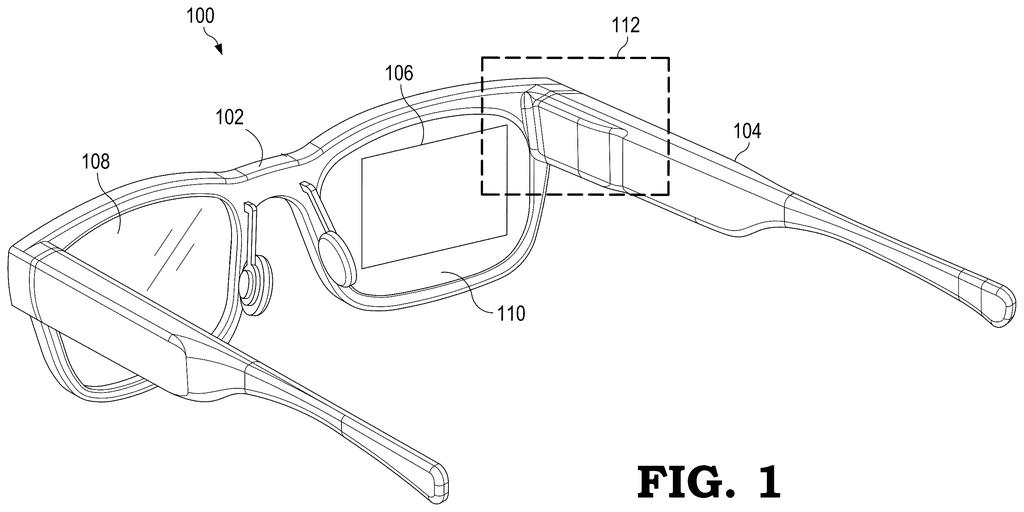
The filing describes an eyeglasses-style headset with the projector in the arm, and says the approach could allow lighter devices. It is an optics fix, so you would never see it as a feature, only as glasses that last longer or weigh less. Whether it reaches a product is unknown. This is a patent application, and the doubling figure comes from the company's own example.
Google's 50th filing we've tracked since May on our smart glasses display work watchlist builds on earlier applications like glasses that navigate by landmarks and spill warnings for devices.
Claim 1 is short on parts and long on reach. It names a light source, one element that changes the light's orientation, one element that passes or bounces light depending on that orientation, and the entry point into the lens. It never says quarter-wave plate, glasses, or any number. Those details show up only in the later claims.
The one tight requirement is that the same orientation-changing element also flips light on its way back, so the bouncing element sends it into the lens again. Any display built that way, in any headset, would fit the wording. A design that gets more light with a thicker lens or a narrower projector beam would sit outside it.
For you, the claim reads as a battery and weight play. The description backs that with one example where the light captured by the lens roughly doubles, though that is the company's own figure for a single setup.
Get our take in your Top Stories
Liked this breakdown? Add Patentlyze as a preferred source on Google, and our plain-English take shows up more often in your Top Stories the next time Google patent news breaks.
There are more where this came from
We read every patent application Big Tech publishes and send you the ones worth knowing. Plain English, free, every week.
The drawings
8 drawing sheets from US 2026/0329103 A1 · click any drawing to enlarge


Want this weekly breakdown for a company we don't cover? Patentlyze Pro →
Be the first to weigh in