
Google Patents Glasses That Flash Notifications From the Frame Instead of the Lens
Google has filed a patent application for smart glasses that tell you something happened with a small light built into the frame, aimed toward your eye. The lenses stay clear, and nothing makes a sound.
What Google's frame-mounted notification lights do
A woman in a quiet meeting wears glasses with perfectly clear lenses. A text arrives. She needs to know about it without a chime going off or her eyes drifting to a screen. That is the situation Google is trying to solve in this patent application.
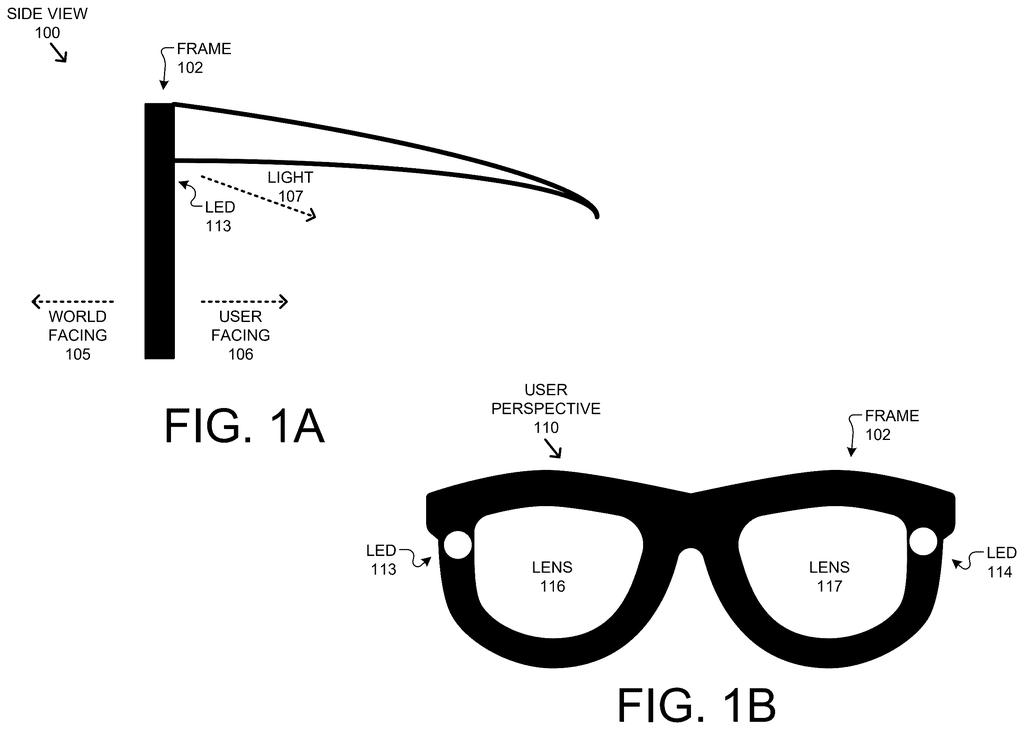
The idea is to tuck a tiny light into the inside of the glasses frame, aimed toward your eye. When something happens, like a new message or a volume change, the light glows. It sits in the frame itself, so your view of the room stays free of pop-up graphics.
The filing also describes a thin layer that can shape the glow into a simple symbol, such as an up arrow when you ask for louder music. It also describes sensors that dim the light in a dark room so it does not dazzle you.
… at least one light-emitting diode (LED) positioned on a portion of the frame facing a user of the frame, the at least one LED configured to emit light, at least partially, in a direction of an eye of the user …
Translation: A tiny light bulb sits on the inside of the glasses frame and shines toward your eye.
How the LED, diffusion and LCD layers work together
The core claim is short. It covers a head-worn device with a frame, a controller (the small computer that runs the glasses), and at least one light-emitting diode (LED, a tiny lamp) on the part of the frame facing you. When the controller sends an instruction, the LED shines at least partly toward your eye. The light does not pass through the lenses or a waveguide (the thin optical channel AR glasses use to push images into the lens). It comes straight from the frame.
The filing describes several optional add-ons:
- Diffusion layer: a frosted material that scatters the light to soften glare and hotspots.
- LCD layer: a liquid crystal film that blocks part of the light to form shapes or letters, like an arrow. It can be tinted to match the frame so the light source blends in when it is off.
- Direct view display: an array of LEDs you look at directly, with no projection involved.
Sensors can adjust the light. A light sensor makes the LED dimmer in a dark room and brighter in a well-lit one. Gaze tracking (infrared cameras or sensors that read eye-muscle signals) can pick which LED to light, such as one on the left or right, so the signal lands in your line of sight. Different LEDs can also stand for different alerts.
If the glasses have a display in the lens, the controller can send alerts to the LEDs when that display is off or on standby. That saves power. One claim covers a version that has both a lens display and the frame LEDs.
According to at least one implementation, a system includes a frame of a head-worn device and a controller.
Translation: The smart glasses use a computer chip inside the frame to control when the lights turn on.
Why a glowing frame beats waking the lens display
The practical payoff is for anyone who wants glasses that talk to their phone without a screen in their face. Plenty of people want a message, a call or a volume confirmation, and nothing more. A glow in the frame can say that and you never have to wear a full display.
It also points at glasses with no display in the lenses at all. The filing says outright that the lenses can be plain vision lenses and the frame LEDs can carry every alert. That would let a pair of glasses look ordinary and still give you feedback. The claims are broad and the filing is a patent application, so nothing here says it will become a product.
Google's 47th filing we've tracked since May on smart glasses display work builds on ideas like switchable mirror lenses and showing two images at once.
Most people would notice this in the first five minutes with a pair of display-free smart glasses. You say "turn it up," and a small arrow lights up to confirm it worked. Without a signal like that, you are left guessing whether the glasses heard you.
The filing is also upfront about the obvious risk: a light pointed at your eye can annoy you. Its answer is to dim the glow in dark rooms and to light the LED on the side where you are looking. If those controls work well, the light feels like a quiet nudge. If they work poorly, it would be a nuisance every time your phone buzzes.
The idea is simple, and simple is useful here. A tiny light is cheap, uses little power compared with a lens display, and takes up almost no room in a frame.
Get our take in your Top Stories
Liked this breakdown? Add Patentlyze as a preferred source on Google, and our plain-English take shows up more often in your Top Stories the next time Google patent news breaks.
There are more where this came from
We read every patent application Big Tech publishes and send you the ones worth knowing. Plain English, free, every week.
The drawings
9 drawing sheets from US 2026/0309984 A1 · click any drawing to enlarge


Show the other 1 sheets

Want this weekly breakdown for a company we don't cover? Patentlyze Pro →
Be the first to weigh in