
Google Patents Smart Glasses Lenses With Switchable Mirrors to Widen the Picture
Most smart glasses show you a small window of floating graphics. Google's patent puts tiny mirrors inside the lens that flip on and off to cover more of your view, without adding bulk to the frame.
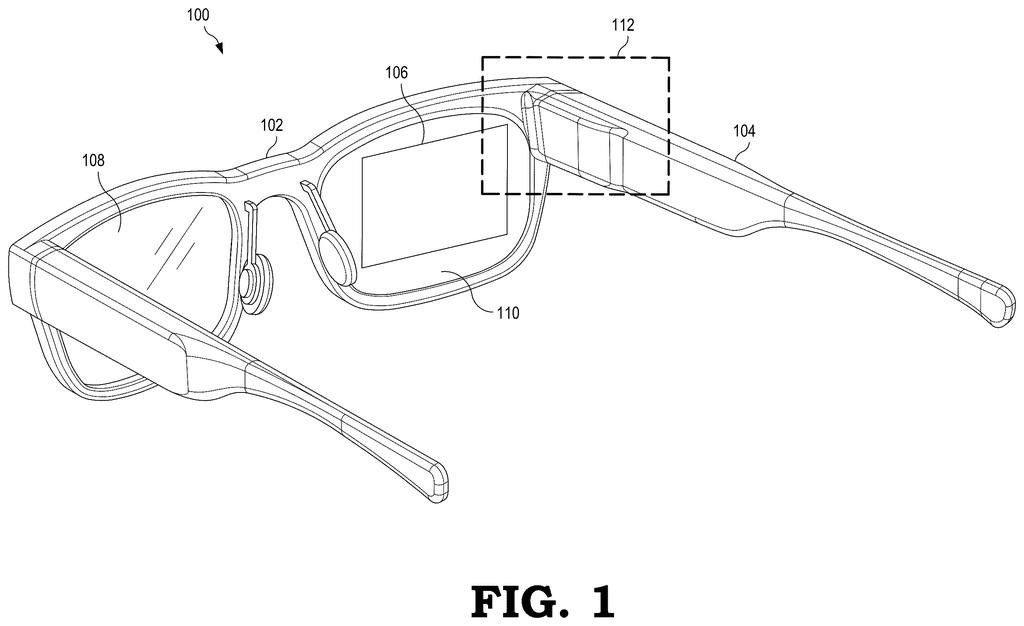
What Google's switchable-mirror glasses do
A pair of smart glasses floats a walking-direction arrow in front of you. The arrow looks fine near the middle of the lens, but the picture only covers a small patch of what you see, like looking through a small window.
Making that window bigger usually means a bigger projector, and a bigger projector means heavier, more power-hungry glasses. Google's patent takes another route. Tiny mirrors built into the lens can switch between bouncing light and letting it pass through, so one small projector can paint different parts of your view.
The glasses can also track where your eyes are pointing and light up only that part of the view. That saves power, because the projector never has to fill the whole area at once.
… an electrochromic facet configured to direct the display light such that the display light propagates through the lightguide along a path of a plurality of paths based on a state of the electrochromic facet.
Translation: A smart glass surface shifts how light travels to change where images appear.
How the lens mirrors flip between two jobs
The projector (called the optical engine) sends light carrying the image into a lightguide, a clear slab inside the lens that carries light along by bouncing it between its surfaces until it exits toward your eye. Where the light travels inside the slab decides which part of your view it lights up.
The patent adds electrochromic facets to that slab. A facet is a small angled mirror surface. Electrochromic means the material changes how it treats light when electricity is applied. With one electrical current the facet reflects light. With a different current it lets light pass through to a fixed mirror behind it, set at a different angle.
- Reflective state: the light bounces off the first facet and follows a first path, lighting a first portion of the view.
- Transmissive state: the light passes through and hits the next mirror, which sends it along a second path to a different portion.
- Chained facets: with two switchable facets plus a fixed mirror, the claims describe a third path as well.
A piece of control circuitry sets each facet's state, and the claims say it can do so based on where you are looking. The filing also describes stacked lightguides and a split exit pupil expander (a stage that spreads the light out), plus view portions that overlap up and down or sit side by side. It says an LCD layer can stand in for the electrochromic one.
By increasing the number of paths at which the display light propagates through the lightguide, the FOV area is increased.
Translation: Using multiple routes for the light makes the virtual screen much larger.
Why a bigger view without bigger glasses counts
If you have tried a pair of display glasses, you know the tradeoff: a bigger picture usually means thicker arms, a heavier frame and a shorter battery life. The filing itself names those costs. It says adding more projector angles, or adding a scanning mirror, makes the glasses larger. Putting the switching mirrors inside the lens aims to widen the view without growing the frame.
The gaze-tracking angle matters too. Lighting only the part of the view you are looking at means less power spent on images your eyes are not using, which could mean longer battery life. The patent gives no numbers on how much wider the view gets or how much power it saves, so those benefits stay claims on paper for now.
Google's 46th filing we've tracked since May adds to work like two separate images and wrong-order depth fixes in our smart glasses display watchlist.
If this works, you would notice it as a display that no longer feels like a postage stamp, in glasses that still look like glasses. That is what people want from this category, and the filing aims at it directly.
You would also notice it in battery life. Lighting only the part of the view you are looking at is a sensible way to stretch a small battery in a frame that has almost no room for one.
The open question is what your eyes would see when the mirrors switch. The filing says nothing about flicker, visible seams between portions, or how fast the switch happens, and any of those could spoil the experience. Until there are real numbers, treat it as a promising idea on paper.
Get our take in your Top Stories
Liked this breakdown? Add Patentlyze as a preferred source on Google, and our plain-English take shows up more often in your Top Stories the next time Google patent news breaks.
There are more where this came from
We read every patent application Big Tech publishes and send you the ones worth knowing. Plain English, free, every week.
The drawings
8 drawing sheets from US 2026/0309999 A1 · click any drawing to enlarge


Want this weekly breakdown for a company we don't cover? Patentlyze Pro →
Be the first to weigh in