
Google Patents a System That Makes AI Models Grade Their Own Answers
What if the AI you're talking to had a second AI looking over its shoulder, circling every mistake before you ever see the reply? That's the core idea in Google's latest patent filing.
How Google teaches AI to catch its own mistakes
Ever asked a chatbot to do something with very specific rules, like "write this in exactly three bullet points, keep it under 100 words, and don't mention prices," only to get back something that ignored half of them? That gap between what you asked for and what you got is the problem this patent is trying to fix.
Google's approach is to bring in a second AI to act as a reviewer. After the first AI drafts a response, the second one reads both your original instructions and the draft, then writes a detailed critique pointing to exactly which parts of the answer broke which rules. That critique, along with the original question and draft, gets saved as a training example.
Over time, those saved examples are used to make the AI better at following complex instructions in the first place. It's a feedback loop: the grader teaches the writer, and the writer gets tighter with every round.
… generating, using a second LLM that differs from the first LLM, a critique response for the candidate response, the critique response including a reference to one or more specific portions of the candidate response to indicate compliance or violation with respect to at least one instructional constraint from the set of instructional constraints …
Translation: One AI reviews another AI's answer to check if it followed all the rules given in the prompt.
How one AI model critiques another's response
The system has two main jobs: real-time response improvement and long-term model training.
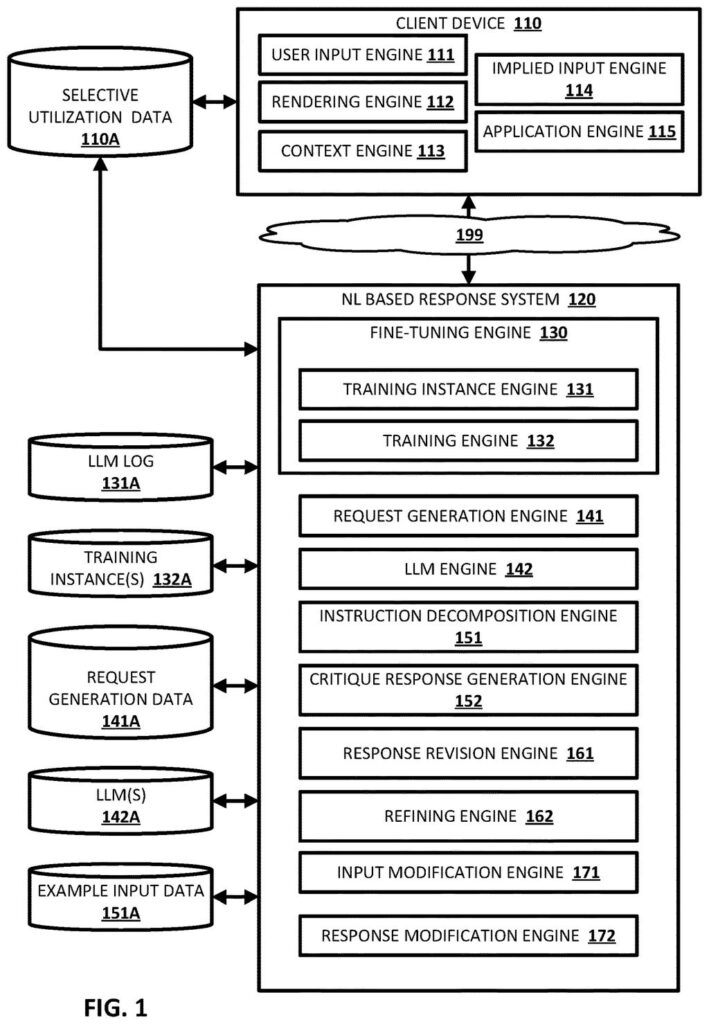
On the real-time side, when a user sends a request, the system breaks the instructions in that request into individual constraints (think of each rule or condition as a separate checklist item). A first large language model (LLM) generates a draft answer. A second, separate LLM then writes a critique response, a structured review that points to specific lines in the draft and flags whether each rule was followed or violated. The system can then use that critique to refine the draft, running the loop until the response passes all the checks or hits a stopping point.
On the training side, every (question, draft, critique) set gets stored as a training instance. These instances are used for fine-tuning (adjusting the model's behavior by showing it examples of what good and bad outputs look like), which gradually makes the model better at following multi-part instructions without needing a reviewer every single time.
The two-LLM design matters here: using a different model to critique than the one that generated the answer avoids a blind spot where the same model would likely approve its own errors.
… generate a plurality of candidate responses and evaluate the candidate responses based on instructions included in the NL based input, using an LLM, and progressively refine the candidate responses until it is determined that one or more termination criteria are satisfied.
Translation: The system keeps tweaking and improving the AI's answer over and over until it is good enough.
What self-grading AI means for chatbot reliability
For everyday users, this is about whether a chatbot actually does what you tell it to do. Precise instruction-following is one of the most consistent complaints about AI assistants, especially in professional workflows where the details matter (legal, medical, editorial). A system that actively grades itself against your specific rules before delivering an answer is a real improvement over one that just tries once and hopes.
For Google has been filing around LLM self-improvement and training data generation, this patent fits a pattern of trying to make models better without requiring humans to label every training example by hand. The critique-and-store loop is designed to generate its own supervision signal, which could scale in a way that human review cannot.
Google's 22nd filing we've tracked since May in our AI teams working together watchlist builds on earlier applications like one on picking the right tool and one on routing AI tasks.
Running two large AI models for every response instead of one means double the computing costs, double the wait time, and double the electricity bill. That is a real price to pay for better instruction-following, and whether it is worth it depends entirely on whether the second model is actually a reliable judge.
That is the weak point in this design. If the reviewing model has its own blind spots or consistently misreads certain kinds of requests, those errors get baked into the training of the writing model, amplified rather than caught.
The saving grace is that Google appears to use the reviewer mainly during training, not for every live response forever. If the lessons from the critic can be absorbed once and then retired, the long-term cost drops considerably, and the trade starts to look reasonable.
There are more where this came from
We read every patent application Big Tech publishes and send you the ones worth knowing. Plain English, free, every week.
The drawings
15 drawing sheets from US 2026/0289108 A1 · click any drawing to enlarge


Want this weekly breakdown for a company we don't cover? Patentlyze Pro →
Be the first to weigh in