
Google Patents an AI System That Activates Only the Specialists Each Task Requires
Most AI models run every part of their brain on every problem. Google's new patent describes a system that figures out which specialists to call, then ignores the rest.
How Google's expert-routing AI saves compute
Imagine a law firm where every lawyer shows up to every client meeting, even when only one of them knows anything useful. That's roughly how many AI models work today: every part of the network processes every piece of data, whether or not that part is relevant.
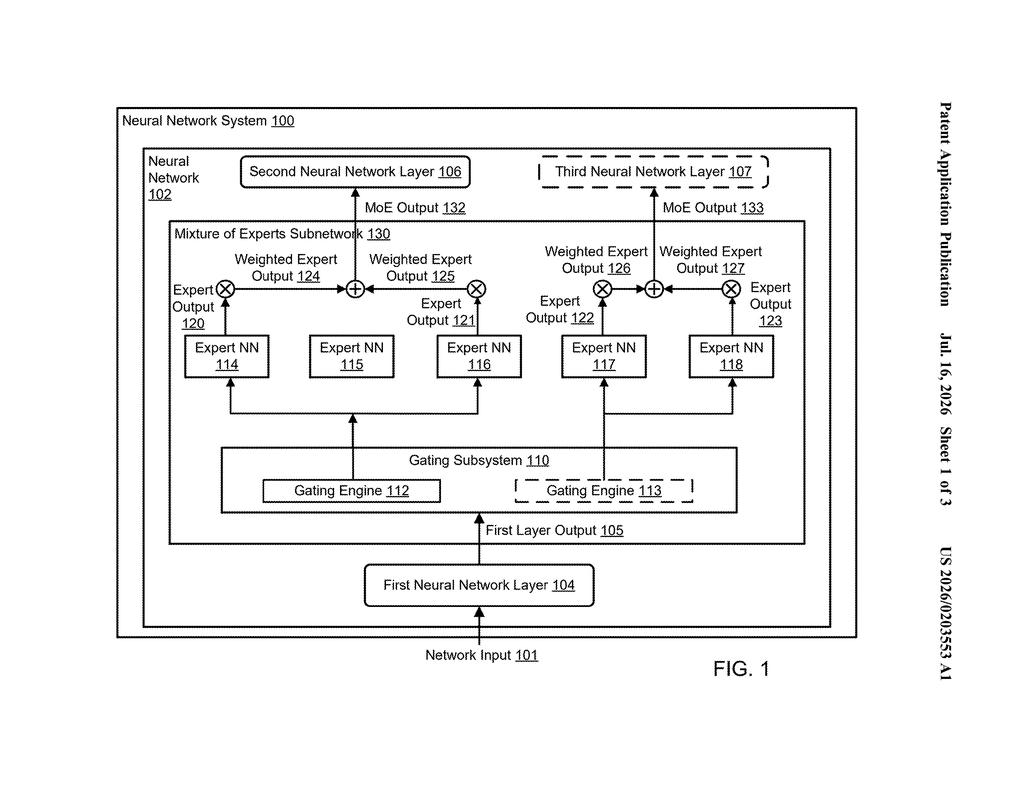
Google's patent describes a different setup. Instead of one big brain, the system has a panel of specialist sub-networks (called experts). A separate "gating" component looks at each incoming task, scores how useful each expert would be, then picks only a small group to actually do the work.
The result is an AI that can be very large in theory (many experts, lots of specialized knowledge) but only uses a fraction of its capacity on any given request. That means less computation per task, which translates to lower cost and faster responses.
How the gating system scores and selects expert sub-networks
The patent describes a Mixture of Experts (MoE) architecture, a design where a neural network is built from many smaller specialist networks running in parallel.
The key component is the gating subsystem, which acts as a traffic controller. Here's how it works step by step:
- It applies a softmax function (a mathematical formula that converts raw scores into a ranked probability distribution, so you can compare them fairly) to a set of learned gating parameters. Each expert gets a score.
- It converts those scores into weights, essentially a ranking of how useful each expert should be for this input.
- It selects only a proper subset of the experts (meaning fewer than all of them) based on those weights.
- It combines the outputs from just that chosen subset, weighted by their scores, to produce the final result.
The word "differentiable" in the title is key: the whole system, including the gating choices, can be trained end-to-end using standard gradient descent (the process by which neural networks learn from feedback). That means the model learns which experts to trust as part of its training, not through a separate hand-tuned process.
What sparse expert routing means for Google's AI costs
The cost of running large AI models is a real constraint for every company in this space. MoE architectures are one of the main tools used to build bigger, more capable models without proportionally increasing the compute bill per request. Google's own Gemini model family is widely believed to use MoE-style routing internally.
This patent stakes out specific claims around how the gating and selection process is structured and trained. For you as a user, the practical implication is AI that can be more capable across a wider range of tasks while still responding quickly. For Google, it's about keeping inference costs manageable as models grow larger.
MoE is not a new idea in AI research, but Google patenting a specific differentiable and sparse implementation signals it wants legal footing around a technique that is increasingly central to frontier model design. This is infrastructure-level IP, not a consumer feature, but it sits at the heart of how the next generation of large AI models will be built and deployed.
Get our take in your Top Stories
Liked this breakdown? Add Patentlyze as a preferred source on Google, and our plain-English take shows up more often in your Top Stories the next time Google patent news breaks.
There are more where this came from
We read every patent application Big Tech publishes and send you the ones worth knowing. Plain English, free, every week.
Want this weekly breakdown for a company we don't cover? Patentlyze Pro →