
Salesforce Patents a System That Coaches AI Into Giving More Accurate Answers
Improving an AI model usually means expensive retraining. Salesforce's new patent skips that entirely, letting a second AI rewrite the instructions until the first one gets things right.
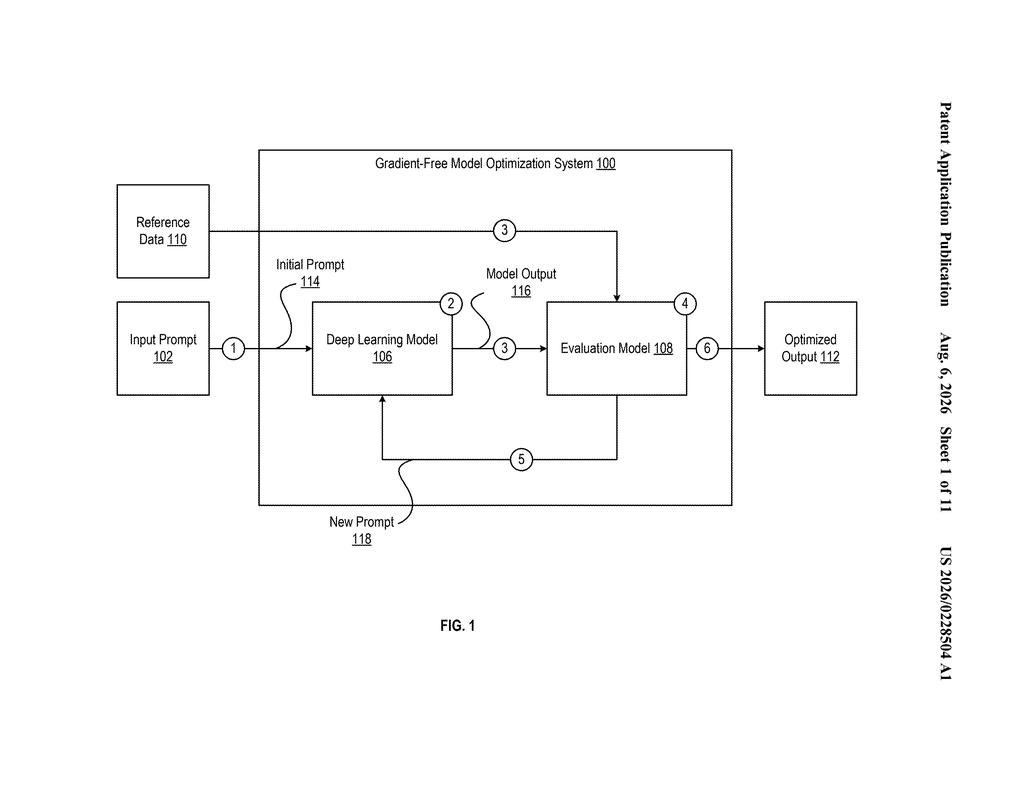
How Salesforce's self-improving prompt loop works
Imagine you hire someone new and instead of sending them to months of additional training every time they make a mistake, you just give them clearer instructions until they get the job done. That's roughly what this Salesforce patent is doing with AI.
Most AI improvement today involves retraining, a process that requires enormous computing power and time. This patent describes a system where a second AI watches the first one work, judges how well it did against some benchmark, and then rewrites the task instructions to nudge it toward a better answer. The loop repeats until the output is good enough.
You end up with a model that improves at a specific task without anyone touching its underlying code or weights. It's less like teaching the AI new skills and more like coaching it through better directions.
obtaining, by a deep learning model, a text prompt describing a task to be performed by the deep learning model; generating an output by the deep learning model based at least on the text prompt; processing the output by an evaluation model to generate a model evaluation …
Translation: The system feeds a prompt to an AI, gets an answer, and has a second AI judge how well it did.
Inside the evaluation-and-rewrite feedback cycle
The system works in a closed feedback loop involving two AI models working together:
- The worker model is a standard large language model (LLM) that receives a text prompt describing a task and produces an output.
- The evaluation model reviews that output against reference data or predefined criteria, essentially grading the response and generating reasoning about what went wrong or could be improved.
- The prompt generator (which can be part of the evaluation model) uses that reasoning to write a new, revised prompt for the worker model.
This loop runs repeatedly until a stopping condition is met, such as the output hitting a quality threshold or a maximum number of iterations being reached.
The key term in the patent is gradient-free optimization. Normally, improving a neural network means computing gradients (mathematical signals that tell you which internal settings to adjust and by how much). That process is computationally heavy and requires access to the model's internals. This approach skips all of that and works purely through language, adjusting the prompt rather than the model's weights. The worker model is treated as a black box that only needs to read and respond.
An initial prompt is obtained and used to generate an initial output by the model to be optimized. This output is evaluated by an evaluation model along with reference data, evaluation criteria, etc. The evaluation model's reasoning can be used to generate a new prompt …
Translation: The AI reviews its own first attempt against a rulebook and rewrites its instructions to try again.
What this means for businesses running AI on a budget
For companies deploying AI in business settings, the cost and complexity of retraining large models is a real barrier. This approach lets you improve an AI's performance on a specific task, say, drafting sales emails or summarizing support tickets, without spinning up a full training run or needing access to model internals. That matters especially when you're using a third-party model you don't control.
It also fits neatly into Salesforce's broader pitch to enterprise customers: that you can get better AI results through smarter orchestration rather than raw compute spending. Whether this specific patent becomes a shipping product feature or stays as background IP, it signals that Salesforce is actively investing in the layer above the model, where its CRM and platform business already lives.
This is a real engineering idea with practical value, especially for enterprises that can't afford to fine-tune their own models. The technique isn't new as a concept (prompt optimization research has been active for a few years), but Salesforce filing it as IP suggests they see it as a defensible piece of their AI platform strategy, not just an academic curiosity.
There are more where this came from
We read every patent application Big Tech publishes and send you the ones worth knowing. Plain English, free, every week.
The drawings
11 drawing sheets from US 2026/0228504 A1 · click any drawing to enlarge


Want this weekly breakdown for a company we don't cover? Patentlyze Pro →
Be the first to weigh in