
Google Patents a Block-by-Block Motion Prediction Method for Video Compression
When you stream a video, your device doesn't download every pixel of every frame, it predicts where moving objects will be. Google's new patent makes those predictions sharper by breaking each image block into smaller pieces and adjusting the motion estimate for each one individually.
What Google's motion prediction patent actually does
Imagine watching a soccer player sprint across your screen. Your phone or TV isn't actually receiving all that motion raw, the video codec is making educated guesses about where the player moved from one frame to the next, and only sending the difference. The more accurate those guesses, the less data needs to travel over the network.
Right now, many codecs treat a chunk of the screen as one unit when making those guesses. Google's patent describes a method that splits each chunk into smaller pieces, then fine-tunes the motion estimate for each piece separately. A starting "base" estimate covers the whole block, and then a small directional tweak is applied per sub-piece to sharpen it.
The result is a more accurate prediction of where moving content lands in each frame. More accurate predictions mean fewer errors to correct, and fewer errors mean smaller file sizes or better picture quality at the same data rate, exactly the kind of incremental gain that matters at YouTube's scale.
identifying a motion shift that includes a direction and a distance; applying the motion shift to the base motion vector to obtain a refined motion vector; and decoding the each sub-block using the refined motion vector.
Translation: It calculates a shift in direction and distance to update the motion vector for each smaller piece.
How the subblock refinement process works
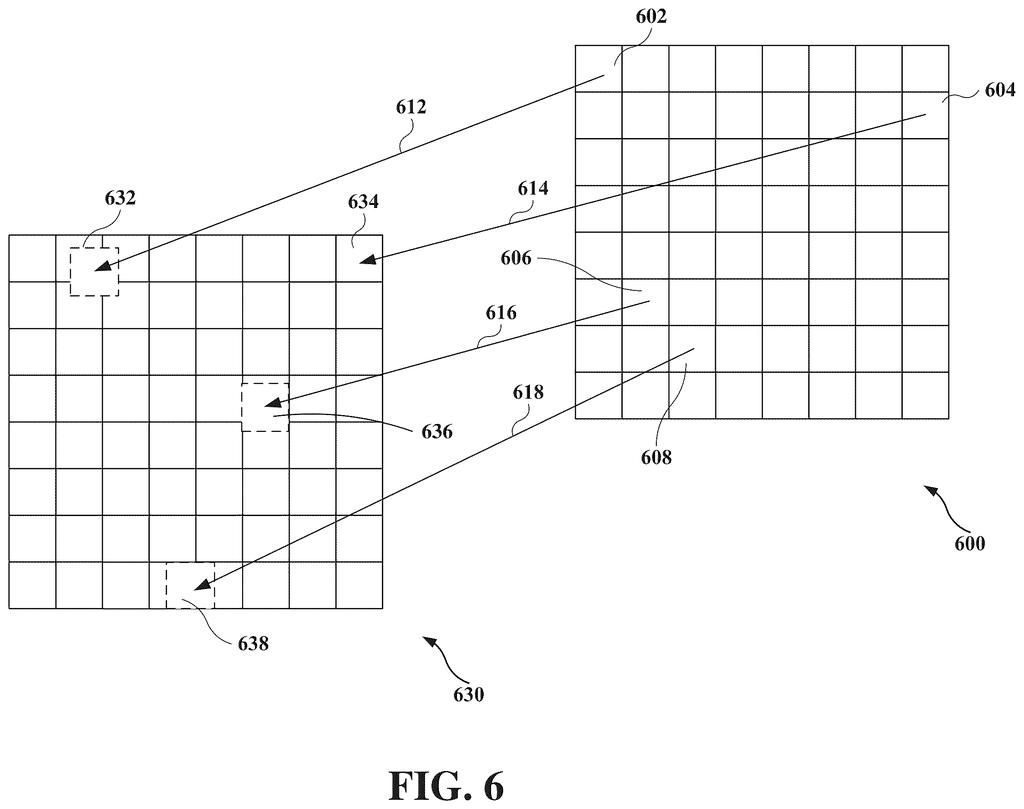
The patent describes an enhancement to a technique called subblock-based temporal motion vector prediction (SbTMVP), a method where a video decoder figures out how objects moved between frames by looking at motion data from previously decoded frames.
Standard SbTMVP picks one motion vector (think: an arrow showing where a chunk of the image came from in the prior frame) and applies it uniformly across a block. Google's approach adds a layer on top:
- A base motion vector is selected for the whole block, as usual.
- The block is partitioned into sub-blocks, smaller regions within it.
- For each sub-block, a motion shift (a small directional offset, expressed as a direction and a distance) is identified and added to the base vector.
- That refined, per-sub-block vector is then used to actually decode that piece of the frame.
The motion shift values come from the bitstream itself, they are signaled as a motion vector difference (MVD), a compact numerical delta rather than a full new vector. This keeps the overhead small while still allowing each sub-region to track motion independently. The approach is described as a merge mode, meaning it builds on existing codec merge-candidate frameworks rather than replacing them wholesale.
A merge mode for video coding is described that has motion vector difference based subblock-based temporal motion vector prediction.
Translation: The system uses past video frames to predict how small blocks of pixels will move.
What this means for Google's video codec strategy
Google controls the AV1 and AV2 open video codec standards through its involvement in the Alliance for Open Media, and YouTube is the world's largest video platform. Any compression improvement that reduces bitrate without hurting quality translates directly into bandwidth savings at enormous scale, and into better streaming quality on slow connections. This kind of per-subblock motion refinement is exactly the type of tool that shows up in next-generation codec proposals.
For you as a viewer, the benefit would be invisible in the best way possible: the same video looking sharper at a lower data cap, or buffering less on a congested network. It's an unglamorous corner of video engineering, but the cumulative effect of many such patents is why modern streaming looks so good compared to a decade ago.
This is deeply routine codec engineering, the kind of incremental motion-prediction refinement that video compression researchers publish and patent constantly. It's not unimportant: small gains in prediction accuracy compound into real savings at YouTube's traffic volumes. But unless you follow codec standardization work closely, there's nothing here that signals a surprise product or a strategic shift.
There are more where this came from
We read every patent application Big Tech publishes and send you the ones worth knowing. Plain English, free, every week.
The drawings
12 drawing sheets from US 2026/0230626 A1 · click any drawing to enlarge


Want this weekly breakdown for a company we don't cover? Patentlyze Pro →
Be the first to weigh in