
Google Patents Temperature-Corrected Skin Autofluorescence for Wearables
Your skin naturally glows when hit with the right wavelength of light — and that glow can reveal a surprising amount about your health. The catch: skin temperature messes with the signal, so Google is patenting a way to subtract that noise out.
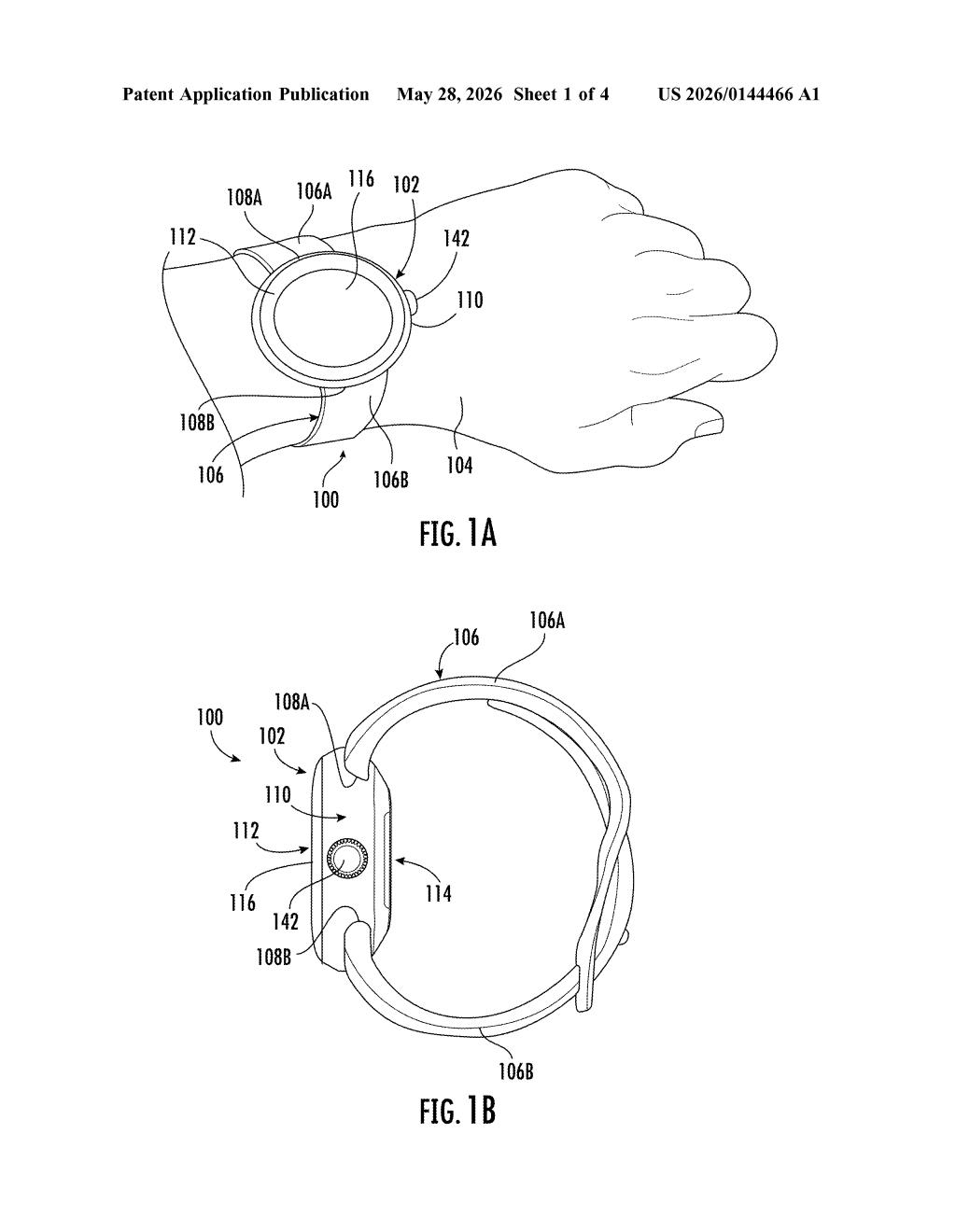
What Google's skin autofluorescence correction actually does
Imagine shining a specific color of light on your wrist and measuring how your skin glows back. That faint glow — called skin autofluorescence — is actually a useful health signal. It can reflect things like how well your body handles blood sugar or how much oxidative stress you're under. But here's the problem: the warmer your skin gets, the more that glow changes, even if your underlying health hasn't shifted at all.
Google's patent describes a wearable device — think a smartwatch — that tracks both your skin temperature and your autofluorescence reading at the same time. Over time, the device figures out exactly how much your temperature is distorting the glow signal, then subtracts that distortion out to give you a cleaner, more accurate health reading.
The end result is that health metrics displayed on your wrist are based on corrected data, not raw readings that swing wildly just because you went for a run or stepped outside on a hot day.
How the device correlates temperature and SAF signal over time
The device pairs two sensors: a skin autofluorescence (SAF) sensor — which fires light emitters at the skin and reads the resulting fluorescent emission with photodetectors — and a temperature sensor that continuously measures skin surface temperature.
The key insight is that SAF signal intensity is thermally dependent: the same biological tissue will fluoresce differently depending on how warm it is. Rather than using a static lookup table to compensate, Google's approach tracks the correlation between temperature and SAF signal over time for that specific user. This per-user, longitudinal correlation is used to derive a temperature correction factor that's applied to the raw SAF data before any health parameter is computed.
The corrected SAF data then feeds into determining health parameters — the patent doesn't enumerate exactly which ones, but SAF is clinically associated with markers like advanced glycation end-products (AGEs) (compounds that accumulate with metabolic stress and are linked to diabetes risk) and oxidative stress.
Finally, the corrected health parameter is surfaced to the user via an on-device display. The system also includes motion sensors and wireless connectivity, suggesting the device architecture maps closely to an existing smartwatch form factor.
What this means for health tracking on future Google wearables
SAF-based health sensing has real clinical backing — non-invasive SAF measurement is already used in research settings to assess cardiovascular and metabolic health risk. The challenge bringing it to consumer wearables has always been signal reliability: skin temperature varies constantly with activity, environment, and blood flow, and those variations contaminate the reading. If Google can solve the temperature-correction problem at the wrist, it opens the door to tracking metabolic health markers continuously without any blood draw.
For Pixel Watch users and the broader Fitbit platform Google absorbed, this could mean a future generation of devices that go beyond heart rate and SpO2 into genuinely novel territory. The approach of computing a personalized correction factor — rather than a universal one — is also a smart hedge against inter-user biological variability, which has historically made optical health sensors frustrating to calibrate.
This is a legitimately interesting patent because it addresses a real, well-documented limitation of optical biosensing rather than just adding another sensor and hoping for the best. The personalized, time-series correlation approach is more sophisticated than static calibration, and SAF is one of the few non-invasive windows into metabolic health that has serious peer-reviewed backing. Whether Google ships this before Apple does something similar is the more interesting question.
There are more where this came from
We read every patent application Big Tech publishes and send you the ones worth knowing. Plain English, free, every week.
Want this weekly breakdown for a company we don't cover? Patentlyze Pro →