
Google
Google · AI / ML · Filed Jul 6, 2026 · USPTO published Nov 12, 2026 · This week's release
Google Files Patent to Train Giant AI Chatbots on Phones Using Your Corrections
Every time you tell a chatbot 'that's wrong,' you hand its maker a free lesson. This Google patent describes a way to collect those lessons from phones without uploading the conversations themselves.
- Publication number
- US 2026/0360353 A1(US20260360353A1)
- Applicant
- GOOGLE LLC
- Filed · Published
- Jul 6, 2026 · Nov 12, 2026
- Inventors
- Yonghui Xiao, Françoise Beaufays, Yuxin Ding
- Status when we published
- Waiting for an examiner
- Document
- 19 claims
- US classification
- 704/244
- Parent application
- Continuation of 18/794,773 (filed Aug 5, 2024)(18794773)
What Google's phone-trained chatbot patent does
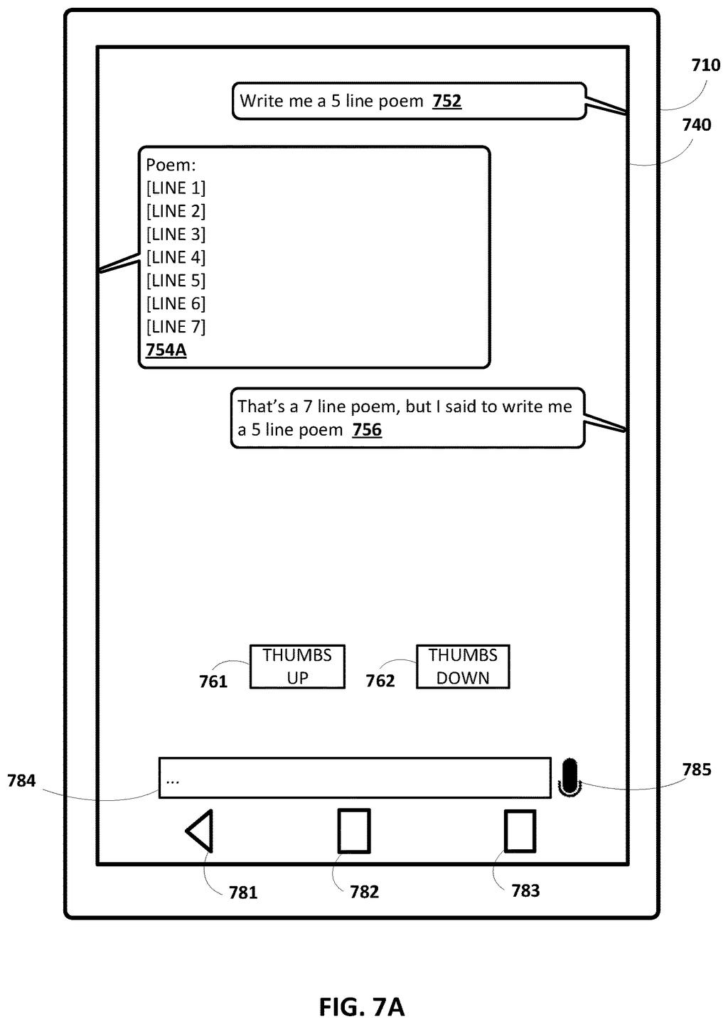
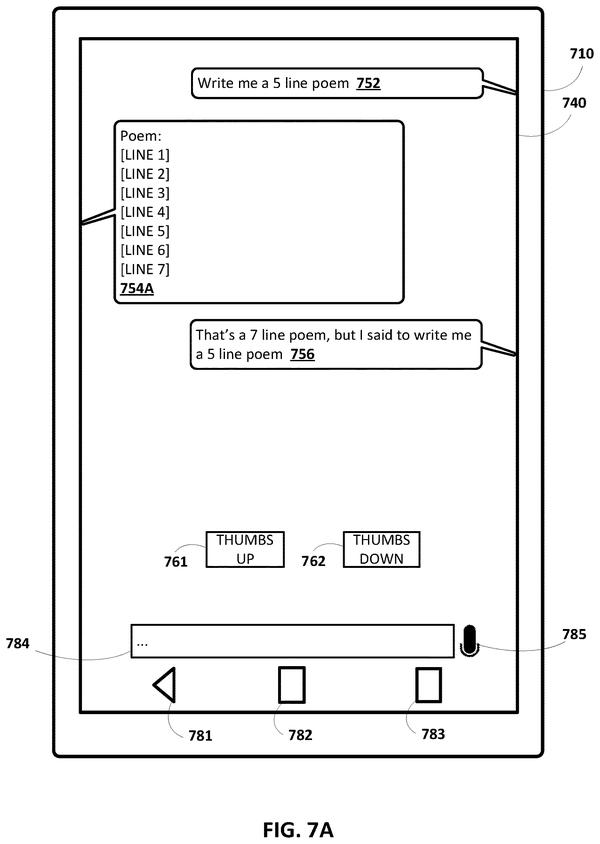
A chatbot on a phone is asked for a five-line poem and hands back seven. The owner types, 'That's a seven line poem, but I asked for five.' That small correction is a useful lesson for the AI's maker, but it only exists on the phone.
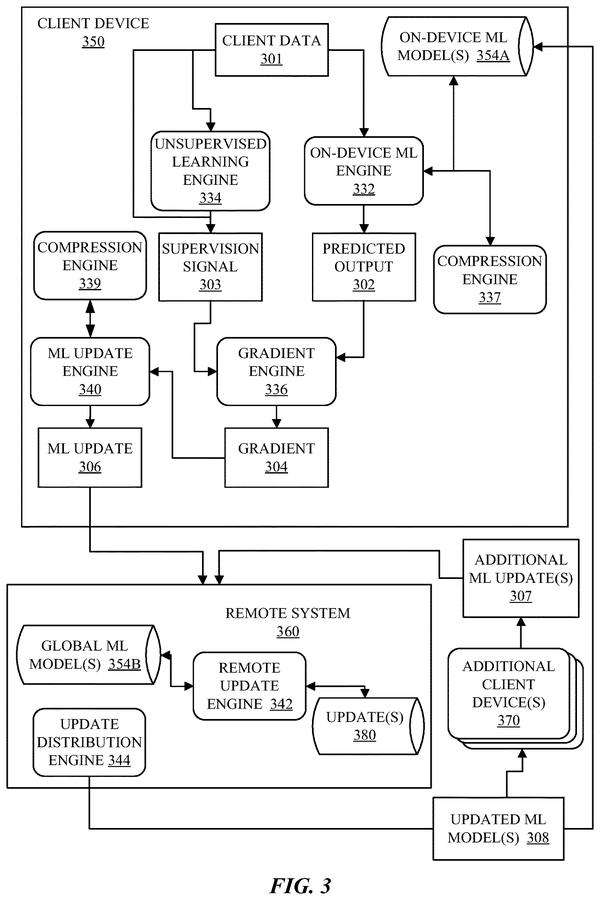
Google's patent describes a way to learn from corrections like that without collecting your chats. Giant AI models are too big and too slow to train on a phone, which may get only a gigabyte or a few of memory and about 10 minutes per round. So Google first shrinks the model, then sends it to phones that have recorded corrections. Each phone tweaks only part of it.
Only the resulting update goes back to Google, not your messages. Google then blends the updates from many phones into the full-size model.
… generating a processed version of the global LLM, wherein the processed version of the global LLM comprises a quantized version of the global LLM, and wherein the processed version of the global LLM is of a reduced transferrable size compared to the global LLM; …
Translation: Shrinking the massive AI model so it can be easily sent to your phone.
How Google shrinks a chatbot to fit your phone
The patent describes a loop with a server on one side and many phones on the other. The server holds the full-size language model (the technology behind chatbots). It first makes a smaller copy by quantizing it, which means storing the model's numbers with less precision, such as turning 32-bit values into 16-bit or 8-bit ones (the claims name float16 or int8).
Each selected phone then runs partial training:
- It restores the squeezed numbers to full precision (dequantizing) before training starts.
- It freezes some layers of the model (layers are stacked stages of processing), such as encoder or decoder layers, so only the rest changes.
- It learns from locally stored natural language input, then sends back only an update.
Phones are chosen in part by asking whether their owners have corrected the on-device model. A phone also filters out data that is not a true correction, such as a user just testing the chatbot. Different phones can freeze different layers.
The server combines the updates using weighted client aggregation, which gives extra weight to rare mistakes so common ones do not drown them out. After a set number of rounds, the updated model is deployed.
Why your chatbot corrections could matter to Google
If it works, the chatbot or voice assistant on your phone could get better at the things you actually complain about, like ignoring a length instruction, without your conversations being uploaded. The filing says the approach reaches feedback that would not otherwise be available, which could improve the model before it ships.
The same method also covers speech recognition. The filing's example is a phone mishearing 'covid' as 'covet' until you fix it. For Google, the appeal is practical: the biggest models are normally too large for this kind of phone-based training, so shrinking them opens a path to private feedback. It is a patent application, so nothing here says a product is coming.
Google's 68th filing we've tracked since May in our on-device AI privacy work follows ideas like the search phrase swap and the people-counting camera, all keeping data off outside servers.
Source: US 2026/0360353 A1 at the USPTO (PDF). Full patent text and figures are in the official publication.
Get our take in your Top Stories
Liked this breakdown? Add Patentlyze as a preferred source on Google, and our plain-English take shows up more often in your Top Stories the next time Google patent news breaks.
Add Patentlyze on Google
One click.
There are more where this came from
We read every patent application Big Tech publishes and send you the ones worth knowing. Plain English, free, every week.
The drawings · 9 sheets
9 drawing sheets from US 2026/0360353 A1 · click any drawing to enlarge


Show the other 1 sheets

More from Google
All 1,079 Google patents →
More in AI assistant & agent
All 413 AI assistant & agent patents →
OpenAI
OpenAI Files Patent for AI Training That Fits Inside a Phone's Limited Memory
Samsung
Samsung Patents a Method to Shrink AI Models While Keeping Them Accurate
Qualcomm
Qualcomm Files Patent for Glasses That Remember What You Saw Today
Microsoft
No comments yet