
Google Files Patent for Swapping Your Search for a Stand-In Phrase Advertisers See
When you search for something, outside companies often want to know what you were after. This Google patent application hands them a short, tidy stand-in phrase instead of your exact words.
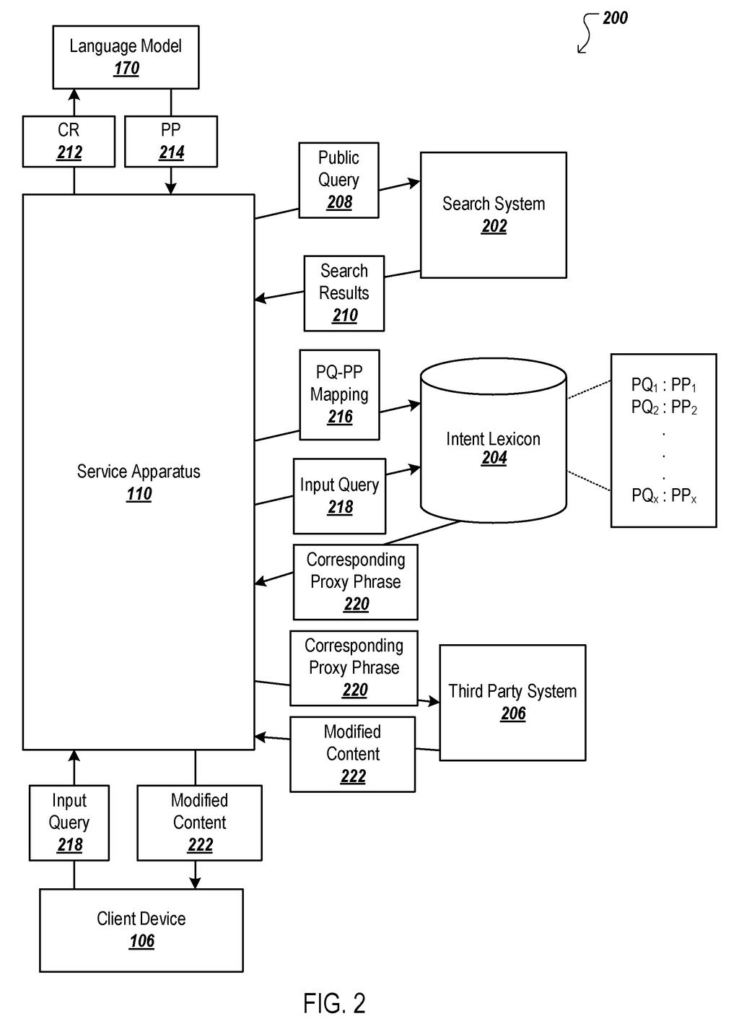
What Google's stand-in search phrases actually do
You type "boston celtics men's shirt reviews" into Google, and a shirt seller wants to know what shoppers like you are looking for. Google would rather not pass along your exact words, because search phrases can be oddly personal. So this patent describes a middle step.
Ahead of time, Google takes popular searches (ones many different people in many different places have typed) and has an AI model rewrite each into a short stand-in phrase. Your shirt search becomes "Men's Boston Celtics Shirt." Google keeps all of these pairs in a big lookup list.
When you search, Google finds the match in that list and sends the outside company the stand-in instead of your words. Because it is a lookup, it is fast. And a rare search worded in an unusual way can still map to a common stand-in instead of getting dumped into an "other" pile.
… converting, by the one or more computing devices and using a language model, the public query to a proxy phrase based on the public query, the search results, a language, and a rewrite prompt that are input to the language model; …
Translation: Google uses artificial intelligence to translate your search terms into a generic stand in phrase.
How Google builds its lookup list of stand-ins
The system works in two stages: a slow, careful stage done ahead of time, and a fast lookup done when you search.
The ahead-of-time stage goes like this:
- Pick safe queries. A search counts as a "public query" only if enough different people typed it from enough different places (the filing gives examples of 50 or 200 users across 10 or 20 regions) and it passes privacy filters, such as screening out home addresses or financial account details.
- Gather context. Google pulls the search results for that query.
- Rewrite it. A language model (the technology behind AI chatbots) receives the query, the results, the language, and a rewrite prompt (written instructions) telling it to keep the core topic, drop the extras, and add nothing new. The results help it guess intent: "jaguar pace range information" becomes "Jaguar Pace Automobile" because the results are about the car.
- Store the pair in an intent lexicon (a lookup table), refreshed on a schedule such as daily.
When your search arrives, Google first looks for an exact match. If there is none, it scores near matches using phrase matching (do the same words show up) and inverse document frequency, or IDF (a score that gives more weight to rare, informative words), then picks the best one. The stand-in goes to the outside company, which can use it to adjust a link or a landing page.
A corresponding proxy phrase that is mapped to the given public query is selected as a representation of the input query. The corresponding proxy phrase is transmitted to a third-party system as a representation of the input query.
Translation: Advertisers get the safe decoy phrase instead of what you actually typed into the search bar.
What this means for your searches and advertisers
For you, the practical change is about which words leave Google's hands. Advertisers and other outside companies would see a cleaned-up stand-in such as "Men's Boston Celtics Shirt," and the odd details of your own wording would stay behind. Because the rewriting is done in advance, the system can answer in the split second Google has before a page loads.
For advertisers, the filing says the aim is better reports. Rare searches that used to be lumped into an "other" bucket could be counted under a common stand-in. The patent office has approved this application, and once Google pays the final fee it should be issued as a granted patent.
Google's 67th filing we've tracked since May in our on-device AI privacy push watchlist follows earlier applications like a camera that counts people and noise-canceling earbuds for voice assistants.
You would never see this feature working. A search goes in, ads and landing pages come back, and the only difference is which words about your search travel to the advertiser's side.
That difference helps you in a small, specific way. Odd details, like a street name typed into the search box or a phrasing nobody else uses, stay with Google, because the outside company only receives the tidy stand-in. The topic still travels, so an advertiser still learns you were shopping for a Celtics shirt.
The bigger winner is the advertiser, who gets a clearer picture of what people want instead of one giant "other" bucket. For you, the likely payoff is a modest privacy gain and perhaps a landing page that fits your search a little better.
Get our take in your Top Stories
Liked this breakdown? Add Patentlyze as a preferred source on Google, and our plain-English take shows up more often in your Top Stories the next time Google patent news breaks.
There are more where this came from
We read every patent application Big Tech publishes and send you the ones worth knowing. Plain English, free, every week.
The drawings
4 drawing sheets from US 2026/0350102 A1 · click any drawing to enlarge


Want this weekly breakdown for a company we don't cover? Patentlyze Pro →
Be the first to weigh in