
Google Patents an Assistant That Knows You're Talking to It Without a Wake Word
What if your Google Assistant could tell you were talking to it just by watching your face and listening to how you speak — no trigger phrase required? That's exactly what this patent describes.
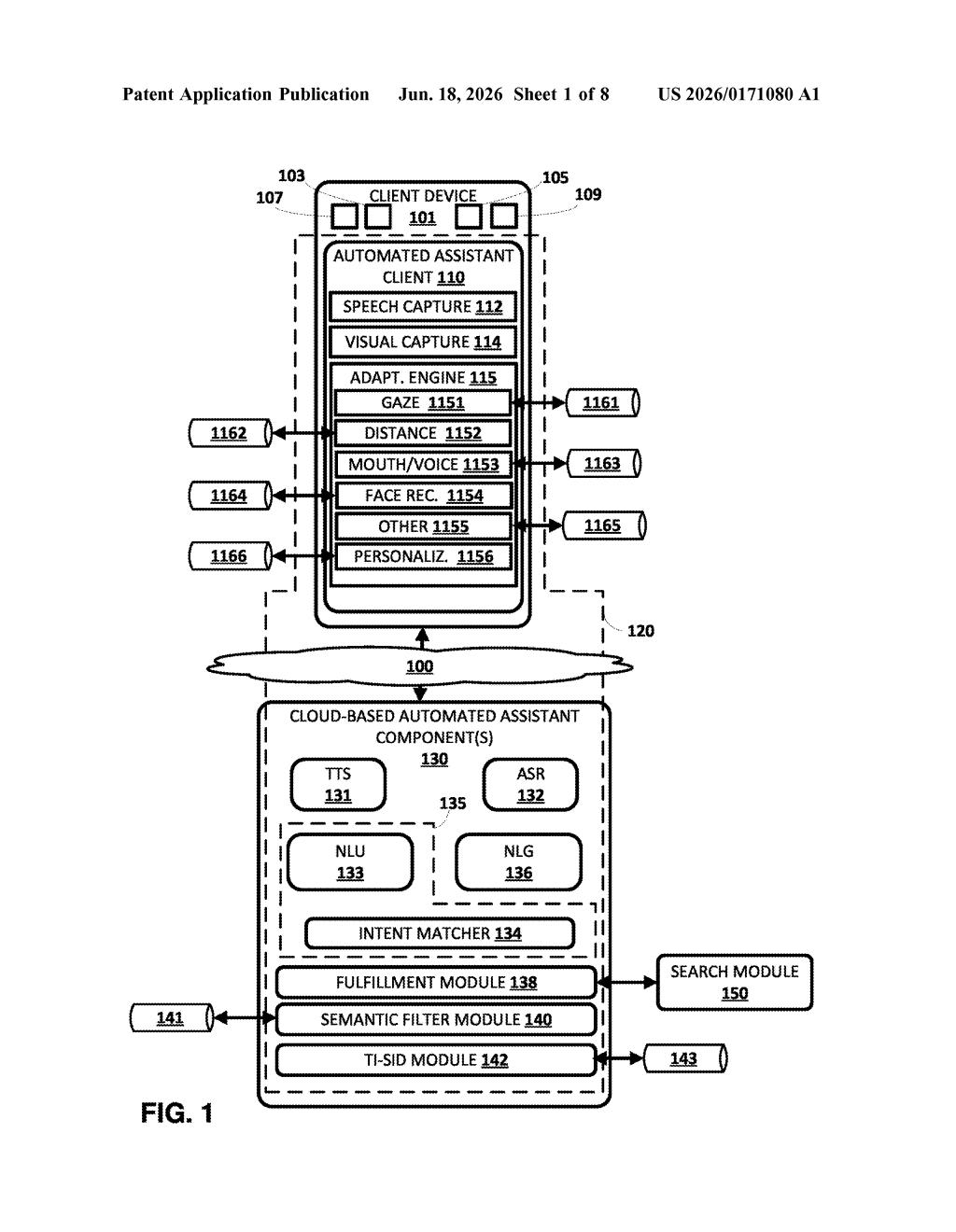
What Google's wake-word-free assistant actually does
Right now, you have to say "Hey Google" or "OK Google" to get your assistant's attention. It's a blunt tool: it either mishears a random word as a wake phrase (false alarm) or it misses you when you genuinely want it (missed cue).
Google's new approach is much more personal. Your device watches your face with its camera and listens to how you typically talk when you're directing speech at the assistant. Over time, it builds a profile just for you — your habits, your lip movements, your vocal patterns — and stores it against your account.
The next time you walk up and start talking without saying a trigger word, the assistant checks your face to identify you, pulls up your personal profile, and uses it to judge whether you're actually addressing it. If the signals line up, it responds — no magic phrase needed. Different people in the same household can each have their own profile, making the system less likely to annoy you with false starts or miss you entirely.
How your face and voice build a personal speech profile
The patent outlines a two-phase system built around what Google calls active speech measures — essentially a score that reflects how likely it is that a given person is actively speaking to the assistant versus just talking nearby or to someone else.
Phase 1 — Building your profile: The system watches past interactions between you and the assistant, combining camera images and microphone audio to calculate active speech scores for each session. Those scores are averaged or weighted into a personalized active speech parameter tied to your Google account.
Phase 2 — Using it in real time:
- The device's camera spots your face and matches it to your account (facial recognition as an identity check, not as the trigger itself).
- It then generates a fresh active speech measure from a short burst of images plus synchronized audio.
- It compares that live measure against your stored personal parameter to decide whether you're directing speech at the assistant.
- If the threshold is met, the assistant adapts — changing how it processes or responds to you — without any wake word.
The personalized parameter is the key detail: because different people speak and move differently, using one global threshold for everyone produces too many errors. Your profile shifts that threshold to match you, which is the core technique for reducing both false positives (assistant triggers when it shouldn't) and false negatives (assistant stays silent when it should respond).
What ditching 'Hey Google' means for everyday use
For anyone who has ever had a smart speaker fire off a response mid-conversation, or stubbornly ignore them when they wanted help, this patent addresses a real friction point. Wake words are a workaround — a user-training trick born from the fact that machines couldn't reliably tell directed speech from ambient chatter. A system that learns your individual patterns doesn't need that crutch.
The account-linked profile also means the technology is designed for shared devices — a Google Nest Hub in a family kitchen, for example — where several people use the same hardware but each should get their own detection threshold. That's a different problem from voice-match features that already exist, and it's specifically about reducing errors rather than just identifying who's speaking.
This is a genuinely worthwhile patent. Wake-word false positives are one of the most complained-about behaviors in smart speakers, and the per-user profile approach is a logical, well-scoped solution. It's not a moonshot — it's an engineering fix for a known annoyance — and that's exactly what makes it worth paying attention to.
There are more where this came from
We read every patent application Big Tech publishes and send you the ones worth knowing. Plain English, free, every week.
Want this weekly breakdown for a company we don't cover? Patentlyze Pro →