
Adobe Patents a Digital Brush That Simulates How Paint Drips With Gravity
When you tip a real canvas sideways, paint drips. Digital brushes have never really cared about that, Adobe wants to change it.
What Adobe's gravity-aware paint brush actually does
Imagine you're painting a wall mural. If you load too much paint on your brush and hold it at an angle, gravity pulls the paint downward into drips and runs. That physical behavior is something traditional digital painting tools simply ignore: a stroke on your screen looks the same whether your virtual canvas is flat on a table or tilted at 45 degrees.
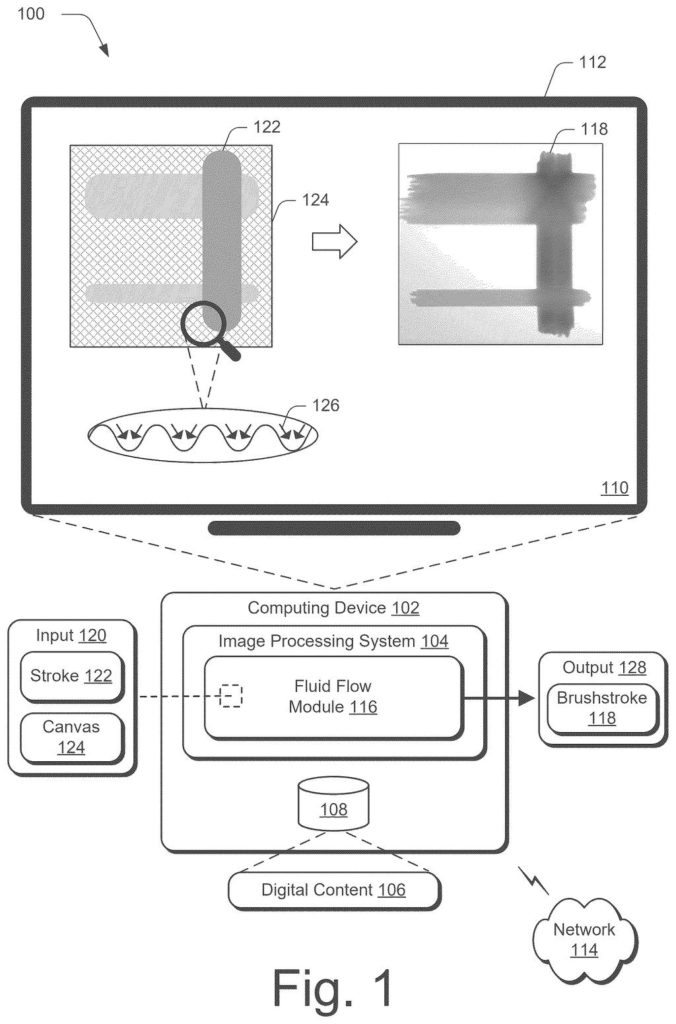
Adobe's new patent describes a brush system that actually knows the shape and orientation of your virtual canvas and uses that geometry to figure out how simulated paint would flow or pool across the surface. When you make a stroke, the software calculates how gravity would affect wet fluid on that specific surface, then shapes the brushstroke to match.
The result is a digital stroke that behaves more like a real one, thicker where paint would settle, tapering where it would drain away. For illustrators or digital painters who want their work to feel physically grounded, this is the kind of detail that separates a convincing painted texture from something that just looks like a filter.
How Adobe models canvas geometry and fluid physics
The patent describes a fluid flow system built into a drawing or painting application. When you draw a stroke on a virtual canvas, the system doesn't just record the path your finger or stylus took. Instead, it runs a physics-inspired calculation.
The key concept is the gravity feature: a value (or set of values) the system derives by modeling how a fluid would interact with the canvas given its geometry. Geometry here means the canvas's virtual shape, tilt, or surface contour. Think of it like asking: if this canvas were a real physical object and I poured water on it, where would the water go?
Once the gravity feature is calculated, the system uses it to reshape the brushstroke. The output stroke:
- Follows the path you drew
- Is modified in width, edge sharpness, or density based on where fluid would flow or pool
- Presents the result in the UI immediately, like any normal brush tool
The patent doesn't tie this to a specific rendering engine or painting style, which means it could apply to watercolor simulations, ink washes, oil paint, or other fluid media. The geometry-based algorithm is the core invention: connecting canvas orientation to stroke appearance in a physically plausible way.
What this means for digital painting in Photoshop or Fresco
Digital painting tools have gotten very good at texture and pressure sensitivity, but most still treat the canvas as a flat, gravity-free surface. Adobe's approach introduces canvas orientation as an input to brush behavior, which is a meaningful step toward making digital paint act like the physical stuff.
For users of Adobe Fresco or Photoshop's live brushes, this kind of feature could make watercolor or ink brushes feel far more believable without the artist manually faking drips and runs. It also hints at a future where rotating your canvas in the app, something artists already do constantly, actually changes how the paint behaves rather than just changing your view.
This is a genuinely useful idea for anyone who works in digital painting and cares about physical realism. Adobe already has fluid-simulation brushes in Fresco, and this patent extends that logic in a direction that real watercolor and ink painters will immediately recognize. It's not flashy from the outside, but it addresses one of the last excuses for choosing physical media over digital.
There are more where this came from
We read every patent application Big Tech publishes and send you the ones worth knowing. Plain English, free, every week.
The drawings
9 drawing sheets from US 2026/0220835 A1 · click any drawing to enlarge


Want this weekly breakdown for a company we don't cover? Patentlyze Pro →
Be the first to weigh in