
Groq
Groq · Chip · Filed Jul 27, 2026 · USPTO published Nov 19, 2026 · This week's release
Groq Files Patent for an AI Chip That Plans Every Data Move in Advance
Most chips spend effort working out what each piece of data is for. Groq's filing describes a chip where the software has already planned every move, so the data needs no labels at all.
- Publication number
- US 2026/0368089 A1(US20260368089A1)
- Applicant
- Groq, Inc.
- Filed · Published
- Jul 27, 2026 · Nov 19, 2026
- Inventors
- Jonathan Alexander Ross, Dennis Charles Abts, John Thompson, Gregory M. Thorson
- Status when we published
- Examiner raised objections; the company can respond
- Document
- 20 claims
- US classification
- 712/220
- Examiner
- DUDEK JR, EDWARD J (Art Unit 2132)
- Parent application
- Continuation of 19/301,427 (filed Aug 15, 2025)(19301427)
What Groq's scheduled-by-software chip does
A train station can run without announcements, and nobody minds. Every train arrives at a fixed minute, so each platform crew already knows which train it is and what to do with it. Groq's new patent applies that idea to the inside of a computer chip.
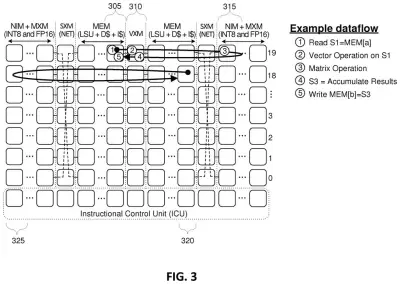
Most chips attach labels to data and spend effort figuring out what each piece is for and where it should go. In Groq's design, a compiler (the software that turns a program into chip instructions) makes the whole schedule ahead of time. Data moves through the chip in set lanes, and each section knows what to do from when the data shows up.
The filing is aimed at AI work, where chips shuffle huge piles of numbers. Less guessing and less label-handling means fewer delays, which could mean faster answers from the AI services you use.
… a streaming register file comprising a plurality of stream registers coupled between the at least one memory functional group and the at least one execution functional group to transfer the operand data and result data from execution of the operations on the operand data …
Translation: A special memory system hands data back and forth between storage areas and the math units.
How Groq's compiler keeps data from colliding
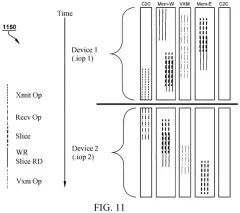
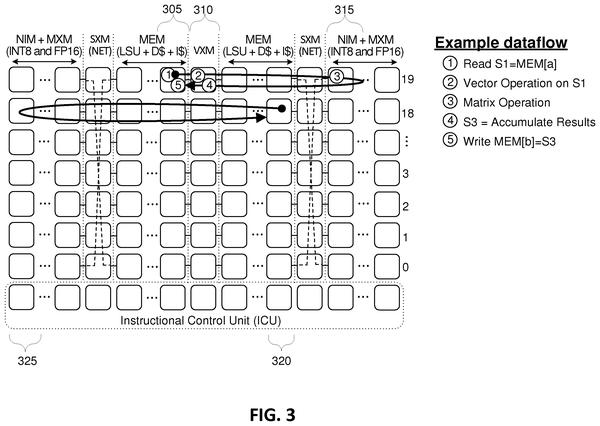
Groq's chip is split into slices, each built for one job: storing data, doing math, or switching data between lanes. Instructions travel along each slice in one direction, while data travels across the chip at a right angle to them. Because the compiler (the software that turns a program into chip instructions) knows the hardware exactly, it times everything so data and instructions meet at a planned moment.
The claims focus on one piece of this: a streaming register file (a set of small holding spots that sit between the memory and the math units and pass data back and forth). The compiler writes the instructions that say which holding spot is used and when. The method claims add that the compiler sets execution times so two math units never reach for the same spot at once.
The dependent claims add details:
- Holding spots are arranged by stream number and lane, and can be grouped to carry larger number types.
- The compiler keeps a clock-tick-accurate model of the chip to plan the data flow.
- An unused bit in each spot flags errors, such as an out-of-range memory lookup or two accesses colliding in the same memory bank.
… allowing operand data to be transmitted between the slices of the processor without any accompanying metadata. Instead, each slice is able to determine what operations to perform on received data based upon the timing at which the data is received …
Translation: Data travels without labels because chips know what to do based on exact arrival times.
Why Groq's pre-planned chip design matters
If you use an AI chatbot or image tool, a chip like this sits behind the screen, and time wasted inside it becomes time you spend waiting. A design that skips labeling and guessing could make answers arrive faster or let the same chip serve more people, though the filing gives no speed numbers.
The filing describes a processor aimed at machine learning work, and it covers a core piece of how that chip is organized. The examiner's first review rejected the claims as filed, which is routine and usually followed by amendments, so the final scope may end up narrower than what you see here.
Source: US 2026/0368089 A1 at the USPTO (PDF). Full patent text and figures are in the official publication.
Get our take in your Top Stories
Liked this breakdown? Add Patentlyze as a preferred source on Google, and our plain-English take shows up more often in your Top Stories the next time Groq patent news breaks.
Add Patentlyze on Google
One click.
There are more where this came from
We read the new patents from Big Tech, carmakers and more and send you the ones worth knowing. Plain English, free, every week.
The drawings · 17 sheets
17 drawing sheets from US 2026/0368089 A1 · click any drawing to enlarge


Show the other 9 sheets


More from Groq
All 2 Groq patents →More in Chip
All 651 Chip patents →
Nvidia
Nvidia Files Patent for Letting Its Graphics and Support Chips Share Data
OpenAI
A New OpenAI Patent Describes a Chip That Keeps AI Model Data in Place
Nvidia
Nvidia Files Patent for a Chip Built to Make AI Chatbots Answer Faster
Intel
No comments yet