
IBM Patents a System That Tailors Public Screen Content to Whoever Is Nearby
That TV in the airport gate or hotel lobby could soon be watching who's watching it, then reshuffling what it shows based on the crowd standing nearby.
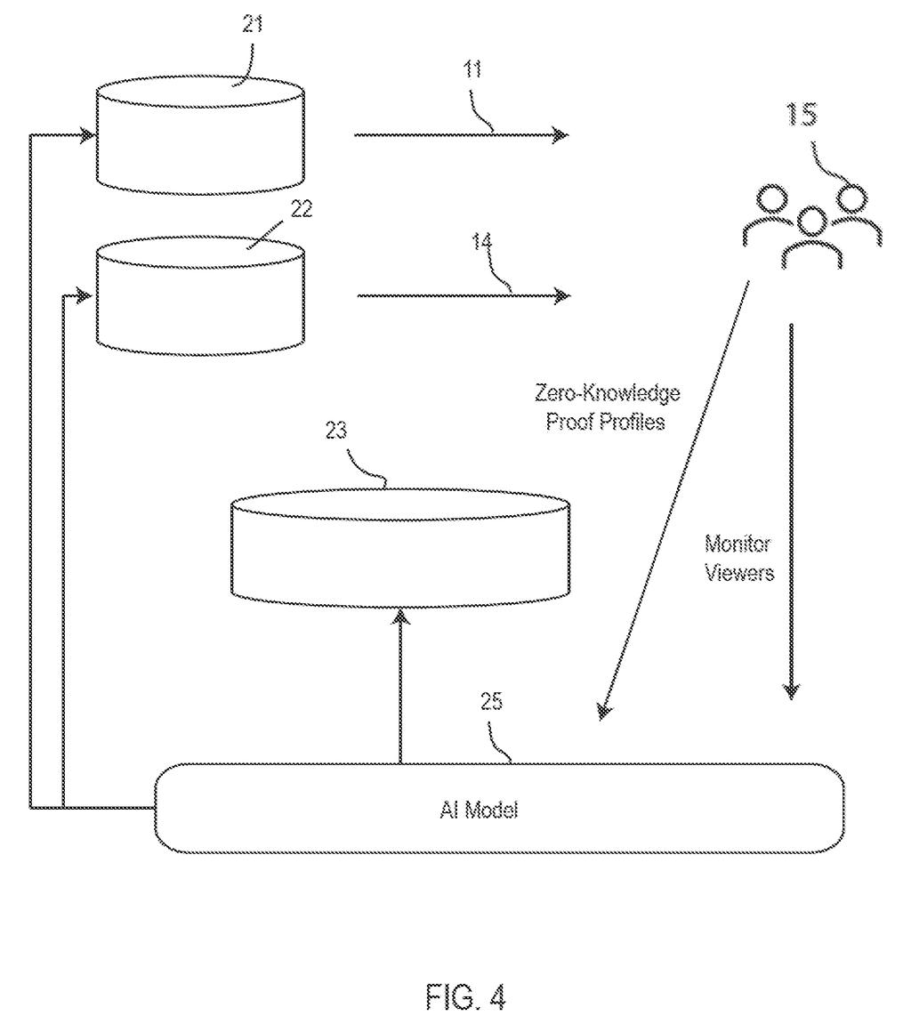
How IBM's crowd-aware broadcast system actually works
You're sitting in an airport gate waiting for your flight, and the TV overhead is playing a generic travel ad loop nobody asked for. IBM's new patent describes a system that would change that, by checking who has opted in nearby and figuring out what that specific group of people might actually want to see.
Here's the basic idea: your phone (or some wearable) shares a lightweight profile with a shared screen nearby. The screen's software collects those profiles from everyone in the area who said yes to participating, runs them through an AI model, and picks content that fits the group as a whole. If three people walk away and two new ones arrive, the system detects that the crowd changed and updates what's on screen accordingly.
IBM calls these "transient user profiles," meaning the system only holds onto your information temporarily, not permanently. Whether that privacy promise holds up in practice is the real question, but on paper the design tries to personalize a shared screen without building a permanent dossier on any individual.
… feeding, by the one or more processors, the transient user profiles into a trained artificial intelligence model in communication with the one or more processors that outputs a recommended content tailored to a group of the opted-in users currently present in the proximity of the common broadcast device; …
Translation: An AI processes nearby viewer profiles to generate custom content for the current crowd.
How the AI reads the room and swaps in new content
The patent describes a computer-implemented method for dynamically inserting personalized content into what IBM calls a common broadcast device, meaning any shared screen broadcasting a continuous stream, think lobby TVs, airport displays, or screens in waiting rooms.
The system works in three stages:
- Profile collection: Users who have opted in share what IBM calls transient user profiles with the system. These are temporary snapshots of preferences or demographic signals, not permanent records tied to an identity.
- Group inference: A trained AI model (the patent doesn't specify the architecture, but the behavior is a recommendation engine) ingests all the profiles of people currently near the screen and outputs content recommended for that group collectively, not any single individual.
- Stream augmentation: When the AI detects that the group composition has changed, for example, someone left or arrived, it triggers an update to the broadcast stream, inserting new recommended content in place of whatever was playing.
The key technical distinction is that the system targets the group rather than any one person. The AI has to find content that works across several overlapping profiles simultaneously, which is a harder optimization problem than individual recommendation. The privacy framing rests on this: no single user's data drives the output alone, and profiles are described as transient, meaning they aren't retained after the person leaves proximity.
An approach is provided for augmenting a broadcast stream while maintaining individual privacy. Transient user profiles of opted-in users within a proximity of a common broadcast device broadcasting a broadcast stream are collected.
Translation: Public screens update their content for nearby viewers while keeping their personal data private.
What this means for ads on public screens near you
For anyone who has ever sat in a waiting room watching irrelevant ads on a screen aimed at nobody in particular, the appeal of this idea is obvious. The system could make shared screens feel less like broadcast leftovers and more like something actually chosen for the people present. IBM frames the opt-in requirement as the privacy safeguard, but that framing papers over a real tension: in practice, opt-in rates in ambient, always-on environments tend to be low or coerced by convenience, and the "transient" label on profiles doesn't tell us how long transient actually is.
The deeper question is whether this is a privacy-forward approach or a new surface for ad targeting dressed in privacy language. IBM is pitching this as a group-level, temporary system, but the infrastructure it requires, proximity detection, profile broadcasting, real-time AI inference on audience composition, is the same stack that powers individual surveillance advertising. That dual-use risk is exactly the kind of tradeoff that Big Tech patent news in the ad-tech and AI space keeps surfacing, as companies try to personalize ambient environments while keeping regulators at arm's length.
This is the 38th IBM filing we've tracked in our Enterprise AI coverage since May, adding to earlier work like AI checking its own confidence and AI catching fake images.
The central design tradeoff here is that IBM is trying to use audience-level aggregation as the privacy mechanism, grouping people so no single profile drives the output. That's a real engineering choice with real costs: the more diverse the crowd, the blander the recommended content has to be to fit everyone. A group-optimized recommendation engine for a mixed crowd is likely to land on the lowest common denominator.
The opt-in framing also carries hidden costs. Opt-in systems in ambient environments, ones where a screen is just playing in a space you happen to be in, create subtle pressure to participate because doing so feels like the default. IBM's design doesn't specify what opting in looks like, and that gap matters enormously for whether the privacy promise is real or procedural.
The "transient" profile language is doing a lot of work in this patent. If transient means seconds, that's meaningfully private. If it means the duration of your stay at an airport, that could be hours of behavioral data. The patent doesn't say, and the answer would change how seriously to take the privacy framing entirely.
Get our take in your Top Stories
Liked this breakdown? Add Patentlyze as a preferred source on Google, and our plain-English take shows up more often in your Top Stories the next time IBM patent news breaks.
There are more where this came from
We read every patent application Big Tech publishes and send you the ones worth knowing. Plain English, free, every week.
The drawings
7 drawing sheets from US 2026/0254669 A1 · click any drawing to enlarge


Want this weekly breakdown for a company we don't cover? Patentlyze Pro →
Be the first to weigh in