Nvidia
Nvidia · AI / ML · Filed Feb 26, 2025 · USPTO published Aug 27, 2026 · Aug 27 release
Nvidia Patents an AI That Tunes Video Compression Quality Shot by Shot
Every time a video is compressed, software has to decide: should this frame look better, or should it take up less space? Nvidia wants an AI to make that call on the fly, learning from every frame it has already encoded.
- Publication number
- US 2026/0254942 A1(US20260254942A1)
- Applicant
- NVIDIA Corporation
- Filed · Published
- Feb 26, 2025 · Aug 27, 2026
- Inventors
- Satish Kumar Suman, Sampurnananda Mishra
- Status when we published
- Examiner raised objections; the company can respond
- Document
- 20 claims
- US classification
- 375/240.02
- Examiner
- ANDERSON II, JAMES M (Art Unit 2425)
How Nvidia's frame-by-frame compression tuning works
A security camera stares at an empty hallway all night, and when its footage is saved, the compression software treats every frame exactly the same. That's wasteful for a still corridor, and it can blur the details when something actually happens. You see a version of this tradeoff in every streaming video you watch.
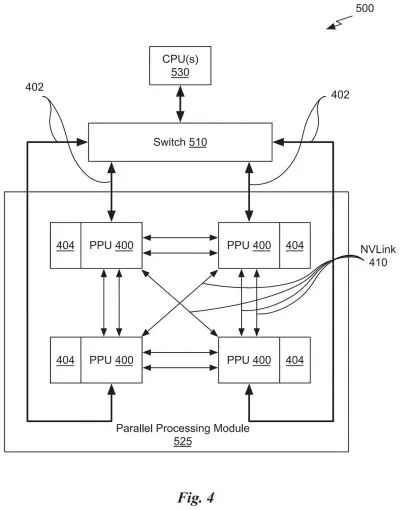
Nvidia's patent describes a system where an AI agent watches how each frame was encoded and then decides, in real time, how much to prioritize picture quality versus file size for the next frame. It's like a sound mixer who constantly nudges the dials based on what just played, rather than setting everything at the start and walking away.
The AI is trained through reinforcement learning, the same approach used to teach computers to play chess or control robots. It learns which dial settings produce the best results over time, and it keeps adapting as the video changes.
determining a weighting parameter for a frame of the video by a trained reinforcement learning (RL) agent, the weighting parameter being determined based on encoding of one or more prior frames of the video; …
Translation: An artificial intelligence agent figures out how to compress each video frame based on how previous frames were handled.
How the RL agent picks and adjusts the lambda weight
At the center of every video encoder is a number called lambda, a weighting parameter that balances two competing goals: keeping file size small (rate) and keeping the picture accurate (distortion). Set lambda too high and you save space but the image looks blocky. Set it too low and the video looks sharp but the file balloons. Most encoders pick a fixed lambda or adjust it with simple rules.
Nvidia's patent replaces those fixed rules with a reinforcement learning (RL) agent, a type of AI that learns by trial and error. The agent watches the results of encoding previous frames in the video, then picks a lambda value for the current frame based on what it has learned so far.
That lambda value then feeds into a process called rate-distortion optimization (RDO), basically the encoder's decision engine that picks the best way to represent each small block of the image. With a better-tuned lambda, RDO can make more accurate trade-off calls for each block.
- The RL agent takes prior encoding results as input.
- It outputs a lambda value tailored to the current frame's content.
- The encoder uses that lambda to choose the best compressed version of each image block.
- The agent is trained via reinforcement learning, so it improves with experience rather than following hand-written rules.
… a neural network is trained using reinforcement learning to dynamically determine the weighting parameter that balances rate and distortion tradeoffs.
Translation: A neural network learns by trial and error to strike the best balance between small file sizes and high image quality.
What this means for streaming and real-time video encoding
For everyday streaming, gaming, or video calls, this kind of adaptive compression could mean better-looking video at the same bandwidth, or the same visual quality using less data. That matters for anything from Netflix delivery pipelines to the chips inside live-broadcasting cameras.
Nvidia already sells GPU hardware that handles video encoding at scale, so a patent like this sits squarely inside their existing product territory. Among the interesting tech patents covering AI-driven video compression, this one is notable for applying reinforcement learning at the codec's core decision loop rather than as a post-processing filter.
This is the 23rd Nvidia filing we've tracked in the AI photo editing race since May, a group that includes one on flickering-free video lighting and one on self-sharpening image output.
Source: US 2026/0254942 A1 at the USPTO (PDF). Full patent text and figures are in the official publication.
Get our take in your Top Stories
Liked this breakdown? Add Patentlyze as a preferred source on Google, and our plain-English take shows up more often in your Top Stories the next time Nvidia patent news breaks.
Add Patentlyze on Google
One click.
There are more where this came from
We read the new patents from Big Tech, carmakers and more and send you the ones worth knowing. Plain English, free, every week.
The drawings · 9 sheets
9 drawing sheets from US 2026/0254942 A1 · click any drawing to enlarge


Show sheet 9

More from Nvidia
All 665 Nvidia patents →
More in AI / ML
All 2,745 AI / ML patents →
Adobe
Adobe Patents an AI That Selects Photo Materials at Two Levels With One Click
Adobe
Adobe Patents an AI That Scores How Well a Video Edit Flows
Samsung
Samsung Patents AI That Turns Blurry Photos Into Sharp, High-Resolution Images
Sony