
IBM
IBM · AI / ML · Filed May 9, 2025 · USPTO published Nov 12, 2026 · This week's release
A New IBM Patent Keeps Your Company Data Out of the AI's Sight
Chatbots that answer questions about company records usually have to read those records first. IBM's filing describes a way for the AI to do the job while seeing only the layout of the data, never the data itself.
- Publication number
- US 2026/0359458 A1(US20260359458A1)
- Applicant
- INTERNATIONAL BUSINESS MACHINES CORPORATION
- Filed · Published
- May 9, 2025 · Nov 12, 2026
- Inventors
- ACHILLE BELLY FOKOUE-NKOUTCHE, SRIDEEPIKA JAYARAMAN, ELHAM KHABIRI, JEFFREY OWEN KEPHART, YINGJIE LI, DHRUV SHAH, YOUSSEF DRISSI, FENNO F. HEATH III, ANURADHA BHAMIDIPATY, FATEH A. TIPU
- Status when we published
- Examiner raised objections; the company can respond
- Document
- 20 claims
- US classification
- 726/26
- Examiner
- LI, MENG (Art Unit 2437)
What IBM's blind-database AI setup actually does
Imagine you work at a factory and ask a chatbot, "Show me the high priority alarms from February 22." To answer, the AI normally needs to look at your company's records, which often means sending them to whoever runs the AI, sometimes an outside provider.
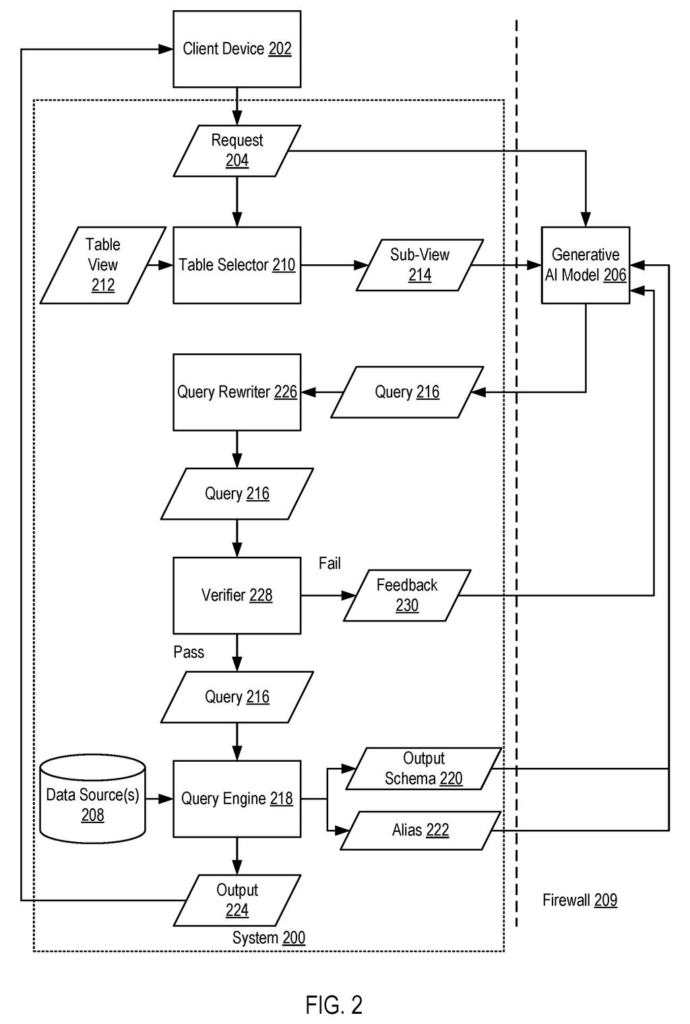
IBM's filing takes a different route. The AI never sees the records. Instead, it gets only the layout of your data: the names of the tables and columns, and how they connect. The AI writes instructions for pulling out the answer, and a system inside your own walls carries them out.
After each step, the AI is told only what the results look like (the column labels) and is given a nickname for them, so it can keep building on its work. The actual rows of data stay home, and only the final answer goes back to you.
receiving, from a generative artificial intelligence (AI) model and based on a first input to the generative AI model comprising a request, an intermediate query for one or more tables, wherein the intermediate query is generated by the generative AI model as an intermediate step of a chain-of-thought for responding to the request …
Translation: The AI system starts by figuring out what data tables it needs to answer a user prompt.
How the AI works from column names and aliases
Retrieval augmented generation (RAG, where an AI looks up outside information before answering) normally hands the looked-up data to the AI. IBM's filing keeps that data out of the model's hands.
The request first goes to a table selector, a language model that reads a map of how the company's tables and outside services relate to each other, then picks the few that matter. Services reached through an API (a standard way for programs to ask each other for data) are presented as virtual tables, so the AI treats everything as ordinary tables.
Then the AI works in a loop:
- It writes an intermediate query (a database instruction, often in SQL) as one step of its reasoning.
- The company's own system runs it and sends back only the output schema (column names and data types) plus an alias (a temporary table name).
- The AI uses that alias in its next step, and repeats until it writes a final query.
The system runs the final query itself and returns the result. A query rewriter swaps virtual table references for function calls that reach the real API, and a verifier checks that column names and parameters are valid. If a query fails, the AI gets feedback and rewrites it. The filing also describes showing you the AI's reasoning steps as it goes.
… providing, to the generative AI model, a second input comprising a schema structure for an output of the intermediate query and an alias for the output of the intermediate query …
Translation: Instead of exposing raw company data, the system feeds the AI only structural outlines and fake names.
Why companies wary of cloud AI might care
If you work somewhere that keeps customer or operations data behind a firewall, the awkward trade-off with AI chatbots is that a useful answer usually means sending that data to an outside company's model. This filing describes a way to get answers from your own records while the model only ever sees table and column names. That is the part privacy-minded businesses would care about.
The examiner's first review rejected the claims as filed, which is routine at this stage and usually followed by amendments, so the final wording could change. It is also a filing about plumbing, and nothing in it names a specific IBM product. Still, it points at a practical need: using powerful cloud AI on private data without handing that data over.
IBM files its 13th application we've tracked since July in our on-device AI privacy work, building on earlier ideas like testing apps on scrubbed data and padding encrypted searches.
Source: US 2026/0359458 A1 at the USPTO (PDF). Full patent text and figures are in the official publication.
Get our take in your Top Stories
Liked this breakdown? Add Patentlyze as a preferred source on Google, and our plain-English take shows up more often in your Top Stories the next time IBM patent news breaks.
Add Patentlyze on Google
One click.
There are more where this came from
We read every patent application Big Tech publishes and send you the ones worth knowing. Plain English, free, every week.
The drawings · 8 sheets
8 drawing sheets from US 2026/0359458 A1 · click any drawing to enlarge


More from IBM
All 470 IBM patents →

More in AI assistant & agent
All 413 AI assistant & agent patents →
Samsung
Samsung Patents a Method to Shrink AI Models While Keeping Them Accurate
OpenAI
OpenAI Files Patent for AI Training That Fits Inside a Phone's Limited Memory
Google
Google Patents an AI Assistant That Asks Before Sharing Your Data
Google
No comments yet