
IBM Files Patent for Letting Anyone Question a Database in Plain English
Databases hold the answers, but you usually need to speak their language to get them. IBM's filing describes an AI that writes its own cheat sheet of domain facts so it can translate your plain question into a working query.
What IBM's self-building cheat sheet actually does
You're a hospital analyst and you type, "Which patients have an abnormal white blood cell count?" The database has no idea what "abnormal" means. Somebody would have to know the exact number range and which column holds it, then write the query in a specialized language called SQL.
IBM's filing tackles that gap. The system first finds facts that show up across many example questions, such as what counts as a normal albumin level. Then an AI writes many more facts like them and stores them in a knowledge base, a library of short, plain sentences.
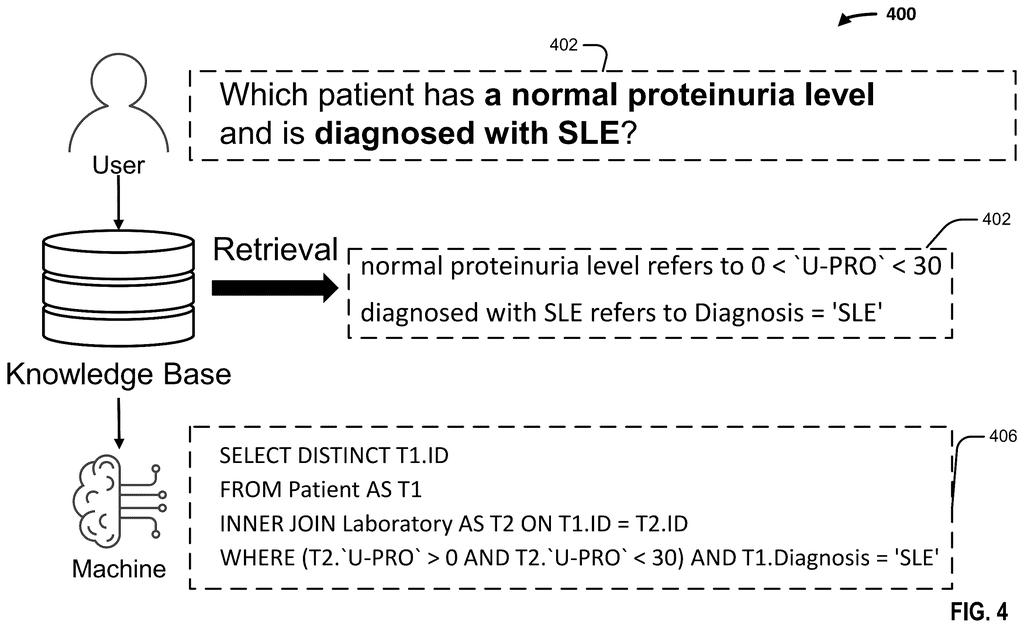
When you ask a question, the system pulls the most relevant sentences and uses them to write the query for you. It then runs the query and checks the answer against questions whose right answers are already known.
an identification component that identifies knowledge that is shared by a plurality of database language queries; and a generation component that generates additional knowledge, for a knowledge base, from the identified knowledge …
Translation: The system finds patterns across multiple database searches to build up its understanding.
How the AI writes and checks its own notes
The patent describes a pipeline that builds and uses a knowledge base, which is a collection of short sentences about what the data means. An example from the filing: "Abnormal white blood cell count refers to WBC≤3.5 or WBC≥9.0."
First, an identification component collects knowledge entries from a public dataset and picks out the ones shared by several example queries. Entries used again and again are likely to be useful. In the filing's example, two questions both mention "albumin" and "normal," so a note about normal albumin levels goes in.
Second, a generation component uses a large language model (an AI trained on huge amounts of text) to write new entries. It is shown diverse collections of demonstrations, meaning small sets of worked examples that are shuffled and sampled so the AI doesn't copy one pattern.
At question time, the system compares your question to every entry, using numeric similarity scores, and keeps the closest few. If a needed entry is missing, it can adapt a nearby one. For example, it can turn "normal proteinuria levels" into "abnormal proteinuria levels" and save it. A second AI then writes the query, the database runs it, and the result is compared with a known benchmark answer. If they don't match, more knowledge is generated.
Systems and techniques that facilitate text to database language query generation are provided.
Translation: Methods are introduced that turn everyday written sentences into formal database commands.
Why this matters for people who aren't coders
The practical payoff is for people who need answers from data but don't know SQL. Today that usually means waiting for a specialist, or guessing. The filing says the knowledge base makes generated queries more accurate, which cuts down on repeated tries and the computing work behind them.
IBM also reports a chart comparing three setups on four test datasets: no knowledge, its knowledge base, and human-written notes. The knowledge base beat no knowledge everywhere, and in some cases came near the human-written ceiling. The filing gives no numbers in the text, so treat that as a claim, not a measured result. The notes can also be built to work across several databases, which matters for companies running many systems.
IBM's 42nd filing in the Language AI patents we cover since May follows work like one on reading sentences twice and one on parsing large numbers.
The trade here is trust for convenience. An AI writes the notes that guide another AI, so a wrong note, such as a bad definition of "abnormal," can shape every answer built on it. The benchmark check catches some of that, but only for questions where someone already knows the right answer.
The other cost is effort up front. The system needs example queries, a public dataset to start from, and repeated generate-and-test rounds. That is cheaper than hand-writing notes for every database, which the filing itself calls impractical, so the trade reads as worth it.
The idea itself is a sensible fix for a familiar problem. Expect careful engineering rather than a dramatic leap, and the real test is how it behaves on messy company data.
Get our take in your Top Stories
Liked this breakdown? Add Patentlyze as a preferred source on Google, and our plain-English take shows up more often in your Top Stories the next time IBM patent news breaks.
There are more where this came from
We read every patent application Big Tech publishes and send you the ones worth knowing. Plain English, free, every week.
The drawings
10 drawing sheets from US 2026/0350424 A1 · click any drawing to enlarge


Show the other 2 sheets


Want this weekly breakdown for a company we don't cover? Patentlyze Pro →
Be the first to weigh in