
IBM Files Patent to Speed Up Search by Showing an AI the Same Sentence Twice
IBM's filing hands an AI the same sentence twice, then skips to the model's early notes to make search faster.
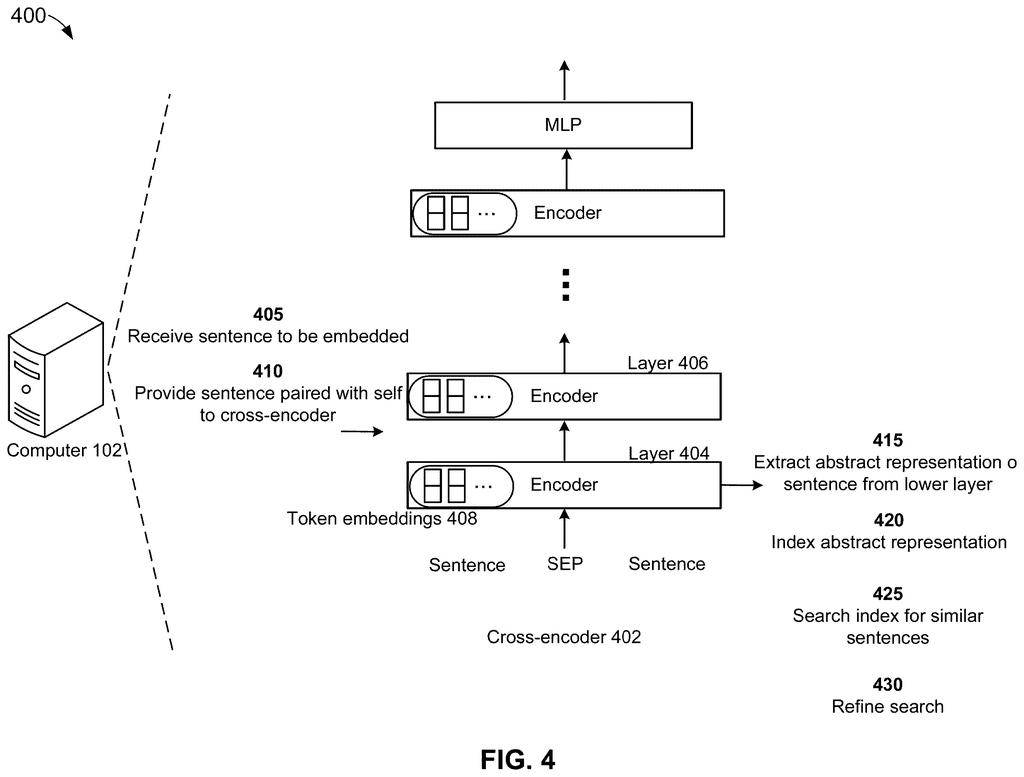
What IBM's sentence-twice search trick does
A company's help-desk search gets a question and has to compare it against millions of stored sentences. Doing that carefully is slow. Doing it fast usually means giving up some accuracy.
IBM's patent application tries to get both. AI models called cross-encoders are good at judging whether two sentences mean the same thing, but they need two sentences as input. So IBM's trick is to hand the model the same sentence twice. Then, instead of waiting for the model's final answer, the system grabs its working notes from an early stage and files them in a searchable index.
When you type a query, your words get the same treatment, and the system looks for the stored notes that sit closest to yours. The filing says this saves computing power and can also help train a lighter, faster search model.
… pairing the text sentence with itself to create a paired sentence input for a cross-encoder, wherein the pairing of the text sentence with itself comprises pairing the text sentence with the text sentence …
Translation: The system feeds the exact same sentence into the AI model twice at the same time.
How IBM pulls search data from early layers
A cross-encoder is a type of neural network (software that learns patterns from examples) that reads two pieces of text together and judges how related they are. It is accurate, but it normally can't power search, because every query would have to be paired with every stored item. IBM's filing sidesteps that problem.
The claims lay out the method like this:
- Take a sentence and pair it with a copy of itself, since the model expects two inputs.
- Run the pair through the model and pull out an 'abstract representation' (a list of numbers capturing the sentence's meaning) from a low layer, such as the embedding layer or the first layer. This is done by pooling hidden states, meaning the model's internal numbers get combined into one fixed-size list. The claims name sum and maximum pooling.
- Store those lists in an index, such as a k-nearest-neighbor index (a lookup structure built to find the closest matches quickly).
- Do the same to a search query, then look up the nearest stored entries.
The claims also cover table columns, not just sentences, so the system could find related columns across databases. Other versions use the numbers to train a dual encoder (a lighter search model that reads each text on its own) with a simpler training routine, or rerank the top results with the full cross-encoder as a final check.
… extract an abstract representation of the sentence from a lower layer of the cross-encoder, where the abstract representation of the sentence is associated with search …
Translation: It pulls a summary of the sentence from an early stage of the AI to use for looking up matches.
Why IBM's search shortcut matters for company data
If you've ever typed a question into a company's search tool and gotten results that match your words but miss your meaning, this is the problem area. The filing names question answering and text search as targets. It says that running only the first layers of the model cuts delay and computing costs. For businesses searching big piles of documents or database tables, cheaper meaning-based matching adds up.
The table-column angle is the sleeper detail. Working out which columns in different databases mean the same thing is a chore for anyone cleaning up company data. The option to train a lighter search model from the cross-encoder could also cut training costs. These are the filing's own claims about savings, and the text gives no benchmark numbers to back them up.
This is the 41st IBM filing we've tracked in Language AI since May, following one on fixing AI misreads of large numbers and one on searching databases in plain English.
Using only the first layer or two of a model gives up most of what the model has learned. Those early layers capture word meaning and sentence structure, while the later layers do the deeper judging. IBM is betting that the early view is good enough to find strong candidates, and the document gives no accuracy numbers to check that bet.
The design also asks for an up-front bill. Every stored sentence or table column has to be run through the model once before the first search can happen. The payoff is that later searches become quick lookups.
The reranking option in claim 11 is the sensible safety net: let the cheap method pick a shortlist, then let the full model sort it. That trade looks worth making, as long as the shortlist doesn't miss the right answer to begin with. Nothing in the text shows how often that happens.
Get our take in your Top Stories
Liked this breakdown? Add Patentlyze as a preferred source on Google, and our plain-English take shows up more often in your Top Stories the next time IBM patent news breaks.
There are more where this came from
We read every patent application Big Tech publishes and send you the ones worth knowing. Plain English, free, every week.
The drawings
9 drawing sheets from US 2026/0340004 A1 · click any drawing to enlarge


Show the other 1 sheets

Want this weekly breakdown for a company we don't cover? Patentlyze Pro →
Be the first to weigh in