
Intel Patents a Way for 5G Devices to Locate Each Other Without a Cell Tower
Most phone location tech relies on towers or satellites. Intel's new patent describes a system where 5G devices measure location signals sent directly from other devices nearby, bypassing the network for the heavy lifting.
How Intel wants phones to find each other in 5G
You're at a busy stadium and every cell tower in range is swamped with traffic. Your phone needs to know exactly where another device is, whether for an emergency handoff, a connected car alert, or a warehouse robot, but the network is too congested to help quickly.
Intel's patent describes a way for devices to handle that problem by talking directly to each other. One device sends out a special reference signal, the other measures how strong that signal is and how it arrived, then reports back. The whole exchange happens within a tight time window set by the network, so the location data stays fresh.
The approach works inside the existing 5G NR (New Radio) standard, meaning it doesn't require new hardware from scratch. The network hands each device a set of instructions, the devices do the measuring themselves, and the results go either to a location manager in the network or directly back to the other device.
decode a sidelink configuration information (SCI) received from a generation Node B (gNB), the SCI including an information element that indicates configuration information for resources of a sidelink positioning reference signal (SL PRS) resource pool …
Translation: The device reads instructions from a cell tower to find special signals used for measuring distance.
How the SL-PRS measurement and reporting loop works
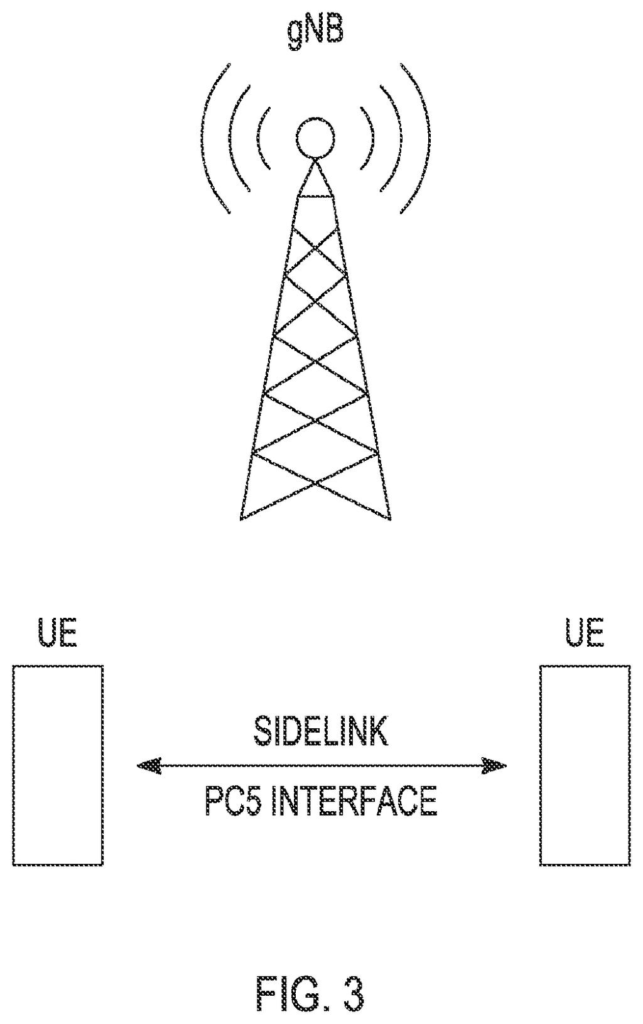
The patent covers a specific piece of 5G machinery called sidelink positioning. "Sidelink" means device-to-device communication: two phones (or a phone and a vehicle, or two industrial sensors) exchanging data directly, not by bouncing signals off a cell tower.
Here's the flow the patent describes:
- A base station (called a gNB in 5G language) sends each device a configuration packet that tells it which radio resources to use for the positioning signals and how to share them.
- The receiving device listens for a Sidelink Positioning Reference Signal (SL-PRS), a precisely timed radio pulse sent by the nearby device.
- It measures two values: SL PRS-RSRP (how much total power arrived) and SL PRS-RSRPP (the power on the strongest direct path, stripping out reflections). Together those two numbers let the system estimate distance and direction.
- The device then reports those measurements within a defined reporting delay window, sending results to either a "Location Management Function" (a dedicated location server inside the 5G core network) or directly back to the other device.
The time constraint on reporting is important. Location data goes stale fast, especially for moving objects, so the patent specifically requires measurements be delivered within a bounded delay.
… report measurements of the SL PRS resources within a measurement reporting delay time. The UE may be configured to report the measurements in a measurement report to the other UE or a location management function (LMF) of the network …
Translation: The device sends back its distance calculations to either the other gadget or the network system within a strict deadline.
What peer-to-peer 5G location means for real products
For everyday users, the payoff shows up in scenarios where you need to know where something is right now and the cellular network can't be relied on to mediate that in time. Think of a car that needs to know a pedestrian's exact position in a parking garage, or a first responder's radio that needs to find a colleague's device when GPS signals don't reach indoors. This patent's approach offloads the measurement work to the devices themselves, which keeps latency low even when the network is overloaded.
For Intel, the filing fits a broader push to make 5G chipsets useful beyond plain data connections, building location awareness directly into the radio hardware. Positioning between devices is one of the harder problems in 5G standardization, and chipmakers who nail the timing and measurement accuracy have an advantage in automotive, industrial, and public-safety markets. 5G location technology is a steady beat of filings in Big Tech patent news, and Intel's approach here reflects the industry's move toward letting devices do more of the location math themselves rather than depending on crowded network infrastructure.
This is the 127th Intel filing in our Intel coverage since May, adding to work like precise 5G location and linked browsing sessions.
From a reader-impact view, this patent matters most to people who won't know it's running. The scenarios it targets, finding a device in a garage, guiding a warehouse robot, coordinating vehicles at an intersection, are exactly the cases where a half-second delay or a few meters of error causes a real problem. The patent is careful and specific about timing constraints and the two measurement values it requires.
That specificity is a good sign that Intel is solving a real implementation problem, not just staking out conceptual ground. Still, 5G sidelink positioning is a crowded standards area.
The filing's value to Intel depends heavily on how close it maps to what ultimately lands in the finalized 3GPP specifications, and that's a slow, committee-driven process where no single company's patent automatically wins.
Get our take in your Top Stories
Liked this breakdown? Add Patentlyze as a preferred source on Google, and our plain-English take shows up more often in your Top Stories the next time Intel patent news breaks.
There are more where this came from
We read every patent application Big Tech publishes and send you the ones worth knowing. Plain English, free, every week.
The drawings
5 drawing sheets from US 2026/0255309 A1 · click any drawing to enlarge


Want this weekly breakdown for a company we don't cover? Patentlyze Pro →
Be the first to weigh in