
Intel Patents a Chip Trick That Runs AI Math in Tinier 4-Bit Numbers
Intel is patenting a way to do the heavy multiplication at the heart of AI models using an unusually compact number format, one that most chips today can't handle natively. The trick is converting those tiny numbers into a slightly different format the hardware already knows how to crunch.
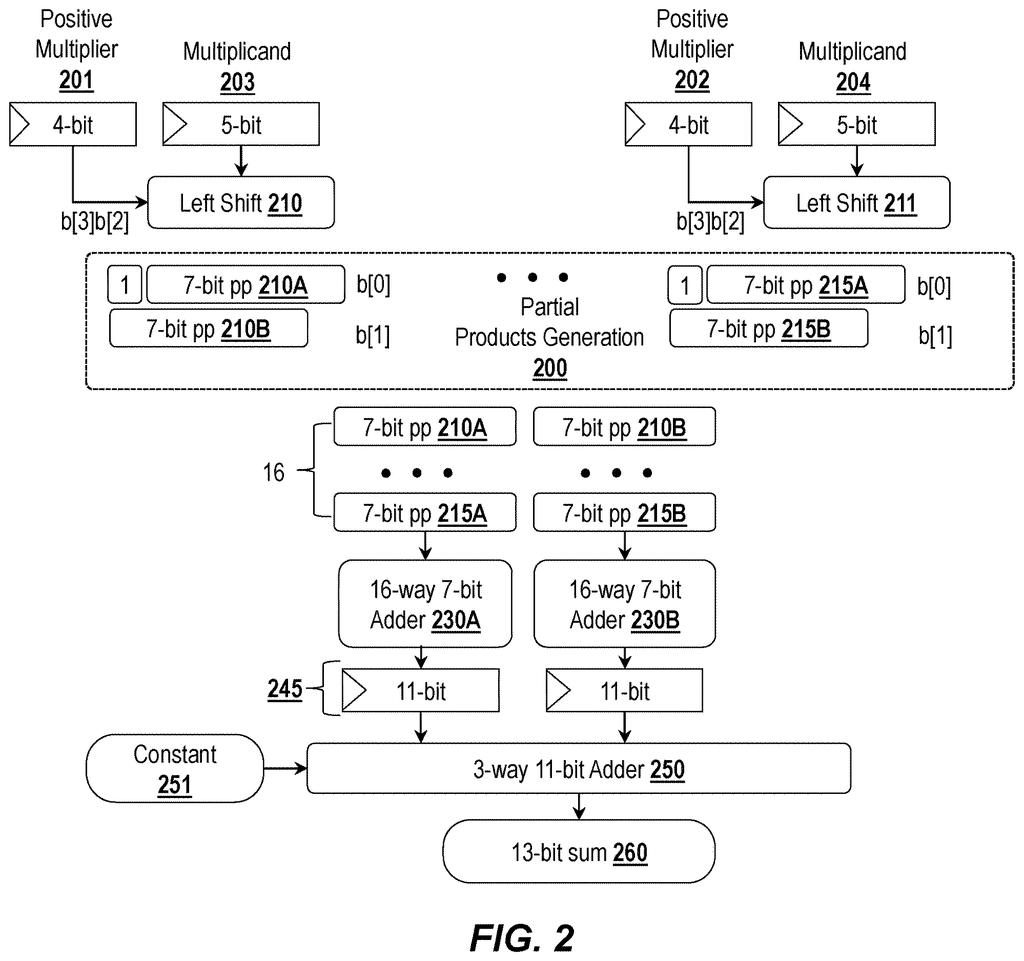
How Intel squeezes AI math into 4-bit numbers
Imagine you're trying to do a lot of arithmetic very fast, but your calculator only understands whole numbers and you're being handed fractions. You'd need to convert them first, and that conversion costs time. AI chips face a similar problem.
AI models run billions of small multiplications called dot products. Researchers have found you can shrink the numbers involved to just 4 bits (called FP4, or 4-bit floating-point) without losing much accuracy, and smaller numbers mean less memory and less power. But most chips aren't built to do math with numbers that small natively.
Intel's patent describes a method that converts each 4-bit floating-point value into a 5-bit integer (INT5) before doing the math, using a simplified circuit that maps numbers directly with fewer logic gates than a conventional approach. The result is that you get the storage benefits of tiny FP4 numbers while still doing the actual multiplication on circuitry that's fast and straightforward to build.
decoding circuitry to perform decoding of each pair of INT5 scalar values in accordance with a map comprising a reduced set of logic gates configured to map each INT5 scalar value directly to generate a corresponding INT5 scalar result …
Translation: Specialized logic gates quickly translate the compressed number values into usable data.
Inside Intel's FP4-to-INT5 conversion pipeline
The patent describes processor hardware built specifically to handle FP4 (4-bit floating-point) dot products, which are the core multiplication-and-sum operations inside AI neural networks.
The process works in stages:
- The processor loads pairs of FP4 values from registers (small on-chip memory slots).
- Each FP4 value is broken into three components: an INT5 scalar (a 5-bit integer representing the fractional part), an INT5 base (representing the magnitude), and an INT5 sign (positive or negative).
- A decoding circuit uses a reduced set of logic gates, fewer transistors than a conventional floating-point unit, to map the scalar directly to a result, avoiding the full complexity of standard floating-point arithmetic.
- A multiplier computes the product of the base values, and two's complement circuitry (the standard way chips represent negative numbers in binary) formats the result.
- A multiplexor network (essentially a fast selector switch) then picks the right bits from that result based on the scalar, producing the final dot-product output.
The key engineering bet here is that FP4 numbers have a small enough range of possible values that you can replace expensive general-purpose floating-point logic with a compact lookup-style map. Fewer gates means less silicon area, less heat, and potentially higher throughput.
… multiplying each corresponding pair of INT5 bases circuitry to generate a base product; generating a two's complement representation of the base product …
Translation: The processor multiplies the scaled number components and converts the result into standard computer math format.
What this means for AI chip efficiency and cost
AI training and inference are dominated by matrix multiplications, and the numerical precision used in those operations is one of the biggest levers chip designers have. Moving from 16-bit to 8-bit math (a shift the industry made a few years ago) roughly doubled throughput per watt for AI workloads. Dropping further to 4-bit formats could have a similar effect, but only if the hardware is built to support it efficiently.
Intel filing this patent signals it is working on silicon-level support for FP4 in future AI accelerators. For you as a consumer or enterprise buyer, that eventually translates to cheaper inference (running AI queries costs less compute), faster model responses, and the ability to run larger models on the same hardware budget.
This is a dense, low-level chip design patent, and it won't make headlines the way a new AI assistant feature would. But 4-bit floating-point is a real and active frontier in AI hardware right now, with Nvidia, AMD, and custom silicon vendors all circling it. Intel staking out specific circuit designs for FP4 dot products tells you this isn't theoretical: they're building toward it.
There are more where this came from
We read every patent application Big Tech publishes and send you the ones worth knowing. Plain English, free, every week.
The drawings
6 drawing sheets from US 2026/0228001 A1 · click any drawing to enlarge


Want this weekly breakdown for a company we don't cover? Patentlyze Pro →
Be the first to weigh in