
Samsung Patents a Way to Measure How Far Away a Pedestrian Is Using a Moving Camera
Most cameras can see a pedestrian. Knowing exactly how far away that person is — without a laser or a radar — is a much harder problem. Samsung's new patent tackles it with nothing but video frames.
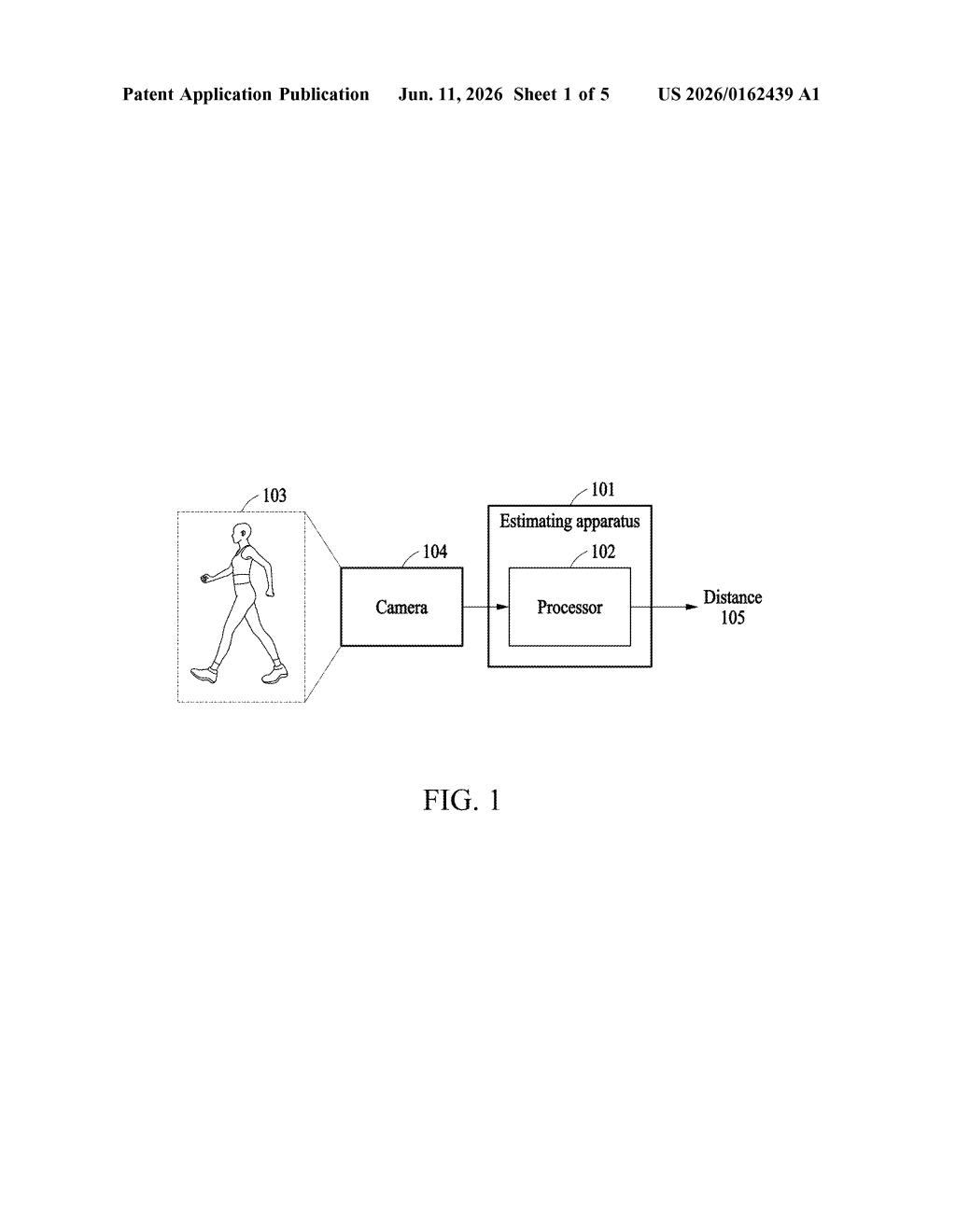
What Samsung's pedestrian distance system actually does
Imagine a security camera mounted on a car or a moving robot. It can clearly see a person walking across the street, but it has no depth sensor — no way to tell whether that person is 5 feet away or 50. That gap between "I see someone" and "I know how close they are" is a real safety problem.
Samsung's patent describes a method for closing that gap using only the video the camera is already capturing. As the camera moves, the system tracks specific body joints — shoulders, hips, knees — on the pedestrian across multiple frames. Because the camera's own position changes between each frame, the math can work backward to figure out how far away those body points must be in 3D space.
The clever part is identifying a static point on the person — a part of the body that isn't swinging or bouncing while they walk. Anchoring the calculation to something stable makes the distance estimate much more reliable, even when the person is in motion.
How the joint-tracking math produces a distance estimate
The system works in three main steps:
- Pedestrian detection: The camera feed is scanned to find the region of the image that contains a person.
- Static point selection: Within that region, the algorithm identifies a body part that stays relatively still relative to the rest of the body — useful because a walking person's limbs swing in ways that would throw off a simple measurement.
- 3D joint reconstruction: The system extracts joint regions (think: anatomical landmarks like elbows, knees, and hips) and uses vectors — directional lines drawn through those joints — to compute their 3D coordinates (their position in real-world space, not just on the flat image).
The key insight is triangulation. Because the camera is moving, the same pedestrian appears at a slightly different angle in each successive frame. By knowing how much the camera moved between frames and where the static point appeared in each one, the system can calculate the actual distance — the same geometric principle a surveyor uses when taking measurements from two spots.
No dedicated depth sensor (like LIDAR or structured-light infrared) is required. This is a monocular approach, meaning a single standard camera is enough.
What this means for cameras that watch for people
Distance-to-pedestrian estimation is a core building block for driver-assistance systems, delivery robots, smart surveillance cameras, and any moving device that needs to avoid hitting people. Today, reliable distance measurement usually depends on LIDAR or stereo cameras — hardware that adds cost and complexity. A software-only solution that works on a plain video feed could bring that capability to lower-cost devices.
For Samsung specifically, this sits at an interesting intersection of its camera hardware business, its automotive components division, and its robotics push. A system like this could surface in dashcams, in-car ADAS processors, or robot vision modules. You might eventually benefit from it indirectly — as a pedestrian who's less likely to be struck by a vehicle whose camera finally knows how close you are.
This is solid, focused computer-vision engineering rather than a flashy AI announcement. The static-point insight is genuinely clever — anchoring distance math to the calmest part of a moving body is a practical solution to a real noise problem. It won't make headlines on its own, but it's exactly the kind of foundational patent that ends up baked into safety systems people rely on.
There are more where this came from
We read every patent application Big Tech publishes and send you the ones worth knowing. Plain English, free, every week.
Want this weekly breakdown for a company we don't cover? Patentlyze Pro →