
Meta Patents a Digital-First Optical Alignment System for AR Headsets
Getting the optics perfectly aligned inside an AR headset is one of the hardest manufacturing problems in the industry — a fraction of a millimeter off and your virtual world looks broken. Meta's new patent describes a clever two-stage approach that does the heavy lifting digitally before anything is physically locked down.
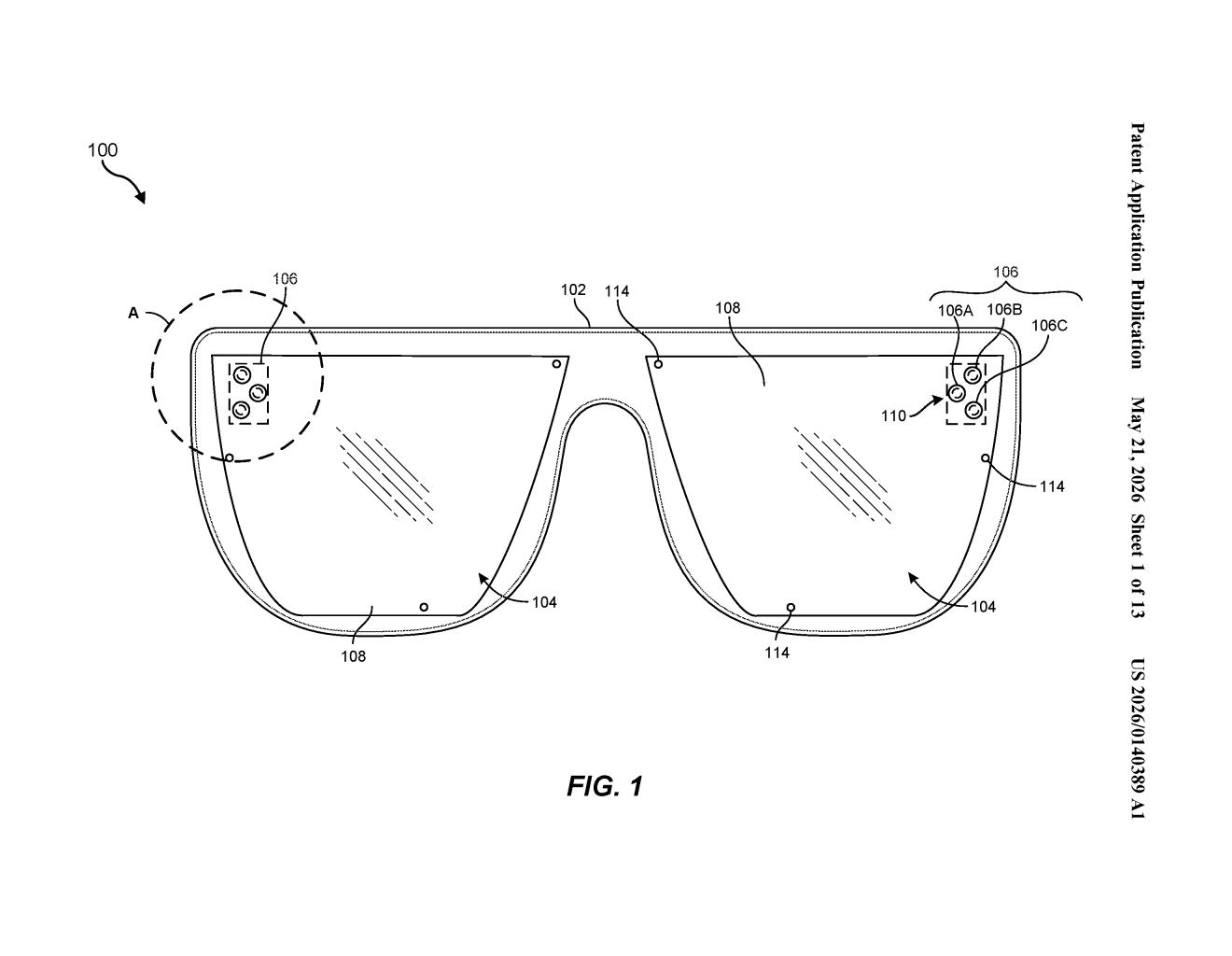
What Meta's two-stage headset alignment actually does
Imagine trying to hang a picture perfectly level on a wall, but instead of one step, you have to align a camera, a projector, and the wall frame itself — all to within a hair's width. That's essentially what happens inside every AR headset on an assembly line, and getting it wrong means blurry images or eye strain for the user.
Meta's patent describes a smarter assembly process. First, a software system digitally rotates and adjusts the optical sensor's coordinate system — basically its internal sense of where "straight ahead" is — so it matches the physical headset frame perfectly. Only after that digital calibration is locked in does a robotic arm physically move the projector into position.
By separating these two steps, the system avoids chasing a moving target. You're not trying to mechanically align three imprecise things simultaneously — you align digitally first, then physically second. The result should be more consistent, higher-precision headsets coming off the line.
How the coordinate systems snap together during assembly
The patent describes a manufacturing assembly process with two distinct alignment stages, each with its own precision threshold.
Stage 1 — Digital alignment: A support mechanism holds the headset frame in place. The system measures the exact location and orientation of the frame coordinate system (the frame's physical "axes" in 3D space) relative to the support jig. Then, rather than physically moving a sensor, the system digitally adjusts the optical coordinate system of an optical sensor — essentially reprogramming the sensor's internal reference frame — until the two coordinate systems match within a tight tolerance.
Stage 2 — Physical alignment: With the sensor now virtually "locked" to the frame's geometry, a projector holder physically moves the projector assembly until its projected image lines up with that calibrated optical coordinate system. This threshold can be a different (potentially looser or tighter) tolerance than Stage 1. Once aligned, the projector is secured permanently to the frame.
- Decouples digital calibration from physical positioning
- Uses separate, independently tunable precision thresholds for each stage
- Reduces compounding mechanical error by solving one axis of the problem in software first
The key insight is that digital adjustment is faster and more repeatable than purely mechanical repositioning, so doing it first gives the physical step a stable, known target to hit.
What this means for Meta's AR headset manufacturing quality
AR headset optical quality lives or dies on sub-millimeter alignment. Even tiny misalignments between a projector and the optics it feeds can cause double vision, chromatic aberration, or eye strain — problems that are nearly impossible to fix after the device ships. A manufacturing process that systematically reduces alignment error at the factory level directly translates to better out-of-box experiences for users.
For Meta specifically, this kind of precision manufacturing infrastructure signals serious investment in high-volume AR headset production. Building a repeatable, automated alignment pipeline is exactly the kind of unglamorous engineering work that separates a prototype lab from a factory capable of shipping millions of units. If Meta is patenting the assembly process, they're thinking about scale.
This is classic deep-stack manufacturing IP — not flashy, but exactly the kind of foundational work that separates companies that can ship AR hardware at scale from those stuck in prototype purgatory. Meta patenting its own optical alignment assembly method suggests they're not just buying off-the-shelf production tooling. That's worth paying attention to.
There are more where this came from
We read every patent application Big Tech publishes and send you the ones worth knowing. Plain English, free, every week.
Want this weekly breakdown for a company we don't cover? Patentlyze Pro →