
Meta Files Patent for a Headset-and-Phone Team-Up to Scan Your Room in 3D
Scanning a room into a 3D copy is slow and fiddly, and one clumsy step can ruin it. Meta's patent has your headset do the quick rough pass, then points your phone at only the spots that need a sharper look.
What Meta's headset-plus-phone room scan does
Imagine you've just moved into a new apartment and want a 3D copy of it you can walk around in a headset. You pull out your phone and start scanning, but it can take 20 to 30 minutes, you're squinting at a small screen, and one clumsy step can ruin the whole thing.
Meta's patent splits the job in two. First, you walk around wearing a headset, which quickly builds a rough model of the room. Then the system works out where that model is blurry or incomplete, like the text on a book or the carpet under a table, and shows you exactly where to aim your phone.
The phone's sharper photos get blended into the rough model, so you end up with a detailed copy of your space without needing to be a scanning pro.
… defining regions, of the initial extended reality environment, that each require additional spatial and/or dimensional data; identifying, based on the defined regions, multiple areas of interest to be captured by a mobile device; …
Translation: The headset figures out which parts of the room need a closer look and tells your phone to snap pictures of them.
How the headset picks where your phone looks
The process starts with an initial scan. You wear an extended reality (XR) headset, and its cameras, depth sensors and motion sensors (an IMU, the chip that tracks tilt and movement) build a rough 3D model of the room as you walk around. The model can be a 3D mesh (a net of tiny connected surfaces) or a Gaussian splat (a cloud of soft, blurry blobs that together look like the scene).
Next, the system checks its own work and flags regions that need more data, such as blurry textures, hidden corners or hard-to-reach angles. The filing's examples include the text on a book, the pattern of a carpet under a table, and a high ceiling. Those regions become a list of areas of interest for your phone to capture.
You get guidance in one or more of these forms:
- Visual: dots or markers appear in the headset view, such as a grid on the ceiling.
- Audible: a spoken prompt like "point your phone at the floor beneath the chair."
- Tactile: a vibration from a controller when the phone is aimed correctly.
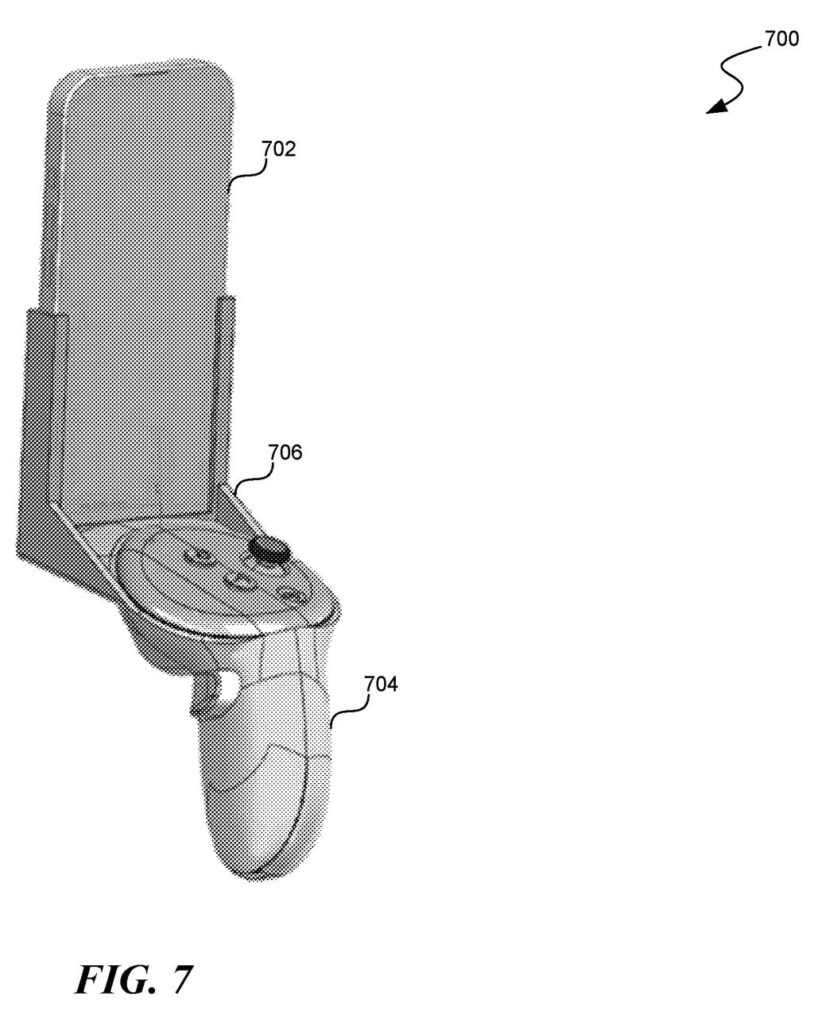
The headset and phone stay in sync over a two-way wireless link, and a mount can clamp the phone to a headset controller so the system knows exactly where the camera points. The phone's photos are then fused into the baseline model to sharpen textures and fill gaps.
This hybrid approach combines the spatial awareness of an HMD with the high-quality imaging of a mobile device to create a complete and detailed digital twin of a physical space more efficiently.
Translation: Using both gadgets together makes it faster and easier to build an accurate digital copy of a real room.
Why room scanning could get easier on Meta headsets
If you ever want a 3D copy of your living room, office or workshop to use in a headset, the hard part today is the scan itself. The filing says phone-only scans are slow and error-prone, while headset-only scans come out lower in quality and struggle with very high or very low surfaces. Combining the two aims to give you the best of both with less skill and patience.
For Meta, easier room capture matters because the more spaces people can bring into a headset, the more reasons they have to put one on. The filing also suggests less wasted computing, since the phone only shoots photos where the model is weak. It is a patent application, so nothing here says a product is coming.
Meta's 75th filing we've tracked in our AR glasses race watch since May builds on ideas like display tilting to slim frames and one beam tracking eyes and room.
If you have ever tried scanning a room with your phone, you know the pain: a slow shuffle, a tiny screen, and a result full of holes. Meta's idea hands the guessing to the headset, which knows where the holes are and tells you where to point. That fixes a chore most people would otherwise abandon halfway through.
You would notice it within the first minute. Dots land on the ceiling and walls where your phone needs to look, so you stop hunting for missed spots. The catch is the gear: a headset, a phone, and ideally a controller mount, so it suits people already inside Meta's headset world. For them, it could make capturing a room feel like a guided walk-through.
Get our take in your Top Stories
Liked this breakdown? Add Patentlyze as a preferred source on Google, and our plain-English take shows up more often in your Top Stories the next time Meta patent news breaks.
There are more where this came from
We read every patent application Big Tech publishes and send you the ones worth knowing. Plain English, free, every week.
The drawings
12 drawing sheets from US 2026/0320931 A1 · click any drawing to enlarge


Show the other 4 sheets


Want this weekly breakdown for a company we don't cover? Patentlyze Pro →
Be the first to weigh in