
Meta Patents Smart Glasses That Read Your Silent Mouthed Words
Meta is patenting a way for smart glasses to understand what you're saying even when you make no sound at all, by reading the tiny muscle movements your face makes when you silently mouth words.
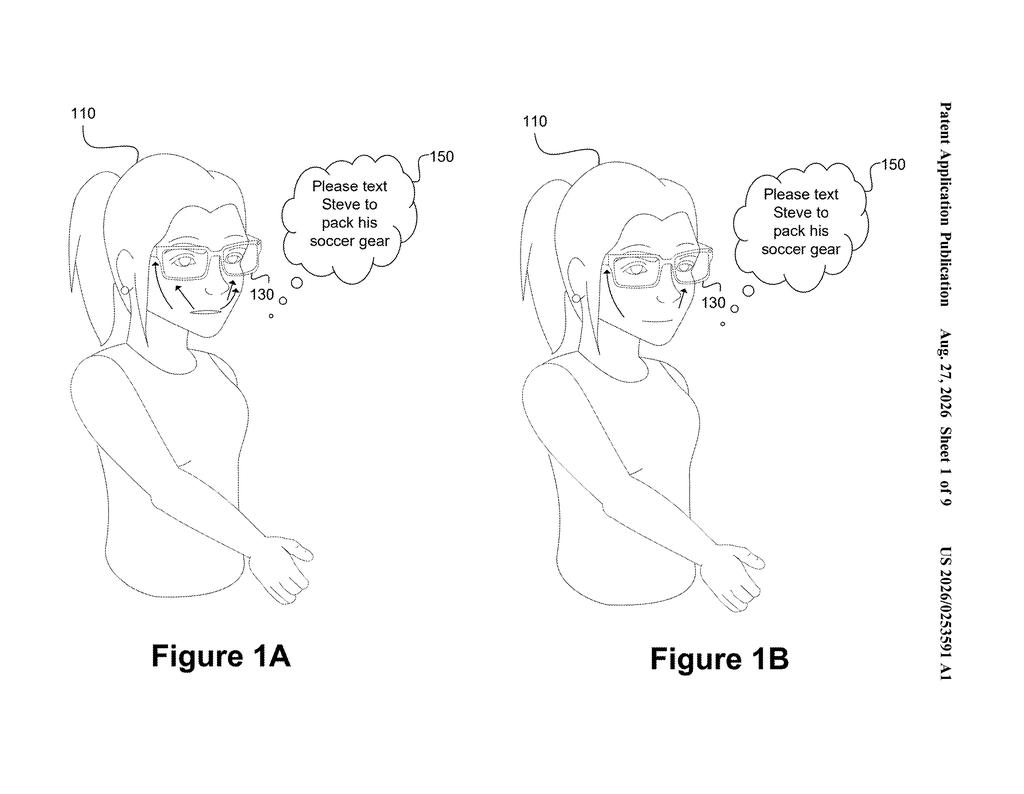
How Meta's silent-speech glasses would work for you
Ever tried to ask your voice assistant something in a quiet library or a loud crowd, only to feel awkward speaking out loud? Meta's patent tackles exactly that situation by letting the glasses do the listening without any actual sound involved.
The idea is that when you mouth a word, your face and jaw muscles still move in recognizable patterns, even if no air comes out. Meta's smart glasses would have sensors pressed against your head or face that pick up those muscle contractions and tiny vibrations, then translate them into the words you intended to say.
You'd never have to whisper or speak up. A silent lip movement, or even a partial one, could trigger a command or compose a message. It's the kind of input that would feel invisible to anyone standing next to you, which is precisely the point for a device you wear on your face all day.
receiving, by one or more processors, signals from one or more sensors of a wearable device worn by a user, wherein the one or more sensors are configured to contact a head or face of the user and to detect at least one of muscle contractions or vibrations associated with articulatory activity by the user; …
Translation: Sensors touching your face pick up the physical movements you make when trying to speak.
How face-contact sensors turn muscle twitches into words
The patent describes a wearable device, specifically citing smart glasses as the example, fitted with sensors that physically contact the user's head or face. These sensors are designed to detect two types of physical signals: muscle contractions (the firing of muscles involved in speech, like those around the jaw and lips) and vibrations (tiny mechanical oscillations that travel through facial tissue during articulation).
The system then runs those raw sensor signals through processing to determine what speech the user intended. The claim doesn't specify the exact decoding method, so it could involve machine-learning models trained on sub-vocal articulation data, signal-processing filters, or some combination.
Articulatory activity is the key phrase in the claim. It refers to the physical movements your mouth, tongue, jaw, and throat make when forming speech sounds, whether or not any breath or voice actually comes out. The patent covers detecting speech from those movements alone.
The first claim is written broadly: it covers any wearable device with face- or head-contact sensors that detect muscle contractions or vibrations tied to articulation. It doesn't restrict itself to glasses, to a specific sensor type (EMG, accelerometer, piezoelectric, etc.), or to a particular decoding algorithm.
For example, a user wearing smart glasses may silently mouth a command without producing audible sound, and the smart glasses may determine the speech based on muscle contractions and/or vibrations associated with the user's articulatory activity.
Translation: You can mouth a command while wearing smart glasses and the device will figure out what you said.
What silent speech detection means for AR wearables
For anyone who has wrestled with voice assistants in awkward settings, a silent-input system on glasses is a genuinely useful fix. Crowded offices, shared rooms, accessibility situations where speaking is difficult or impossible, these are all real friction points that silent speech detection could address without requiring you to pull out a phone or tap a button.
The claim's breadth is also worth noting from a product-strategy angle. By covering any face-contact wearable sensor that detects articulatory muscle activity, Meta is staking out wide ground in the emerging category of body-signal input for AR devices, the kind of interesting tech patents that map where the AR wearables race is heading beyond touchscreens and microphones.
This is the 59th Meta patent we've tracked on our smart glasses watchlist since May, adding to filings like one explaining AI decisions and one using gaze to shape sound.
Claim 1 covers a single loop: sensors touching the face detect muscle movement tied to speech, and a processor turns those signals into words. No specific sensor type is required, no particular decoding method, no accuracy standard. The claim draws a wide circle around the basic idea rather than around any specific way of doing it.
That width has real consequences. Any face-worn device that reads body signals from the head and converts them into speech could fall inside this claim, regardless of the underlying technology used to do it.
Whether that territory holds depends entirely on what the patent office does next. Examiners may push back and require narrower language before granting anything. But as written, Claim 1 stakes out a remarkably large piece of ground for a remarkably simple description.
Get our take in your Top Stories
Liked this breakdown? Add Patentlyze as a preferred source on Google, and our plain-English take shows up more often in your Top Stories the next time Meta patent news breaks.
There are more where this came from
We read every patent application Big Tech publishes and send you the ones worth knowing. Plain English, free, every week.
The drawings
9 drawing sheets from US 2026/0253591 A1 · click any drawing to enlarge


Want this weekly breakdown for a company we don't cover? Patentlyze Pro →
Be the first to weigh in