Meta
Meta · AR / VR · Filed Feb 21, 2025 · USPTO published Aug 27, 2026 · Aug 27 release
Meta Patents Smart Glasses That Pick One Voice Out of a Noisy Room
Meta is patenting a system that lets AR glasses lock onto a single person's voice in a noisy room and amplify it just enough to drown out everything else. It's a hearing aid concept built into a pair of glasses.
- Publication number
- US 2026/0253596 A1(US20260253596A1)
- Applicant
- Meta Platforms Technologies, LLC
- Filed · Published
- Feb 21, 2025 · Aug 27, 2026
- Inventors
- Vicki CHANG, Holly Marie ORMSETH, Camila Cortes DE ALMEIDA E DE VINCENZO, Jan LINDEN, Francesco NESTA, Alexander REICH, Andreas Thelander BERTELSEN
- Status when we published
- Examiner raised objections; the company can respond
- Document
- 20 claims
- US classification
- 704/226
- Examiner
- OPSASNICK, MICHAEL N (Art Unit 2658)
How Meta's AR glasses would tune into one voice
Ever tried to follow a conversation at a loud party while everything around you competes for your ears? Meta's latest patent application describes AR glasses that would handle exactly that situation automatically.
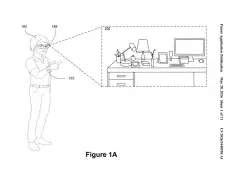
The glasses use their built-in microphones to measure how loud the background noise is, then pick a specific voice you want to hear. From there, they filter out other sounds, amplify just that one voice, and calibrate the volume so the remaining background noise stays below what your ears would naturally notice. The result: one clear voice cutting through the noise, without the rest of the room feeling artificially silent.
Think of it as a hearing boost mode you'd switch on when someone across the table is hard to hear, rather than a full hearing aid that's always on.
… based on the selected amplification gain for the audio signal, selecting a level of noise suppression to apply to the audio signal having the applied amplification gain, such that an amount of remaining residual noise is below the estimated level of ambient noise …
Translation: The system automatically adjusts noise reduction so that any background hiss stays quieter than the actual room noise.
How the system balances amplification and noise filtering
The patent describes a two-stage audio processing pipeline running inside an AR headset or glasses.
Stage one: measure the room. The device's microphones constantly sample ambient noise and calculate a baseline volume level. This number becomes the ceiling the system works around.
Stage two: amplify then filter (in that order). The system picks an amplification level based on the ambient noise measurement, applies that gain to the selected voice signal, and then chooses how aggressively to filter out other sounds. The filter strength is calculated so that whatever noise leaks through after filtering stays quieter than the ambient baseline the wearer would hear without any enhancement at all.
The patent describes two approaches:
- Set amplification first based on ambient noise, then tune the filter to keep residual noise below that ambient level.
- Filter first, measure how much noise remains in the filtered signal, then set amplification to bury that residual noise.
Voice selection can happen automatically (the system identifies a speaker) or manually (the user points to or designates someone). The output goes directly to the AR system's speakers, so the wearer hears a processed mix rather than raw room audio.
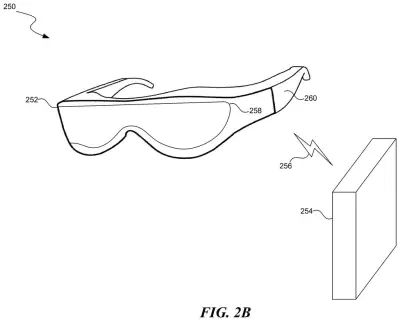
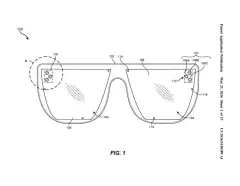
A hearing enhancement system can provide a wearer of an XR system, such as augmented reality (AR) glasses, heightened hearing for a conversation by accentuating a particular voice for the wearer.
Translation: These glasses can act like a hearing aid by isolating and boosting the voice of the person you are talking to.
What this means for hearing aid alternatives in AR
For people with mild hearing loss, or anyone in a consistently loud environment, a feature like this built into everyday AR glasses could be more practical than carrying dedicated hearing aids. The glasses are already on your face, the microphones are already there, and the processing happens in real time without any external device.
The latest Big Tech patents in AR audio show a clear push toward health-adjacent features that blur the line between consumer electronics and assistive technology, and this Meta filing sits squarely in that space. Whether it ships as a dedicated hearing mode or gets folded into broader audio settings, the underlying signal is that Meta sees AR glasses as a platform for hearing enhancement, not just visual overlays.
That makes this Meta's 56th filing we've tracked since May in the AR glasses race, a list that includes work on faster device pairing and finger-rub menu scrolling.
Source: US 2026/0253596 A1 at the USPTO (PDF). Full patent text and figures are in the official publication.
Get our take in your Top Stories
Liked this breakdown? Add Patentlyze as a preferred source on Google, and our plain-English take shows up more often in your Top Stories the next time Meta patent news breaks.
Add Patentlyze on Google
One click.
There are more where this came from
We read the new patents from Big Tech, carmakers and more and send you the ones worth knowing. Plain English, free, every week.
The drawings · 14 sheets
14 drawing sheets from US 2026/0253596 A1 · click any drawing to enlarge


Show the other 6 sheets


More from Meta
All 192 Meta patents →
More in AR / VR
All 718 AR / VR patents →
Meta
Meta Patents a Dual-Resolution Display Panel to Widen AR Headset Field of View
Meta
Meta's New Patent Hides Headset Hardware Where Your Eyes Can't See It
Meta
Meta Patents a Disambiguation System for Ray-Ban Glasses That Asks You to Clarify What You're Looking At
Meta