
Meta Patents a Display That Adjusts Its Light Beam to Match Your Pupil Size
Your pupil shrinks in bright light and opens wide in dim rooms, and most AR displays simply ignore that. Meta's new patent describes a system that tracks the change and reshapes its light output to match.
What Meta's pupil-matching AR display actually does
Imagine slipping on an AR headset and walking from a sunny patio into a dark room. The image quality stays crisp the entire time, because the headset widened its beam of light to match your now-larger pupil without you touching a thing.
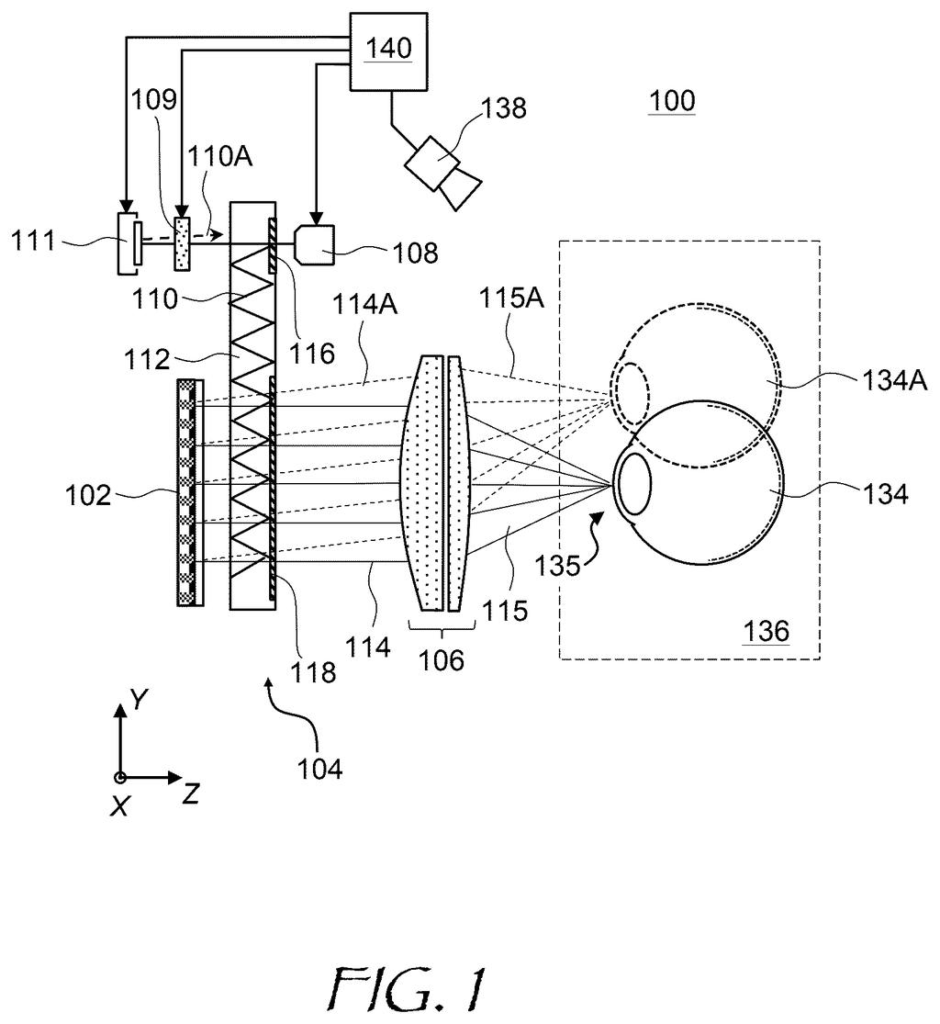
That is what this Meta patent is working toward. It describes a component called a switchable diffuser, a layer that can be turned on or off electronically to change how spread-out or concentrated the light hitting your eye is. When your pupil is small, the system sends a tight beam. When your pupil is large, it widens the beam to fill it. The goal is that none of the picture gets wasted by missing your pupil entirely.
A small tilting mirror inside the system can also nudge the beam left or right to keep it centered on your eye even if the headset shifts slightly on your face. Together, these two tricks are meant to make AR images look brighter and sharper across a wider range of real-world conditions.
… using a switchable diffuser to impart at least one of spatially variant amplitude or spatially variant phase delay to the illuminating light beam …
Translation: It uses a special screen to actively alter how the light waves spread out and shape the beam.
How the switchable diffuser tunes the exit pupil
The core of the patent is a switchable diffuser placed in the optical path before the display panel. A diffuser scatters light; switching it changes how much scattering happens. By controlling that scattering electronically, the system can tune the divergence of the light beam (how fast the beam spreads out as it travels). A tightly collimated beam produces a small exit pupil; a more divergent beam produces a larger one.
Exit pupil is the circular region in space where your eye can sit and still see the full image. If it is smaller than your actual pupil, you lose brightness and see a darkened or incomplete picture. If the two match, every photon the display produces reaches your retina.
The patent also describes a tiltable reflector (a small mirror that can pivot) that steers the beam laterally. This shifts the exit pupil's position so it tracks your eye even when the headset moves slightly on your head, a common problem that causes images to blink out at the edges.
The independent claim covers any method that:
- Generates a light beam
- Passes it through a switchable diffuser that changes the beam's amplitude or phase (how bright or how timed the light waves are) across its width
- Sends the result through a display panel to form an image
- Delivers that image to an eyebox
That structure is broad enough to cover a wide range of AR and VR display architectures that use a diffuser for beam shaping.
… tunable exit pupil size at the eyebox of the display apparatus, which may be matched to a pupil size of a user's eye …
Translation: The system changes the size of the light beam so it fits the exact width of your eye.
What this means for AR headset comfort and clarity
For anyone who has worn an AR or VR headset and noticed that the image dims or disappears when the device shifts a millimeter on your nose, this is the kind of fix that actually changes the experience. A display that adapts its beam to your pupil size in dim and bright environments reduces one of the most persistent annoyances in consumer headsets today.
Meta's long bet on AR and VR displays shows up clearly here. The claim language is wide, covering any switchable diffuser that applies spatially varying amplitude or phase to a light beam. That breadth means the patent, if granted, could touch competitors' designs even if they use different physical implementations of the diffuser, which raises the stakes well beyond a narrow engineering refinement.
This is the 63rd Meta filing we've tracked since May in the AR glasses race, continuing work seen in a multi-camera sharpness system and a position-tracking VR controller.
Claim 1 is written at a high level of abstraction. It does not specify what kind of switchable diffuser (liquid crystal, MEMS, holographic film, or anything else) or how the system decides when to switch. That breadth is deliberate, and it is the most important fact about this filing.
A claim that broad, if it survives examination, would give Meta a stake in almost any AR or VR display that uses an electrically tunable diffuser to control beam divergence. That is a foundational component category, not a narrow product feature. Competitors building next-generation headsets would need to work around it.
Whether the claim survives in this form is another question entirely. Patent examiners frequently push back on claims this wide, demanding narrower language tied to a specific mechanism. But as filed, this is an attempt to hold broad ground in a part of AR optics that every headset maker will eventually need to solve.
There are more where this came from
We read every patent application Big Tech publishes and send you the ones worth knowing. Plain English, free, every week.
The drawings
13 drawing sheets from US 2026/0276984 A1 · click any drawing to enlarge


Want this weekly breakdown for a company we don't cover? Patentlyze Pro →
Be the first to weigh in