
Meta Patent Targets Cleaner Muscle Signal Readings in Wristband Technology
Meta is building the hardware foundation for a wristband that reads your nerve and muscle signals well enough to control computers with subtle hand gestures. This patent covers two of the most unglamorous but important parts of that: how the electrodes are arranged, and how the circuitry is protected from electrical noise.
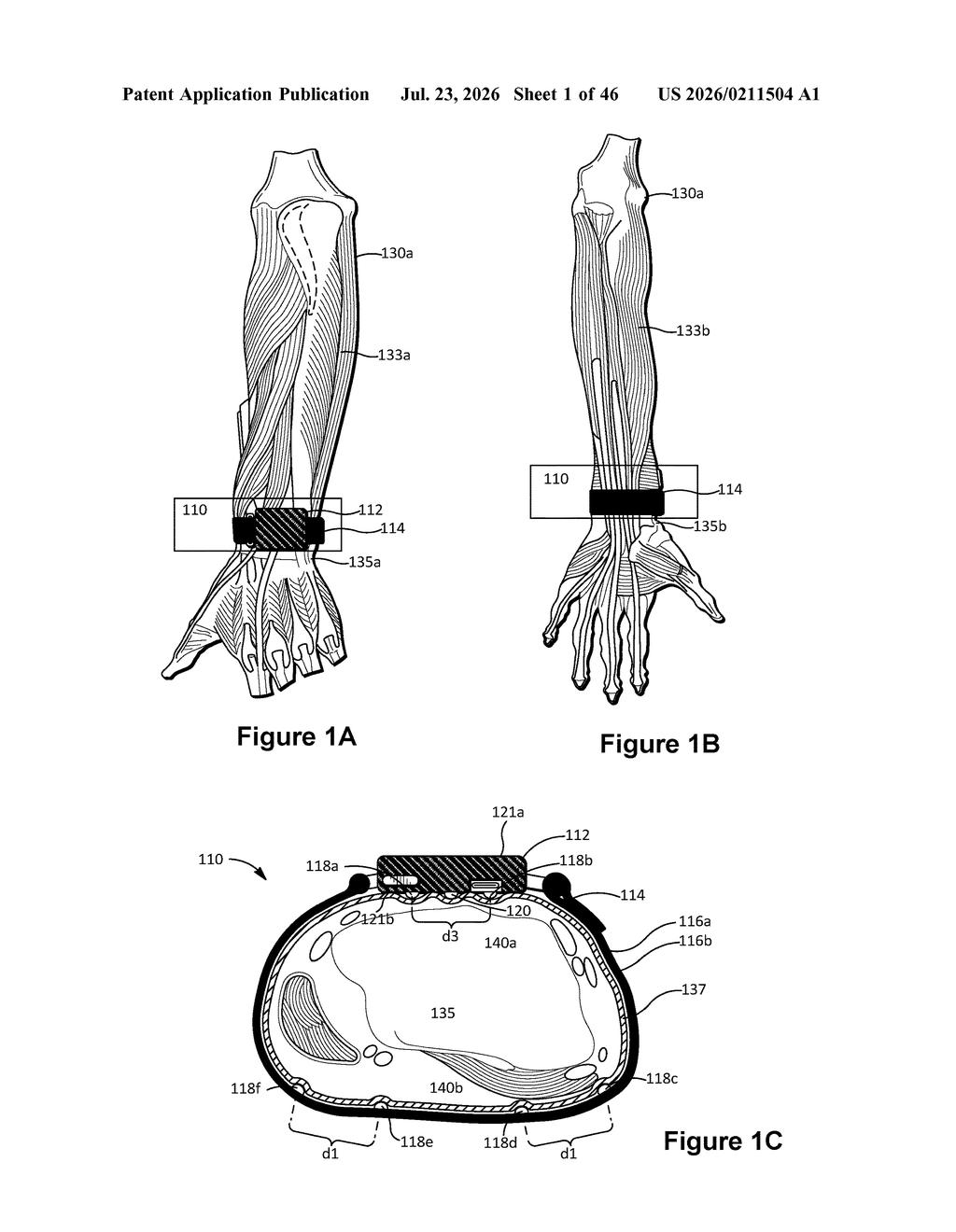
What Meta's muscle-reading wristband actually does
Imagine a wristband that can tell whether you're twitching your index finger or your ring finger, just from the tiny electrical signals your muscles and nerves send when you move. That's what Meta is working toward with its neural input research, and this patent covers a specific piece of the puzzle: how to lay out the sensing electrodes on the inside of the band.
The key idea here is spacing. Each pair of electrodes that forms a sensing "channel" is kept no more than 9 millimeters apart, center to center. That's roughly the width of a pencil eraser. Keeping them that close means the wristband can pick up signals from a small, specific area of your wrist rather than getting a blurry average across a wider stretch of skin.
The patent also describes a metal shield that wraps around the circuit board inside the device. Your home's electrical wiring creates a faint 50 or 60 Hz hum that can drown out the far weaker signals your muscles produce. The shield is designed to block that interference before it ever reaches the sensitive parts of the circuit.
How the electrode spacing and shielding work together
The patent covers two related design choices that work together.
Electrode arrangement: The wristband holds multiple sets of electrodes. Within each set, the two electrodes that form a sensing channel are separated by no more than 9 mm (center to center). In electromyography (EMG, the technique of reading muscle electrical signals), tighter spacing means better "spatial resolution", the ability to distinguish activity in one small muscle group from a neighboring one. This matters enormously for gesture recognition: a system trying to tell a pinch from a point needs to pick up very localized signals.
Electromagnetic (EM) shielding: The circuit board inside the device has sensitive analog components (amplifiers and filters that handle the raw, tiny electrical signals before they're digitized) mounted on its top surface, with the sensors on the bottom. A metal shield is shaped to wrap around the board's sides and cover those analog components, forming a partial enclosure.
- The shield blocks power line interference, the 50/60 Hz electrical noise that radiates from household wiring and can be many times stronger than an actual muscle signal.
- The design positions the shield between channels as well, reducing crosstalk (signal leakage between adjacent sensing channels).
- By shielding at the component level rather than the whole device level, the design stays compact enough for a wearable form factor.
What this means for Meta's gesture-control ambitions
Meta has been openly investing in wrist-based neural input as a core interface for its AR glasses and mixed-reality headsets. The promise is that instead of fumbling with a controller or air-typing, you'd make tiny, natural hand movements that the wristband interprets as commands. For that to work reliably in everyday environments, offices, kitchens, outdoors, the hardware has to be able to cleanly isolate individual muscle signals even when you're near appliances, power outlets, or fluorescent lights.
This patent is not a product announcement, but it reflects the kind of incremental, detail-level engineering that turns a lab demo into something you'd actually wear. The 9 mm spacing figure and the shielding geometry suggest Meta's hardware team is past the "does this concept work" stage and into "how do we make it work reliably on real wrists in real rooms."
This is foundational hardware work, not a flashy feature patent, but it's the kind of thing that determines whether a product ever actually ships. The specific electrode spacing number and the described shielding geometry suggest a team that has moved well beyond early prototypes. If Meta's wrist-input wearable ever reaches consumers, patents like this one will have been the unsexy reason it works.
There are more where this came from
We read every patent application Big Tech publishes and send you the ones worth knowing. Plain English, free, every week.
The drawings
46 drawing sheets from US 2026/0211504 A1 · click any drawing to enlarge


Want this weekly breakdown for a company we don't cover? Patentlyze Pro →