
Microsoft
Microsoft · AI / ML · Filed Mar 27, 2025 · USPTO published Oct 1, 2026 · Oct 1 release
Microsoft Patents AI That Catches and Fixes Bias in Legal Case Analysis
AI is already being used to help analyze legal cases, but if the data those models trained on is skewed, so are their conclusions. Microsoft is patenting a system designed to catch and fix that bias before it influences a legal outcome.
- Publication number
- US 2026/0301087 A1(US20260301087A1)
- Applicant
- Microsoft Technology Licensing, LLC
- Filed · Published
- Mar 27, 2025 · Oct 1, 2026
- Inventors
- Aanchal GUPTA, Abhilasha BHARGAV-SPANTZEL
- Status when we published
- Approved; patent expected soon
- Document
- 20 claims
- US classification
- 705/311
- Examiner
- CHEN, GEORGE YUNG CHIEH (Art Unit 3628)
What Microsoft's AI fairness engine does in court cases
You're a lawyer using an AI tool to research case precedents, and the tool keeps surfacing results that favor one demographic group over another because the historical cases it learned from were themselves unfair. That's not a hypothetical: it's a real concern with AI in legal settings.
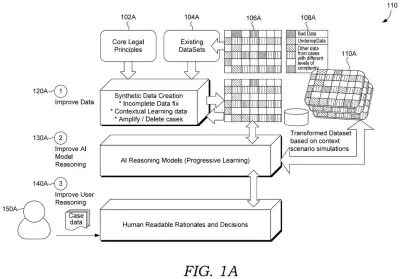
Microsoft's patent describes a system that tries to fix this at the root. Instead of just flagging bias after the fact, it looks for gaps in the legal record, types of cases or communities that are underrepresented in training data, and then generates fictional but realistic case variations to fill those gaps before the AI model ever makes a decision.
The system also keeps updating itself over time, pulling in new court rulings and changing regulations so that its sense of "fairness" doesn't get frozen in the past. And it includes tools that explain, in plain language, why the AI reached a particular conclusion, so a human can actually check its work.
… analyzing the dataset to identify jurisprudential gaps associated with the legal cases; based on the jurisprudential gaps, determining legal case parameters for generating synthetic case variations; using the legal case parameters, generating the synthetic case variations associated with the jurisprudential gaps; …
Translation: The system finds missing legal perspectives and invents fake case data to fill those blind spots.
How the system spots gaps and fills them with synthetic cases
The core of this system is what Microsoft calls a bias mitigation engine layered on top of an AI-driven legal analysis platform. It works in several stages.
First, the system scans a legal database and identifies jurisprudential gaps (areas of law or categories of people that are poorly represented in the historical case record). From those gaps, it determines parameters for generating synthetic case variations, fabricated but plausible legal scenarios designed to balance out the training data.
Those synthetic cases are then used to update an adaptive AI model, which is continuously retrained rather than frozen at a single point in time. The system also uses Retrieval-Augmented Generation (RAG), a technique where the model can dynamically look up recent court decisions or regulatory changes rather than relying solely on what it learned during training, to stay current.
On the auditing side, the engine applies adversarial testing (deliberately trying to expose biased outputs) and statistical fairness checks. Explainability tools like SHAP and LIME (methods that break down which factors drove a particular AI decision, in human-readable terms) generate rationales a human reviewer can actually evaluate. The whole system is designed to recalibrate continuously rather than require a one-time fix.
The bias mitigation engine utilizes synthetic data generation, fairness metrics, and scenario-based training to ensure equitable representation of legal cases.
Translation: It relies on fake case scenarios and fairness scorecards to make sure the legal analysis stays balanced.
What this means for AI tools used in legal decisions
Legal AI tools are already in use at law firms and in courts, and the stakes for bias there are much higher than in, say, a movie recommendation engine. A skewed output could influence bail decisions, sentencing recommendations, or contract analysis, outcomes with real consequences for real people. A system that actively hunts for gaps in its own training data and patches them is a meaningfully different approach from one that just monitors outputs after the fact.
For everyday users, this matters because AI in legal settings is not going away. If you ever interact with the legal system and an AI tool has touched the analysis behind a decision about your case, you'd want that tool to have been trained on a balanced picture of who actually gets taken to court and why. Microsoft's run of AI-accountability filings suggests this is an area the company is treating as infrastructure, not an afterthought.
Microsoft's 19th filing we've tracked since July in the AI guardrails race continues a pattern that includes a self-checking AI agent and a code safety screener.
Source: US 2026/0301087 A1 at the USPTO (PDF). Full patent text and figures are in the official publication.
Get our take in your Top Stories
Liked this breakdown? Add Patentlyze as a preferred source on Google, and our plain-English take shows up more often in your Top Stories the next time Microsoft patent news breaks.
Add Patentlyze on Google
One click.
There are more where this came from
We read the new patents from Big Tech, carmakers and more and send you the ones worth knowing. Plain English, free, every week.
The drawings · 10 sheets
10 drawing sheets from US 2026/0301087 A1 · click any drawing to enlarge


Show the other 2 sheets


More from Microsoft
All 681 Microsoft patents →
More in AI training & infrastructure
All 324 AI training & infrastructure patents →
OpenAI
OpenAI Patents a Watchdog AI That Reads Other Models' Internal Reasoning
IBM
IBM Patents an AI That Catches Bad Data by Reading Rows Like Sentences
Adobe
Adobe Patents a Way to Send Human Reviewers Only the Data That Will Trip Them Up
IBM
No comments yet