
Microsoft · Filed Jun 27, 2025 · Published Oct 29, 2026

A New Microsoft Patent Teaches AI Chatbots When to Be Warm and When to Be Brisk

Ask a chatbot for help with a grief and ask it to proofread an email, and you often get the same cheerful voice. A new Microsoft patent application tries to fix that by matching the amount of warmth to the job.
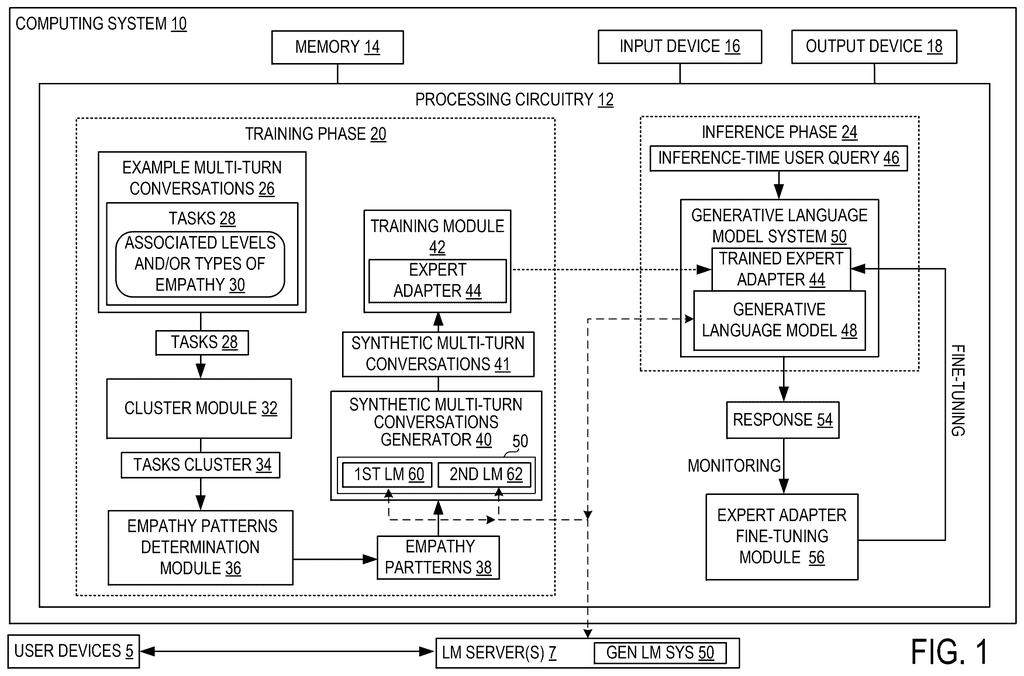
A computer setup that teaches an AI assistant to sense how a person feels and reply with warmth or brevity. Drawing from patent filing US 2026/0339933 A1.
A computer setup that teaches an AI assistant to sense how a person feels and reply with warmth or brevity.
See all 33 drawings from this filing ↓
Publication number US 2026/0339933 A1 US20260339933A1
Applicant Microsoft Technology Licensing, LLC
Filing date Jun 27, 2025
Publication date Oct 29, 2026
Inventors Jin A SUH, Javier HERNANDEZ RIVERA, Nagendran RANGAN, Seyed Erfan SHAYEGANI, Andrew David WILSON
US classification 707/769
Examiner JACOB, AJITH (Art Unit 2161)
Status when we published Company responded; back with the examiner (Sep 30, 2026)
Parent application Claims priority from a provisional application 63794971 (filed 2025-04-25)
Document 20 claims

What Microsoft's empathy-tuned chatbot add-on does

Imagine you tell an AI assistant you're struggling after a rough week, and it answers in the same chirpy voice it uses to fix your spreadsheet formulas. Or you ask for help with a cover letter and get a long, gushing pep talk. Chatbots tend to have one emotional setting, and it's often wrong for the moment.

Microsoft's filing describes a way to give a chatbot different levels of warmth for different kinds of requests. The company studied hundreds of real conversations in which people said how much empathy they wanted before chatting and how much they felt they got afterward. People wanted much more for personal problems and distressing situations than for learning a skill or working through an assignment.

The patent then uses that pattern to train small add-on pieces, one per type of request, that nudge the chatbot's tone up or down depending on what you're asking about.

From the filing · CLAIM 1
… cluster the tasks based on empathy levels and/or types associated with each task to identify shared empathy task clusters; determine empathy patterns for each task cluster; generate synthetic multi-turn conversations for each task cluster based on the empathy patterns …

Translation: The system groups similar tasks together and creates practice dialogues to learn the right tone.

How Microsoft trains a chatbot's tone by task

The filing describes a training phase and a use phase. In training, the system collects example multi-turn conversations (back-and-forth chats) between people and AI models. Each conversation is tied to a task, such as writing help or personal issues, and to how much empathy the user expected and how much they felt they received.

The tasks are then grouped into clusters that share similar empathy needs. In the company's example, eight tasks were sorted into four clusters, including "Distressing/Social/Personal Situations" and "Learning Skills." Each cluster gets its own empathy pattern.

Because real conversations are limited (the example dataset had 755), the system generates synthetic conversations, meaning AI-written practice chats steered toward each cluster's pattern. Those are used to train an expert adapter, a small add-on layer that changes how the main model talks without rewriting the model itself. The filing says these can be LoRA adapters, a common lightweight method.

A scoring system (a reward model, which grades conversations on how well they match the target empathy) helps fine-tune the adapter. At use time, the model spots your task and answers with the empathy level that fits. The claims also cover other tone traits, such as humor, formality, friendliness and curiosity.

From the filing · THE ABSTRACT
… train an expert adapter based on the synthetic multi-turn conversations to adapt an output of the generative language model system to achieve a task-specific target level and/or type of empathy.

Translation: An add on module is trained using those practice dialogues so the chatbot knows how much warmth to show.

Why chatbot tone matters for Microsoft's AI products

For you, the practical payoff is an assistant that reads the room. Support bots, coaching apps and health-adjacent tools are where a tone-deaf reply costs the most, and the filing names mental health support, customer service and coaching as target uses. The company reports that adapters cut the gap between desired and perceived empathy by about 72.66% in its tests, and held up better across long chats than a plain instruction telling the model to be empathetic.

The filing is a patent application, and the examiner's first review rejected the claims as filed, which is routine and usually followed by amendments. Nothing here says it will ship in a product, but it shows Microsoft treating tone as something to be engineered per task.

This is the 19th Microsoft patent we've tracked in voice & speech AI since May, including one that filters out other voices and one that picks reply format.

Editorial take

The problem here is real. Anyone who has poured out a bad day to a chatbot and received a bulleted list of tips knows how jarring a wrong tone feels, and the filing's own data shows people want very different warmth for a personal crisis than for learning a skill. A mismatch costs trust, and in sensitive moments it can sting.

The approach fits the size of that problem. Tuning one dial per type of request, using what people said they wanted, is a sensible step, and the finding that a long instruction fades as a chat gets longer matches what many users notice.

The open question is whether the data behind it is big enough. It rests on 755 conversations from 109 mostly professional participants. That is a modest sample for deciding how a global audience wants to be comforted.

Get our take in your Top Stories

Liked this breakdown? Add Patentlyze as a preferred source on Google, and our plain-English take shows up more often in your Top Stories the next time Microsoft patent news breaks.

There are more where this came from

We read every patent application Big Tech publishes and send you the ones worth knowing. Plain English, free, every week.

The drawings

33 drawing sheets from US 2026/0339933 A1 · click any drawing to enlarge

Training an AI to match its tone to your task, drawing sheet 1 from US 2026/0339933 A1
Sheet 1 Training an AI to match its tone to your task
Instructions that keep an AI focused on your conversation topic, drawing sheet 2 from US 2026/0339933 A1
Sheet 2 Instructions that keep an AI focused on your conversation topic
Testing how well the AI spots caring replies, drawing sheet 3 from US 2026/0339933 A1
Sheet 3 Testing how well the AI spots caring replies
Comparing predicted empathy ratings against human judgments, drawing sheet 4 from US 2026/0339933 A1
Sheet 4 Comparing predicted empathy ratings against human judgments
How desired empathy levels shift between personal crises and work, drawing sheet 5 from US 2026/0339933 A1
Sheet 5 How desired empathy levels shift between personal crises and work
Maintaining a warm tone over long back-and-forth chats, drawing sheet 6 from US 2026/0339933 A1
Sheet 6 Maintaining a warm tone over long back-and-forth chats
Left half of data linking felt empathy to chat satisfaction, drawing sheet 7 from US 2026/0339933 A1
Sheet 7 Left half of data linking felt empathy to chat satisfaction
Right half of data linking felt empathy to chat satisfaction, drawing sheet 8 from US 2026/0339933 A1
Sheet 8 Right half of data linking felt empathy to chat satisfaction
Show the other 25 sheets
Comparing how different AI models rate and express empathy, drawing sheet 9 from US 2026/0339933 A1
Sheet 9 Comparing how different AI models rate and express empathy
Instructions telling an AI how to judge helpfulness in chats, drawing sheet 10 from US 2026/0339933 A1
Sheet 10 Instructions telling an AI how to judge helpfulness in chats
Example prompts used to make realistic test questions, drawing sheet 11 from US 2026/0339933 A1
Sheet 11 Example prompts used to make realistic test questions
Follow-up instructions for creating diverse crisis queries, drawing sheet 12 from US 2026/0339933 A1
Sheet 12 Follow-up instructions for creating diverse crisis queries
Sample questions about personal crises created for tests, drawing sheet 13 from US 2026/0339933 A1
Sheet 13 Sample questions about personal crises created for tests
How matching emotional warmth raises satisfaction across tasks, drawing sheet 14 from US 2026/0339933 A1
Sheet 14 How matching emotional warmth raises satisfaction across tasks
User frustration spikes when an AI misses the desired warmth, drawing sheet 15 from US 2026/0339933 A1
Sheet 15 User frustration spikes when an AI misses the desired warmth
Rules that direct the chatbot to sound comforting and caring, drawing sheet 16 from US 2026/0339933 A1
Sheet 16 Rules that direct the chatbot to sound comforting and caring
Coaching an AI to encourage a learner, drawing sheet 17 from US 2026/0339933 A1
Sheet 17 Coaching an AI to encourage a learner
Prompts directing the bot to stay purely practical, drawing sheet 18 from US 2026/0339933 A1
Sheet 18 Prompts directing the bot to stay purely practical
Practice dialogues used to shape conversational tone, drawing sheet 19 from US 2026/0339933 A1
Sheet 19 Practice dialogues used to shape conversational tone
Standards an AI judge uses to rate chat replies, drawing sheet 20 from US 2026/0339933 A1
Sheet 20 Standards an AI judge uses to rate chat replies
Steps for generating artificial multi-turn chats across topics, drawing sheet 21 from US 2026/0339933 A1
Sheet 21 Steps for generating artificial multi-turn chats across topics
Training setup for the scoring model that rates bot empathy, drawing sheet 22 from US 2026/0339933 A1
Sheet 22 Training setup for the scoring model that rates bot empathy
Accuracy test scores for the automated empathy grader, drawing sheet 23 from US 2026/0339933 A1
Sheet 23 Accuracy test scores for the automated empathy grader
Settings used to train the model that tracks user preferences, drawing sheet 24 from US 2026/0339933 A1
Sheet 24 Settings used to train the model that tracks user preferences
Training settings used to tune the conversational AI models, drawing sheet 25 from US 2026/0339933 A1
Sheet 25 Training settings used to tune the conversational AI models
Sample dialogue showing how the adapter keeps a supportive tone, drawing sheet 26 from US 2026/0339933 A1
Sheet 26 Sample dialogue showing how the adapter keeps a supportive tone
Test scores showing adapters outperform standard prompts across tasks, drawing sheet 27 from US 2026/0339933 A1
Sheet 27 Test scores showing adapters outperform standard prompts across tasks
Glitches removed during synthetic dialogue generation, drawing sheet 28 from US 2026/0339933 A1
Sheet 28 Glitches removed during synthetic dialogue generation
Common chatbot behaviors that frustrate real users, drawing sheet 29 from US 2026/0339933 A1
Sheet 29 Common chatbot behaviors that frustrate real users
Comparing discrete and continuous scoring for empathy ratings, drawing sheet 30 from US 2026/0339933 A1
Sheet 30 Comparing discrete and continuous scoring for empathy ratings
Accuracy metrics across different ways of prompting the judge AI, drawing sheet 31 from US 2026/0339933 A1
Sheet 31 Accuracy metrics across different ways of prompting the judge AI
Steps for training and running task specific empathy adapters, drawing sheet 32 from US 2026/0339933 A1
Sheet 32 Steps for training and running task specific empathy adapters
Hardware parts that run the chatbot system, drawing sheet 33 from US 2026/0339933 A1
Sheet 33 Hardware parts that run the chatbot system
Browse all the drawings 33 drawing sheets
Patent filing page

Source. Full patent text and figures from the official USPTO publication PDF.
Reader comments

Be the first to weigh in

Start the discussion

Real name or a handle, either is fine. Comments are read by a person before they appear, so allow a little time. Keep it about the filing.