
Microsoft Patents an AI System That Groups Cloud Warnings Into Actionable Outage Summaries
When something goes wrong inside a cloud platform, hundreds of error signals fire at once, and figuring out which ones are related is slow, manual, and expensive. Microsoft has filed a patent for a system that uses AI to group those signals automatically, then tells engineers what probably caused the problem.
What Microsoft's anomaly-grouping system actually does
Every time a cloud service hiccups, dozens or hundreds of tiny warning signals light up across different servers, regions, and software layers. An engineer trying to fix the outage has to sift through all of them and guess which ones are connected. That's a lot of noise when something is actively broken.
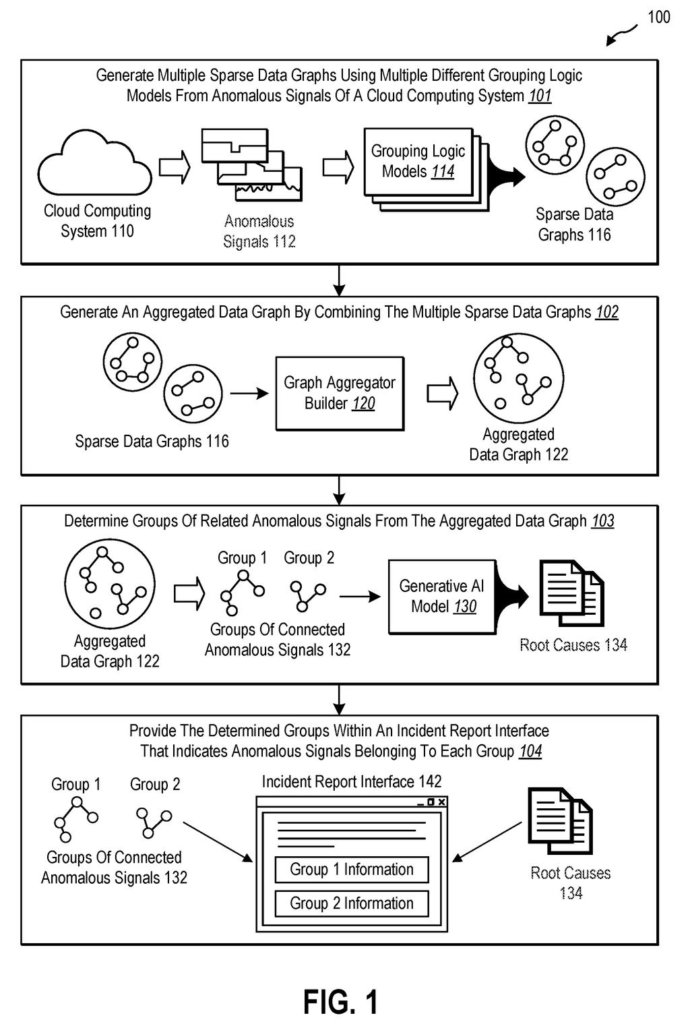
Microsoft's patented system does the sorting automatically. It applies several different grouping rules at once, each looking for a different kind of connection between warnings, then stitches the results together into a single map. From that map, a generative AI model figures out the most likely root cause and presents everything in one incident report, with suggested (or already-taken) fixes alongside it.
The goal is to get from "something is wrong" to "here's what broke and why" without requiring an engineer to spend an hour correlating log files by hand.
… generating, using multiple different grouping logic models, multiple data graphs that each include groups of related anomalous signals from the set of detected anomalous signals; generating an aggregated data graph by combining the multiple data graphs to form multiple groups of connected anomalous signals; …
Translation: The system runs several different models to sort error alerts and then merges the results into a single comprehensive map.
How the system connects error signals into a single graph
The system starts with a batch of anomalous signals (error events, metric spikes, dropped packets, and similar indicators) detected across a cloud environment.
Instead of applying one grouping rule, it runs multiple grouping logic models in parallel. Each model uses a different strategy for deciding which signals belong together, for example, signals on the same server, signals in the same time window, or signals affecting the same service dependency. Each model produces its own data graph, a network diagram where nodes are signals and edges mean "these two are related."
The system then aggregates those graphs into one combined graph. Where two initially separate groups share even one signal in common, they get merged. This is how it catches cross-cutting problems that a single grouping strategy would miss.
Finally, a generative AI model (the kind of large language model that can reason across context, not just pattern-match) analyzes the first group's signals and proposes a root cause. The whole picture, groups, root cause, and remediation actions, lands in an incident report interface that operators can act on directly.
… the anomaly-based mitigation system presents the anomalous signal groups in an incident report interface that includes actions to take or actions that were automatically taken to resolve a service incident.
Translation: Engineers see the organized alerts in a dashboard along with specific steps to fix the problem.
What this means for cloud outages and the people who fix them
Cloud platforms run thousands of interdependent services, and when something goes wrong, the flood of alerts is often the hardest part of the problem. On-call engineers at companies running Microsoft Azure or similar infrastructure routinely spend the first hour of an incident just figuring out what they're actually looking at. A system that does that correlation automatically and hands over a prioritized, cause-labeled report could cut that time significantly.
From a product angle, this fits squarely into the broader push to make AI a co-pilot for IT operations, a category sometimes called AIOps. Microsoft keeps filing on AI-assisted cloud operations across observability, diagnostics, and remediation. Whether this specific architecture ships as a feature in Azure Monitor or a similar tool isn't clear from the filing, but the target user is obvious: the engineer paged at 2 a.m.
Microsoft's 70th filing in the Language AI patents we've tracked since May adds to a run that includes one on spotting document gaps and one on testing AI ranking models.
Microsoft already runs the cloud infrastructure, the anomaly-detection pipelines, and the AI models this system needs. There is no new hardware to build, no outside vendor to depend on, and no waiting for a technology that does not exist yet.
The core idea is straightforward: instead of having engineers manually connect the dots when something breaks across a cloud network, this system groups the warning signals automatically and then offers a reasoned explanation of what went wrong. The gap between that description and a working product is mostly about training the AI on enough real incidents to make its suggestions trustworthy, which is harder to prove in a patent than it is to build.
For any organization paying people to be on call at two in the morning, automating that first triage step has obvious value. Microsoft is already in position to ship something like this without asking customers to change how they work.
There are more where this came from
We read every patent application Big Tech publishes and send you the ones worth knowing. Plain English, free, every week.
The drawings
14 drawing sheets from US 2026/0300474 A1 · click any drawing to enlarge


Want this weekly breakdown for a company we don't cover? Patentlyze Pro →
Be the first to weigh in