
Microsoft Patents a Separate Safety Layer That Reviews Medical AI Chats in Real Time
Microsoft is patenting a system that sits between a user and a medical AI model intercepting every message to make sure the conversation stays on clinical track. If your question falls outside the guidelines, the AI never even sees it.
What Microsoft's clinical AI guardrail actually does
A doctor types a question into an AI assistant during a clinical session. That message doesn't go straight to the AI. Instead, a separate piece of software reads it first, checks it against medical guidelines, and only forwards it if it passes.
That's the core of what Microsoft is describing here. The idea is that a standalone gatekeeper processor monitors everything exchanged in a session between a user and a generative AI, specifically one being used for clinical practice. If a message doesn't fit the scope of that session, the system sends the message back and asks the user to try again with something more appropriate.
For you as a user, the experience looks like a chat interface. Under the hood, a second system is acting as a referee, deciding what the AI gets to see and respond to. The goal is keeping AI-assisted clinical conversations focused and within sanctioned medical guidelines.
monitoring, by a model safeguarding processor, an interactive session between a user and a generative Artificial Intelligence (AI) system to ensure that content exchanged between the user and the generative AI system complies with guidelines for clinical practice, the model safeguarding processor being independent from the generative AI system …
Translation: A separate processor watches the AI chat to make sure everything follows medical rules.
How the safeguarding processor intercepts and reroutes messages
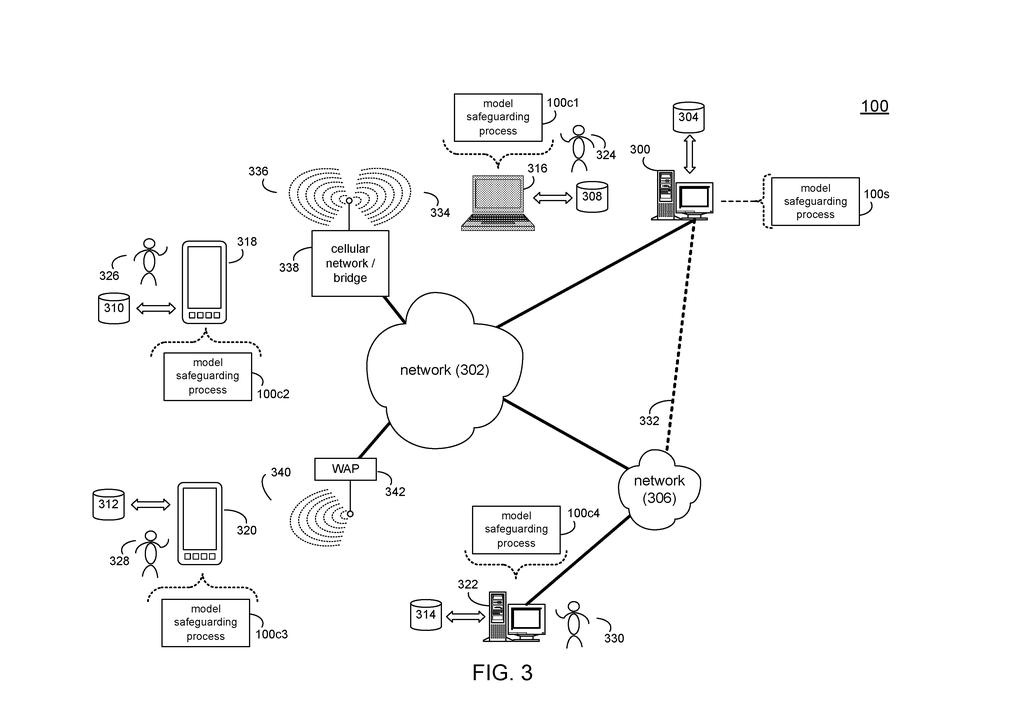
The patent describes a model safeguarding processor that operates independently from the generative AI model itself. That independence is the key design choice: rather than asking the AI to police itself, Microsoft proposes a separate software layer that acts as an intermediary.
Here is how a session works under the patent:
- A user sends an initial message during a clinical AI session.
- The safeguarding processor receives that message first, before the AI does.
- It evaluates the message against guidelines for clinical practice to decide whether the content is relevant and appropriate.
- If the message passes, it gets forwarded to the AI. If it fails, the processor asks the user to send a replacement inquiry instead.
- The replacement message is then transmitted to the AI in place of the original.
The claim language is specific about the processor being independent from the generative AI system. This matters because it means the guardrail cannot be bypassed by prompting the AI in clever ways. The gatekeeper is outside the model's control entirely.
The patent also mentions determining whether content is relevant to the analysis protocol, which suggests the system could enforce topical scope, not just safety rules. A question about something outside the defined clinical task could be rejected even if it isn't harmful.
… determining whether the received content is relevant with respect to the analysis protocol.
Translation: The system checks if the user's input matches the intended medical plan.
What this means for AI tools used in clinical settings
For anyone using an AI tool in a medical or clinical context, the failure mode this targets is real: a general-purpose AI drifting off-topic, giving advice outside its authorized scope, or being steered off-script by an unusual prompt. An external gatekeeper that the AI itself cannot override is a more defensible architecture than asking the model to self-regulate.
a growing pile of Microsoft AI-safety filings suggests the company is building out infrastructure for regulated-industry deployments, not just consumer products. Whether this specific approach reaches production, the architectural idea, that the safeguard lives outside the model, is likely to matter more than any single product release.
Microsoft's 20th filing we've tracked since July in the AI safety guardrails race continues a pattern seen in the legal bias catcher and the self-critiquing security agent: applying internal checks to keep AI outputs honest.
From a reader's perspective, the concrete payoff here is accountability. If you're a clinician using an AI assistant, you want to know the tool cannot be talked into going off-script. A separate enforcer that the AI never controls addresses that concern more directly than a system prompt or a fine-tuned model boundary.
The patent is procedurally straightforward. There's no exotic algorithm here, just a routing layer with a compliance check. The originality is in formalizing the independence of the gatekeeper, which makes it harder to bypass and easier to audit.
Whether this translates into a product or remains an architectural idea depends on adoption in clinical software. But for regulated sectors where liability follows every AI output, this kind of documented, auditable guardrail is exactly the design choice that procurement teams and regulators will ask about.
There are more where this came from
We read every patent application Big Tech publishes and send you the ones worth knowing. Plain English, free, every week.
The drawings
3 drawing sheets from US 2026/0300484 A1 · click any drawing to enlarge


Want this weekly breakdown for a company we don't cover? Patentlyze Pro →
Be the first to weigh in