
Microsoft Patents a Way to Run AI Models Inside Your Browser Without the Cloud
Microsoft has filed a patent for running AI entirely inside your web browser, on your own device, without sending your data to a remote server. That single shift has real consequences for both privacy and how quickly AI can respond.
What Microsoft's in-browser AI processing actually does
A doctor types patient notes into a web app. Without thinking about it, those notes travel across the internet to a distant server, get processed by an AI, and come back. That round trip takes time, and it means sensitive information left the device.
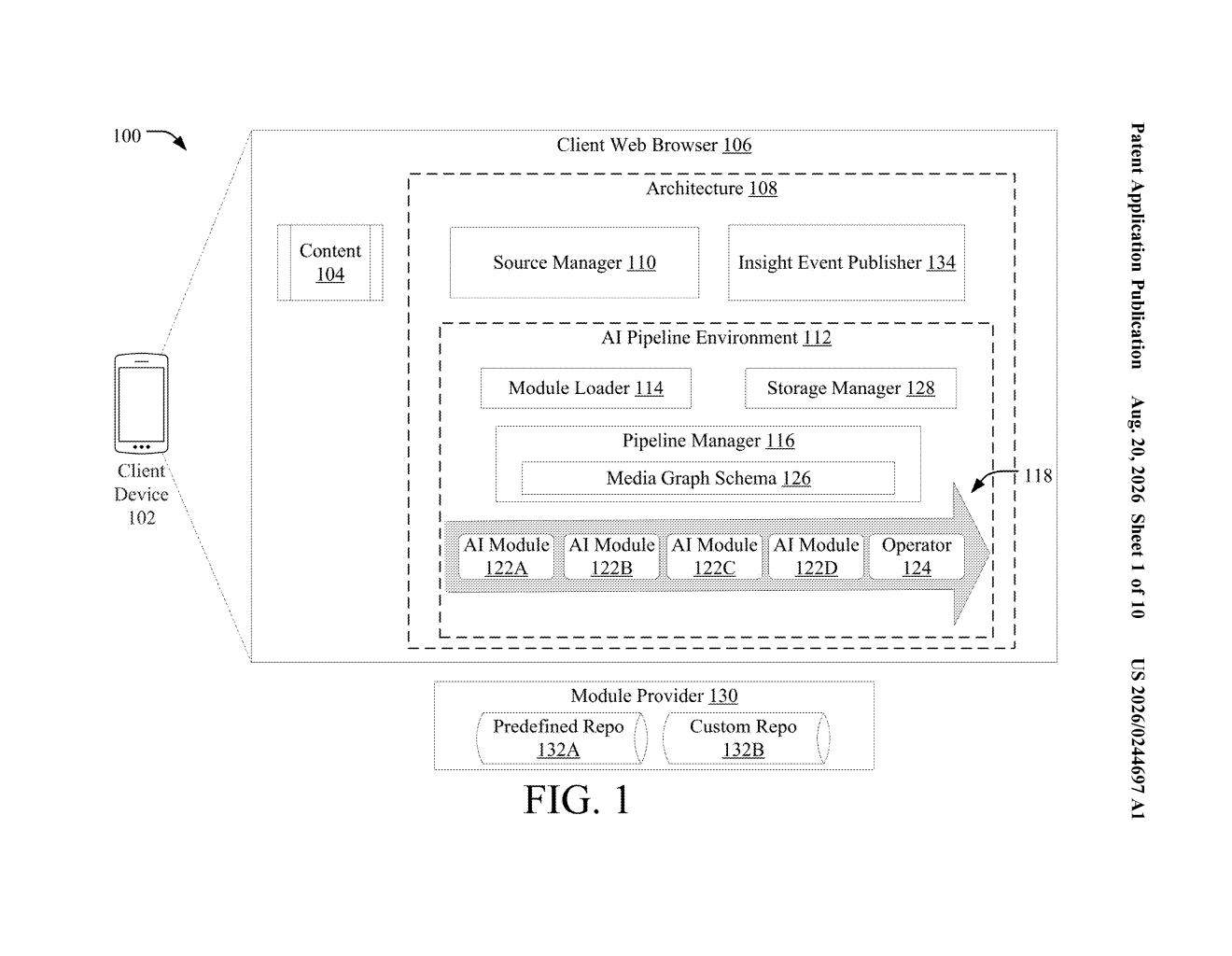
Microsoft's patent describes a system that skips that round trip entirely. The AI would run inside your browser, on your own computer or phone, processing your content locally before you ever see a result. You pick an AI task (summarizing, analyzing, whatever the app offers), your content gets broken into chunks, and a set of AI modules loads up inside the browser to handle those chunks on the spot.
The key idea is that neither your raw data nor the AI's intermediate work needs to leave your device. The browser becomes the AI engine, not just the window to one.
The content is segmented into multiple data segments and a set of data features is generated for the data segments. AI modules associated with the AI pipeline are loaded to create the AI pipeline. The set of data features is provided to the AI pipeline.
Translation: Your browser chops up your files and feeds them into local AI tools.
How the patent's AI pipeline segments and analyzes data locally
The patent describes a browser-based system that runs a full AI pipeline (a chain of AI processing steps) entirely on the user's device. Here is the sequence the patent lays out:
- The user selects an AI pipeline, meaning a specific type of AI task they want to perform.
- The system receives the user's content and segments it into smaller data chunks, making it easier for the AI to handle piece by piece.
- A set of data features is extracted from those chunks (structured representations the AI can actually read and analyze).
- The relevant AI modules are loaded directly into the browser to assemble the chosen pipeline.
- The pipeline runs locally, generating insights from the features, and those results are delivered back to the user.
The architecture is modular: different AI tasks can be served by loading different combinations of AI modules, so the browser does not need one giant monolithic model sitting in memory at all times.
The claim that has been published covers the overall method. Worth noting: claims 1 through 20 were canceled in the published version, which is not unusual at this stage of prosecution and does not necessarily reflect the final scope of protection Microsoft will seek.
What local browser AI means for privacy and everyday software
For everyday users, the most immediate benefit is privacy. If the AI never phones home, your documents, messages, or health data stay on your device. A secondary benefit is speed: skipping a network round trip means the AI can respond faster, especially on a slow or unreliable connection.
For Microsoft, this patent fits a broader pattern of pushing AI closer to the hardware and away from centralized cloud dependence. The browser is the one near-universal software surface across Windows, Mac, iOS, and Android, so a browser-based AI engine could theoretically reach almost any device without requiring a dedicated app. On-device AI processing is one of the more actively filed areas among the interesting tech patents coming out of the major software companies right now, and Microsoft's framing here, specifically targeting the browser as the execution environment, gives it a distinct angle within that crowd.
Microsoft files its third patent on our on-device AI privacy watchlist since August, building on earlier applications covering catching bad auto-dubs and HTML-powered browser chatbots.
The problem this patent addresses is real and affects anyone who uses cloud-based AI tools with sensitive data: every query is a data transfer, and every data transfer is a potential exposure. Regulatory pressure around data residency (where your data physically lives during processing) has grown steadily, and web apps are a particularly exposed surface because users rarely know where their content goes once they hit a button. The in-browser approach Microsoft describes here is proportionate to that problem. Whether the implementation can handle genuinely demanding AI tasks within the memory and compute limits of a browser tab is the open question the patent does not answer.
Get our take in your Top Stories
Liked this breakdown? Add Patentlyze as a preferred source on Google, and our plain-English take shows up more often in your Top Stories the next time Microsoft patent news breaks.
There are more where this came from
We read every patent application Big Tech publishes and send you the ones worth knowing. Plain English, free, every week.
The drawings
10 drawing sheets from US 2026/0244697 A1 · click any drawing to enlarge


Want this weekly breakdown for a company we don't cover? Patentlyze Pro →
Be the first to weigh in