
Microsoft Files Patent for an AI That Tags Security Alarms Before They Ever Go Off
Most security alerts tell a company that something tripped a wire, but not what the attacker is actually up to. Microsoft's patent application has two AI models label each tripwire in advance, so every alert arrives with an explanation attached.
What Microsoft's attack-labeling patent does
Imagine a smoke alarm that only screams "something's wrong," with no hint whether it's burnt toast or a house fire. That is how many security alerts feel to the people who get them at 3 a.m. The alert says a rule was triggered, but not what sort of attack it points to.
Microsoft's patent application tries to fix that before the alarm ever goes off. A security team writes a detection rule (a tripwire that watches computer activity for suspicious patterns), and software reads it and attaches labels. First comes a broad label, like the attacker's goal. Then comes a narrower one, like the specific trick being used.
When the tripwire later fires, those labels travel with the alert. A human analyst, or an automated tool, can see what is likely happening and respond faster, for example by locking an account or cutting a device off the network.
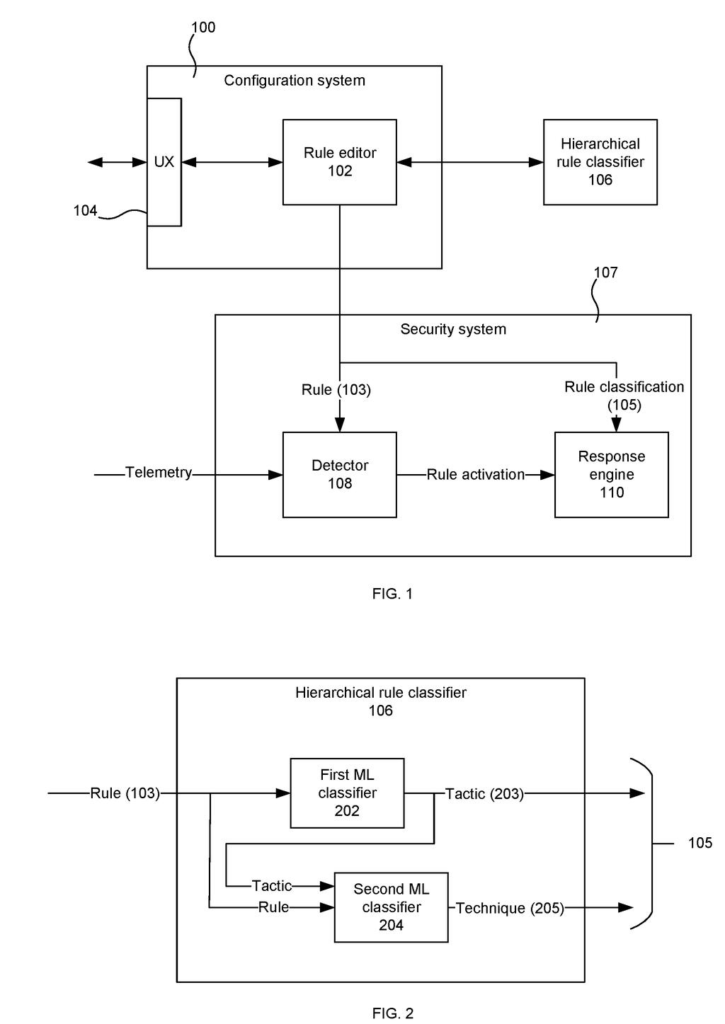
assigning a first threat classification label to a detection rule, using a first machine learning (ML) classifier; assigning a second threat classification label to the detection rule, using a second ML classifier based on the first threat classification label …
Translation: Two AI classifiers work in sequence to label security rules with threat categories.
How two AI models label a security rule
The filing describes a pipeline in which a detection rule is labeled by machine learning before it is deployed. A detection rule is a piece of code, written in a query language such as KQL, that defines a suspicious pattern in collected activity data (called telemetry). The detection itself stays rule-based. The AI only labels the rule.
The labeling happens in two stages:
- A first classifier (a model that sorts things into categories) reads the rule's code, its title and description, or both, and assigns a broad label such as a tactic, the attacker's goal.
- A second classifier takes the rule plus that first label and assigns a narrower one, such as a technique, the specific method.
The filing's main example uses the public MITRE ATT&CK catalog of attacker behavior for both labels, though it says any two-level scheme would work. Its sample setup uses a text-counting step and LightGBM models (a common, fairly lightweight type of ML model). It says a training set of a few thousand expert-labeled rules was enough, and that training the second model on the correct first label gave the best accuracy.
Once a rule is deployed and its pattern matches live telemetry, a response engine uses both labels. It can send an alert showing them, or act on its own by isolating a device or software component, or restricting an account.
A two-stage rule classification process is disclosed, where a first classifier assigns a first threat classification label (e.g., tactic) and a second classifier assigns a second threat classification label (e.g., technique).
Translation: The system uses a hierarchical method to assign tactics and techniques to detection rules.
Why labeled alerts could speed up responses
The practical payoff is speed. Security teams drown in alerts, and the first minutes after one fires are spent working out what it means. If every alert already says "this looks like credential theft, via this specific method," a person or an automated tool can skip that detective work. That matters most for companies using Microsoft's security products.
The filing also keeps the predictable, auditable nature of hand-written rules and adds AI only for labeling. As for status, the examiner's first review rejected the claims as filed, which is routine and usually followed by amendments. This is an application, not a granted patent.
Microsoft's 535th filing in our Microsoft coverage since May adds to a run that includes a step-minimizing AI job tool and an AI that picks reply format.
Claim 1 is wide. It covers any two machine-learning models where the second uses the first one's answer, followed by a detector that runs the rule and a response step that uses both labels. It names no particular catalog of attacks, no model type and no specific response. Those details appear only in narrower claims further down, such as claim 12, which requires the MITRE labels.
If granted, that breadth would mark out a broad territory: any broad-to-specific labeling chain for security rules that feeds into an automated response. A rival building something similar would have to study the claim carefully before copying the layout.
The idea itself is simple and sensible: a coarse guess that sharpens a fine one. A claim this broad is the sort an examiner pushes back on, so the rejection of the first draft is no surprise. Expect narrowing before anything is granted.
Get our take in your Top Stories
Liked this breakdown? Add Patentlyze as a preferred source on Google, and our plain-English take shows up more often in your Top Stories the next time Microsoft patent news breaks.
There are more where this came from
We read every patent application Big Tech publishes and send you the ones worth knowing. Plain English, free, every week.
The drawings
3 drawing sheets from US 2026/0320186 A1 · click any drawing to enlarge


Want this weekly breakdown for a company we don't cover? Patentlyze Pro →
Be the first to weigh in