
Microsoft Patents Two Hidden Audio Signals to Catch Pirated Sound Files
Microsoft's filing says pirates can scramble a hidden audio ID just by playing a track through a speaker and re-recording it. The fix is to hide two different IDs in the same audio, each built to survive a different kind of damage.
What Microsoft's double audio watermark does
You publish an audiobook, and a week later a pirated copy shows up online. The thief didn't hack anything. They played it through a speaker and recorded the room with a phone. A hidden ID tucked inside the audio, called a watermark, often gets scrambled by that kind of copying, and then you can't prove where the copy came from.
A new Microsoft patent application goes after this by hiding two different watermarks in the same audio, each made with its own secret key (a long code only the owner knows). One is built to hold up against background noise. The other is built to hold up against echo, the kind you get when audio is re-recorded in a room.
The filing also describes putting the two marks in separate pitch ranges so they don't step on each other, and keeping them quiet enough that people shouldn't hear them. If one gets wrecked, the other can still point back to the original file.
… performing linear predictive coding (LPC) analysis on the digital audio file to decompose the digital audio file into a spectral envelope signal and an excitation signal …
Translation: The system breaks down a sound file into two separate components before hiding the tracking codes.
How the audio gets split before it's marked
The first step is to split the audio using linear predictive coding, or LPC (a method long used in speech compression). It separates the sound into a spectral envelope, the overall tonal shape of the sound, and an excitation signal, the raw buzz or breath that shape is applied to.
Each piece then gets its own watermark, made from its own secret key:
- Spread spectrum watermark on the envelope: a hidden message is shuffled and multiplied by a random-looking sequence, so it reads as faint noise. In the example, the key has three 32-bit parts: a seed for the sequence, shuffle instructions, and sign information.
- Self-correlated watermark on the excitation: the audio is cut into blocks, and two mutually orthogonal patterns (patterns that don't interfere with each other) are embedded in alternation. Detection checks how strongly the audio matches itself.
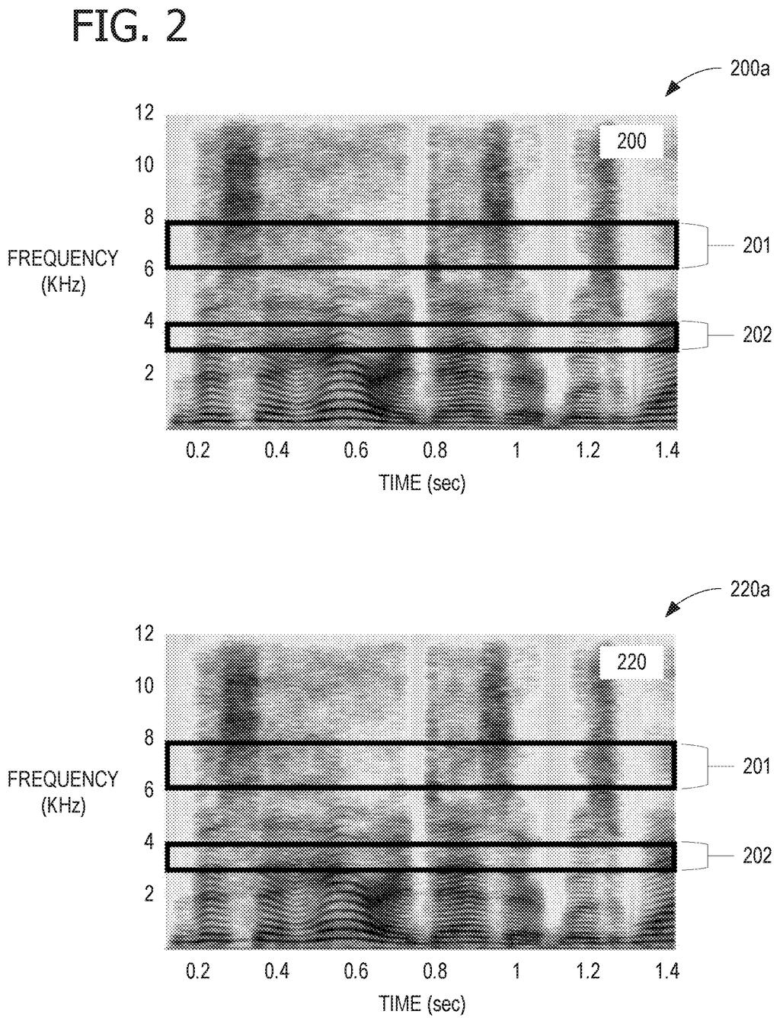
A model of human hearing, called a psychoacoustic model, sets how strong each watermark can be so it stays below what your ears pick up. LPC synthesis then stitches the pieces back into an ordinary audio file. In its example, the filing puts the two marks in separate frequency bands, 6 to 8 kHz and 3 to 4 kHz.
To check a file, a detector scores each watermark with the same keys, combines the scores into a probability, and produces a report. An optional neural network can add a third score and recover the hidden message.
Why audiobook and music makers would care
If you make or sell audio, such as audiobooks or music, a watermark that survives re-recording gives you better proof that a copy came from your file. The filing says it targets audio where listeners care about sound quality, and it reports listening-test score gaps under 0.02 between marked and unmarked audio.
For everyone else, the result is nothing you'd notice: the same audio, with an ID you can't hear. The filing says its versions handled noise levels from minus 10 to 30 decibels and topped 95% correct detections in real-world scenarios. It also says they hold up against attacks like speeding up the track, filtering it, or stamping a new watermark on top. Those are the filing's own test results, not independent ones.
Microsoft's 510th filing in our Microsoft coverage since May adds to a run that includes meeting replay filtering and richer remote desktop color.
Most people will never see a watermark, and that is the goal. You would only run into one when it fails: a song you made turns up on a pirate site and nothing proves it's yours. Two marks built for different kinds of damage lower the odds of that failure.
For listeners, the benefit is indirect. You shouldn't hear any change, and the filing reports listening-test gaps under 0.02 on a standard scoring scale. That number matters most, because a copy-protection tool that makes music sound worse gets switched off.
A patent application describes lab results and names no product. Treat it as a sensible upgrade to an old copyright tool, and expect creators who sell audio to get the most out of it.
Get our take in your Top Stories
Liked this breakdown? Add Patentlyze as a preferred source on Google, and our plain-English take shows up more often in your Top Stories the next time Microsoft patent news breaks.
There are more where this came from
We read every patent application Big Tech publishes and send you the ones worth knowing. Plain English, free, every week.
The drawings
14 drawing sheets from US 2026/0311711 A1 · click any drawing to enlarge


Show the other 6 sheets


Want this weekly breakdown for a company we don't cover? Patentlyze Pro →
Be the first to weigh in