
Microsoft
Microsoft · AI / ML · Filed Nov 21, 2025 · USPTO published May 21, 2026 · May 21 release
Microsoft Patents an AI System That Routes Meeting Questions to the Right Person
Every long meeting has that moment: someone asks a question, it gets lost in the chat, and the right expert never sees it. Microsoft is filing a patent for an AI layer that automatically detects, categorizes, and routes those questions to whoever should answer them.
- Publication number
- US 2026/0141184 A1(US20260141184A1)
- Applicant
- Microsoft Technology Licensing, LLC
- Filed · Published
- Nov 21, 2025 · May 21, 2026
- Inventors
- Dean GECKT, Abed El Kader ASI, Royi RONEN, Roy EISENSTADT, Alexander TSVETKOV
- Status when we published
- Waiting for an examiner
- US classification
- 704/9
- Parent application
- Continuation of 18/307,724 (filed Apr 26, 2023)(18307724)
What Microsoft's meeting-question router actually does
Imagine you're in a 90-minute all-hands meeting. Someone in the audience types, "Who handles vendor contract renewals?" — and that question quietly disappears into a scrolling chat feed. Nobody from procurement ever sees it.
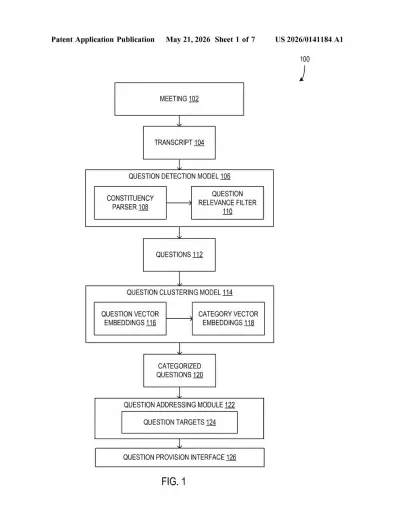
Microsoft's patent describes a system that watches the meeting transcript in real time, spots questions as they appear, figures out what category each question belongs to (HR, legal, finance, product, etc.), and then automatically sends it to the team or person best positioned to answer. The routing logic is driven by vector embeddings — a way of turning words into numbers so the system can judge how similar two questions are in meaning, not just in wording.
The clever part is how the categories themselves are defined: instead of hardcoding rules, an admin can supply a catalog of example questions for each topic. The model learns from those examples and can be updated without retraining from scratch — meaning a company can swap in new categories as their org chart changes.
How vector embeddings categorize and route each question
The system works in a pipeline with several distinct stages:
- Question detection: A dedicated model scans the meeting transcript and flags utterances that are questions — filtering out statements, announcements, and filler text.
- Vector embedding generation: The detected question is passed through a question clustering model that converts it into a high-dimensional numerical vector (think of it as a coordinate in meaning-space). Similar questions end up near each other in that space.
- Category matching: The model compares the question's vector against a set of category vector embeddings — each representing a topic cluster built from example questions in a catalog. The closest match determines the category.
- Routing: Once categorized, the system looks up which person or team owns that category and delivers the question to them through a "question provision interface" — likely a dedicated view or notification channel.
The category embeddings are generated from example question catalogs, not hard-coded rules. That means an organization can add, remove, or rename categories just by updating the catalog — no retraining the core model. A question relevance filter is also mentioned, suggesting the system can discard low-signal or off-topic questions before they ever reach a target.
What this means for Teams meetings and enterprise workflows
For anyone who runs or attends large enterprise meetings — think town halls, quarterly business reviews, or big customer calls — the pain point here is real. Questions get buried, the wrong person gets pinged, and follow-ups fall through the cracks. A system that automatically triages questions the way a help-desk ticket system triages support requests could meaningfully reduce meeting overhead.
Microsoft has obvious deployment surface here: Teams already has live transcription, Copilot integrations, and a growing suite of meeting intelligence features. This patent slots naturally into that stack. The vector-embedding approach also means the system is language-model-adjacent without requiring a full LLM inference call per question — which keeps latency and cost manageable at scale.
Source: US 2026/0141184 A1 at the USPTO (PDF). Full patent text and figures are in the official publication.
Get our take in your Top Stories
Liked this breakdown? Add Patentlyze as a preferred source on Google, and our plain-English take shows up more often in your Top Stories the next time Microsoft patent news breaks.
Add Patentlyze on Google
One click.
There are more where this came from
We read the new patents from Big Tech, carmakers and more and send you the ones worth knowing. Plain English, free, every week.
More from Microsoft
All 681 Microsoft patents →
More in AI vision
All 352 AI vision patents →
Apple
Apple Patent Reveals Siri Detecting When Users Are Actually Addressing It
IBM
IBM Patents an AI That Finds Objects in Photos Using Words and Pictures Together
Nvidia
Nvidia Patents an AI Video System That Combines Multiple People and a Chosen Movement Style
IBM