Microsoft
Microsoft · AI / ML · Filed Apr 6, 2026 · USPTO published Aug 13, 2026 · Aug 13 release
Microsoft Patents a System That Builds Its Own AI Models Layer by Layer
Building an AI model usually takes teams of researchers months of trial and error. Microsoft has filed a patent for a system that does much of that work automatically, growing neural networks by testing candidate pieces and keeping the ones that perform best.
- Publication number
- US 2026/0236780 A1(US20260236780A1)
- Applicant
- Microsoft Technology Licensing, LLC
- Filed · Published
- Apr 6, 2026 · Aug 13, 2026
- Inventors
- Debadeepta DEY, Hanzhang HU, Richard A. CARUANA, John C. LANGFORD, Eric J. HORVITZ
- Status when we published
- Waiting for an examiner
- Document
- 21 claims
- US classification
- 706/25
- Parent application
- Continuation of 18/080,407 (filed Dec 13, 2022)(18080407)
How Microsoft's self-building AI model process works
A research team stares at a blank whiteboard, trying to figure out how to structure an AI model that will work well on their data. That process, repeated thousands of times across the industry, costs enormous amounts of time and money, and you never really know if you landed on the best design.
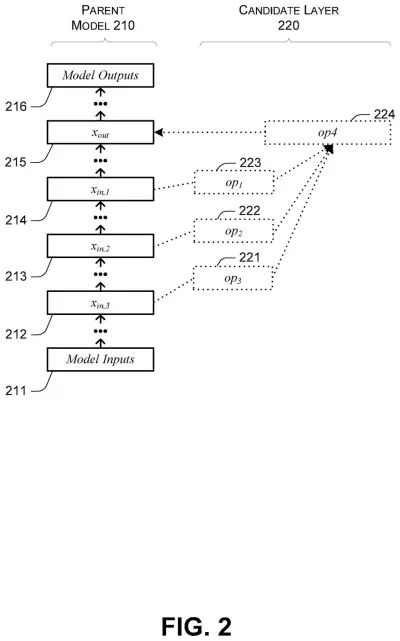
Microsoft's patent describes a system that takes over that design work. Instead of human engineers picking how to build a neural network (the underlying structure of most modern AI), the system starts with a basic model and repeatedly experiments with adding new pieces, called layers, until it finds a combination that performs well. It keeps the winners and discards the rest.
The key trick is that the system doesn't evaluate layers blindly. It uses information from an early training phase to predict which candidate layers are worth keeping before running the full, expensive test. That pre-screening step is what makes the whole loop practical rather than an endless brute-force search.
The iterative model-growing process can also include selecting candidate layers to include in the child models based at least on weights learned in an initialization process of the candidate layers.
Translation: The system builds AI by testing different building blocks and keeping the ones that show the most promise early on.
How the layer-selection and model-growing loop runs
The patent describes what researchers call a neural architecture search system, which is a way to automate the design of AI models rather than leaving that design entirely to human engineers.
The process works as an iterative loop:
- The system starts with one or more parent models, which are baseline neural networks.
- It generates child models by modifying the parents, primarily by inserting or replacing layers (the individual processing stages inside a neural network).
- Before committing to a full training run on each candidate, the system runs a short initialization process that produces early weight values (numerical parameters that determine what the layer has learned). Those early weights act as a fast signal for whether the layer is worth keeping.
- The best-performing child model becomes the final model output.
The initialization-as-filter idea is the central engineering contribution. Full model training is computationally expensive, so using cheap early signals to prune bad candidates means the search covers far more ground without proportionally more compute.
The claim set has been canceled in this publication, which typically means the patent is mid-prosecution and the applicant is refiling or amending claims, so the exact legal scope is still being negotiated with the patent office.
What automated model design means for AI development costs
For companies running large AI programs, the cost of designing model architectures is a real constraint. Skilled researchers spend months on work that this kind of automated system could, in principle, compress into days of machine time. That matters most at organizations building many specialized models rather than one large general-purpose one.
The five inventors include well-known Microsoft Research figures with long track records in machine learning and AI decision systems, which suggests this is a research output rather than an engineering build nearing production. The gap between a published research patent and a shipping product feature is wide here: the system would need to be packaged, validated on real workloads, and integrated into something like Azure's AI platform before most developers would ever touch it. Still, automated model design is one of the more active areas covered among new tech patents, and Microsoft's entry adds weight to the bet that AI will increasingly design itself.
Source: US 2026/0236780 A1 at the USPTO (PDF). Full patent text and figures are in the official publication.
Get our take in your Top Stories
Liked this breakdown? Add Patentlyze as a preferred source on Google, and our plain-English take shows up more often in your Top Stories the next time Microsoft patent news breaks.
Add Patentlyze on Google
One click.
There are more where this came from
We read the new patents from Big Tech, carmakers and more and send you the ones worth knowing. Plain English, free, every week.
The drawings · 11 sheets
11 drawing sheets from US 2026/0236780 A1 · click any drawing to enlarge


Show the other 3 sheets