
Microsoft Files Patent to Catch New Software Bugs by Reading What Error Messages Mean
Every software update risks breaking something, and the hard part is telling a brand-new bug from an old one in disguise. Microsoft's filing sorts error messages by what they mean, so a shifted line number does not fool it.
What Microsoft's bug-spotting patent actually does
When a company updates an app or online service, its error logs fill up with messages. Today's tools often match those messages by exact wording and layout, so a shifted line number or a slightly reworded message can make an old, known problem look brand new. Engineers end up chasing false alarms.
Microsoft's patent filing takes a different route. It turns each error message into a list of numbers that captures what the error means, then groups similar ones together, mixing in the errors from the previous version of the service. A group that holds only errors from the new version is flagged as a fresh bug.
From there, the system can alert the person who changed the code, write a report, or even switch the service back to the older version on its own.
… transform the runtime stack trace data batch into a first group of error log vectors, wherein the first group of error log vectors represents a semantic meaning of a stack trace of the obtained runtime stack trace data batch associated with the current version of the service; …
Translation: It converts raw crash data into mathematical vectors that capture what the error actually means.
How error messages get sorted by meaning
The system starts by pulling error logs (the running diary a service keeps of things that go wrong) for the current version from a log store. The main claim focuses on stack traces, which are step-by-step records of what the program was doing when it failed.
An AI model, such as a large language model, converts each one into a vector, a long list of numbers that encodes what the error means. The filing names an OpenAI embedding model, text-embedding-ada-002, as one example. Each vector also carries labels like the file, line number, timestamp and error type, and the vectors are saved in a historical store for later comparisons.
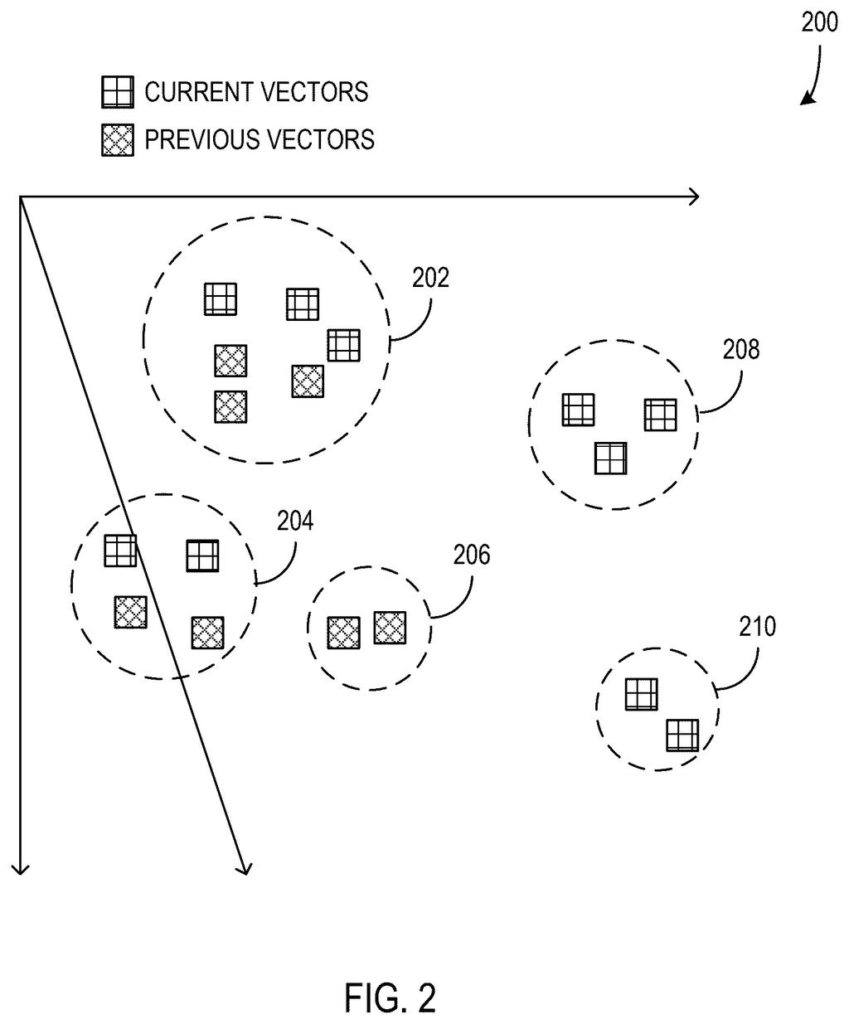
Next, vectors from the previous version are pulled in and everything is clustered (grouped by closeness in meaning, using methods like DBSCAN or k-means). A group with both old and new errors is a known problem. A group with only old errors was probably fixed. A group with only new errors is flagged as a regression, meaning a bug introduced by the latest update.
Then the system acts on that flag:
- Send an alert or report with the code line, timestamp and error type.
- Rank versions of the service by performance in a report.
- Halt the new version and recommend or start the old one if the group grows past a size threshold.
… a vector cluster that includes error log vectors from the first group and no error log vectors from the second group is identified as a regression vector cluster.
Translation: New bugs are spotted by finding error patterns that appear today but never existed in older versions.
Why faster bug alerts could reach your apps
For most people the payoff is indirect: fewer outages and faster fixes in the apps and online services you use. The filing lists cloud, web, productivity and AI services as examples, and says matching errors by meaning should cut the false alarms that slow engineers down.
For software teams, the useful part is the paper trail. Each flagged problem comes with the file, line and time, and a spike of new errors can trigger an automatic switch back to the previous version. That turns a late-night scramble into a rule the system follows on its own.
Microsoft's 556th filing in our Microsoft coverage since May adds to a run that includes the spreadsheet checker and the empty-search blocker.
Most of us only meet software bugs after they reach us: the app that crashes after an update, or the online service that stalls for an hour. A tool that tells engineers within minutes that an update broke something new could shorten that wait, and the automatic switch back to the older version could cut it further.
You would never see this system. What you might notice is a bad update that gets pulled before it spoils your afternoon, or a fix that lands sooner. The patent gives no figures on how much it reduces false alarms, so the benefit stays a promise for now.
Overall this is back-office engineering with a modest payoff for ordinary users. Any gain depends on the meaning-matching being accurate, which the filing asserts but does not measure.
Get our take in your Top Stories
Liked this breakdown? Add Patentlyze as a preferred source on Google, and our plain-English take shows up more often in your Top Stories the next time Microsoft patent news breaks.
There are more where this came from
We read every patent application Big Tech publishes and send you the ones worth knowing. Plain English, free, every week.
The drawings
5 drawing sheets from US 2026/0329726 A1 · click any drawing to enlarge


Want this weekly breakdown for a company we don't cover? Patentlyze Pro →
Be the first to weigh in